

 Español
 Português
 لالعربية
 Русский
 Bahasa Indonesia
 Français
 Türkçe
 Bahasa Melayu

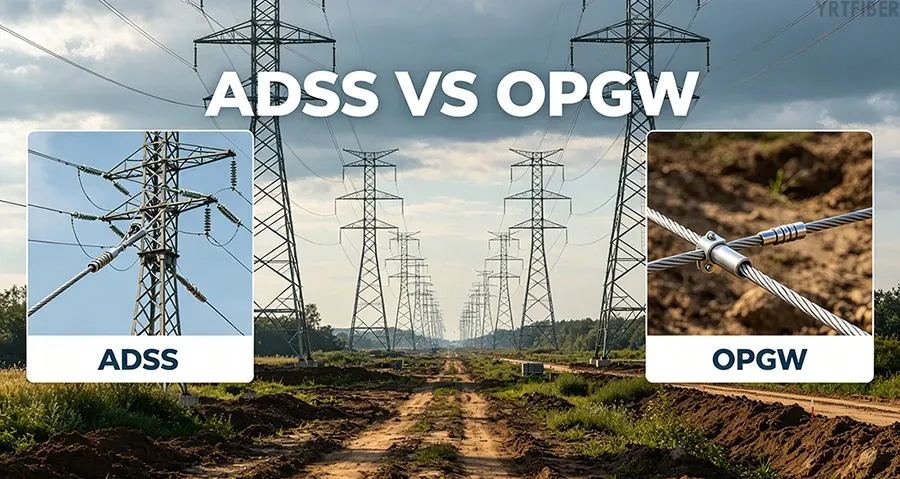
ADSS is best suited for adding communication capacity to existing transmission or distribution lines without an outage, especially where grounding is impractical or costly, lightning activity is high, or budgets and schedules are tight-but it is not suitable when the ground wire itself is being replaced, when extreme ice or wind loads exceed its design limits, when rodent or shotgun damage risk is severe without protective measures, or when high-voltage AT Sheath selection cannot be properly engineered. OPGW, by contrast, is the right choice for new transmission line construction where a ground wire is required, for high-voltage and extra-high-voltage lines (220 kV and above), for routes demanding maximum mechanical robustness and long spans, where fault current capacity is a design priority, or where wildlife and vandalism damage is a concern-but it is not suitable for retrofitting existing lines without an outage or tower modification capability, for distribution networks where the ground wire function is unnecessary, for projects with severe budget constraints and no need for ground wire replacement, or where grounding maintenance cannot be guaranteed.
All-dielectric self-supporting (ADSS) and optical ground wire (OPGW) are the two dominant fiber optic cable solutions for overhead power line environments. Both are installed on transmission structures and both serve communication needs, but they approach the problem from fundamentally different directions. ADSS is a purely dielectric cable that shares tower space with energized conductors, while OPGW replaces the traditional ground wire with a dual-function conductor that carries both fault current and optical signals. This article compares the two cable types across structure, electrical function, mechanical performance, installation, and application scenarios to support engineering selection.
What Are ADSS and OPGW Cables?
ADSS (All-Dielectric Self-Supporting) is an aerial fiber optic cable that contains no metallic components and carries its own weight between structures without a separate messenger wire. The tensile load is managed by non-metallic strength members, typically aramid yarn. ADSS is designed for installation on existing transmission towers, often in the space between the conductors and the tower structure, and can be deployed without taking the power line out of service. The cable is standardized under IEC 60794-4-20 and IEEE 1222.
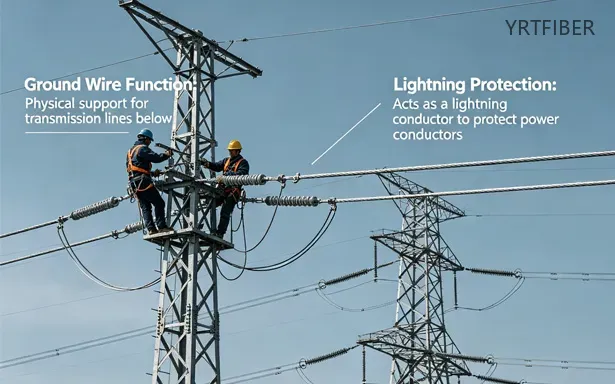
OPGW (Optical Ground Wire) is a dual-function cable that serves simultaneously as the overhead ground wire (shield wire) of a transmission line and as a fiber optic communication channel. Its outer metallic strands-typically aluminum-clad steel or aluminum alloy-carry fault currents and provide lightning protection, while a central or embedded stainless steel tube protects the optical fibers. OPGW is designed to replace the conventional ground wire on transmission towers, meaning the tower structure must be modified or the line must be de-energized during installation in most cases.
A critical distinction: OPGW is a functional component of the power line itself, whereas ADSS is an add-on communication asset that shares physical space but remains electrically isolated from the power system.
Structural Comparison
ADSS Cable Construction
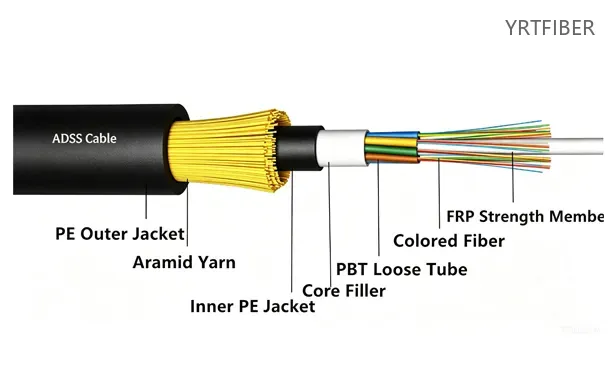
ADSS consists of single-mode optical fibers contained in one or more protective dielectric fiber optic units, surrounded by dielectric strength members and sheaths. The typical construction includes gel-filled loose tubes stranded around a central FRP strength member, water-swelling tape, aramid yarns for peripheral strengthening, and an outer PE or anti-tracking (AT) jacket. For installations where surface induction exceeds 12 kV, an AT sheath is specified to resist dry-band arcing.
OPGW Cable Construction
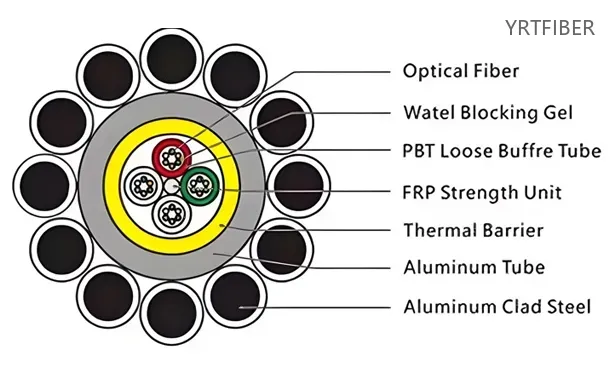
OPGW typically consists of a central stainless steel tube (or aluminum-clad stainless steel tube) containing optical fibers, surrounded by one or more layers of stranded metallic wires. The metallic layers serve dual purposes: carrying fault current and providing mechanical strength. Common designs include aluminum-clad steel (ACS) outer strands, mixed ACS and aluminum alloy wires, or aluminum tube designs. The optical fibers inside are typically standard single-mode G.652.D, with the tube filled with a water-blocking compound.
Electrical Function and Safety Comparison
ADSS offers a significant safety advantage in that it can be installed while the power line remains energized, eliminating the cost and disruption of planned outages. Because it contains no metallic components, there is no risk of induced currents, no grounding requirements, and no electrical corrosion mechanism from the cable itself. However, ADSS is vulnerable to surface contamination and dry-band arcing in high-voltage fields, which is why AT sheathing is required above certain electric field thresholds.
OPGW, by contrast, is an integral part of the power line’s electrical system. It must be grounded at every tower and at splice points, and its fault current capacity must be coordinated with the transmission line’s protection scheme. Installation almost always requires either a de-energized line or specialized live-line techniques, adding operational complexity and cost.
Mechanical Performance Comparison
ADSS achieves its span capability through the exceptional strength-to-weight ratio of aramid yarn. However, the cable’s lightweight construction means it is more susceptible to wind-induced vibration and requires careful sag-tension engineering. OPGW’s metallic construction gives it substantially higher tensile strength and environmental load capacity, making it suitable for longer spans and harsher conditions-but at the cost of significantly greater weight and tower loading.
Installation Comparison
The installation economics strongly favor ADSS when an existing tower can accept the additional load. Because ADSS requires no outage and minimal tower modification, the installed cost is typically 30–50% lower than OPGW. OPGW installation is a more invasive process: the existing ground wire must be removed (or a new tower prepared), and the cable must be strung with specialized anti-twist equipment to prevent torque damage to the metallic strands and fiber tube.
Cost and Total Cost of Ownership
While ADSS has a lower barrier to entry, its long-term reliability depends heavily on proper installation and environmental conditions. Rodent damage, gunshots, and surface contamination are documented risks. OPGW’s metallic construction is more physically robust, but its electrical function introduces grounding maintenance obligations and fault-current coordination requirements that ADSS avoids entirely.
Suitable and Unsuitable Applications
ADSS Cable - Suitable For
Adding communication capacity to existing transmission lines without outage
Distribution networks and subtransmission lines where tower loading permits
Routes where grounding is impractical or costly
Environments with high lightning activity (dielectric isolation)
Projects with constrained budgets and tight schedules
ADSS Cable - Not Suitable For
Transmission lines where the ground wire is being replaced or upgraded
Locations with extreme ice or wind loads exceeding ADSS design limits
Routes with severe rodent or shotgun damage risk (without protective measures)
High-voltage environments where AT sheath selection is not properly engineered
OPGW Cable - Suitable For
New transmission line construction where ground wire is required
High-voltage and extra-high-voltage lines (220 kV and above)
Routes requiring maximum mechanical robustness and long spans
Projects where fault current capacity is a design priority
Environments where physical damage from wildlife or vandalism is a concern
OPGW Cable - Not Suitable For
Retrofitting existing lines without outage or tower modification capability
Distribution networks where the electrical function is unnecessary
Projects with severe budget constraints and no need for ground wire replacement
Situations where grounding maintenance cannot be guaranteed
Selection Checklist
When choosing between ADSS and OPGW for a power line project, evaluate the following:
Is the ground wire being replaced or upgraded? If yes, OPGW is the natural choice. If no, ADSS is likely simpler.
Can the line be taken out of service? If not, ADSS is the only option.
Is the tower structurally capable of additional load? ADSS adds load; OPGW replaces existing load.
What is the required span and environmental load? OPGW handles heavier loads; ADSS is limited by aramid yarn design.
Is grounding feasible and maintainable? ADSS eliminates grounding; OPGW requires it.
What is the fault current coordination requirement? OPGW must be sized for the line’s short-circuit duty.
What is the budget and schedule? ADSS is typically faster and less expensive to install.
What is the risk of physical damage? OPGW is more robust against rodents and vandalism.
Frequently Asked Questions
Can ADSS and OPGW be used on the same transmission line?
Yes. In some projects, OPGW is installed on the ground wire position while ADSS is added in the conductor zone or on lower-voltage structures for additional communication capacity. However, the two cables serve different functions and are governed by different standards.
Does ADSS require any grounding?
No. ADSS contains no metallic components and does not require grounding. This is one of its primary advantages in power line environments.
What happens if OPGW is not properly grounded?
Improper grounding can lead to dangerous induced voltages on the cable sheath, risk of arc faults, and potential injury to personnel. OPGW grounding must be designed as part of the transmission line’s grounding system.
Is ADSS suitable for 220 kV lines?
ADSS can be installed on 220 kV lines, but the electric field strength at the attachment point must be calculated and an appropriate AT sheath selected. The cable must be positioned where surface induction does not exceed the sheath’s rating.
Which cable has a longer service life?
OPGW typically has a longer design life (30+ years) due to its metallic construction. ADSS design life is typically 25–30 years, with actual lifespan dependent on installation quality and environmental exposure.
Can OPGW be installed without taking the line out of service?
In some cases, yes, using live-line techniques. However, this requires specialized procedures and equipment, and many utilities prefer to schedule outages for OPGW replacement to ensure safety and quality.
Conclusion
ADSS and OPGW are both proven Aerial Fiber Cable technologies, but they serve different roles in the power line ecosystem. ADSS is the pragmatic choice for adding communication capacity to existing lines without outage, particularly in distribution and subtransmission environments where grounding is unnecessary or impractical. OPGW is the integrated solution for new transmission lines and ground wire replacements, offering dual-function capability with superior mechanical robustness at the cost of higher installation complexity.
The correct choice depends on whether the project requires ground wire function, whether outage is acceptable, how much tower load capacity is available, and what environmental conditions the cable must withstand. Neither cable is universally superior; each is optimized for specific power line scenarios.
References
IEC 60794-4-20:2018 - Sectional specification for ADSS (all dielectric self-supported) optical cables along electrical power lines
IEEE 1222 - IEEE Standard for Testing and Performance for All-Dielectric Self-Supporting (ADSS) Fiber Optic Cable for Use on Electric Utility Power Lines
IEEE 1138 - IEEE Standard for Testing and Performance of Optical Ground Wire (OPGW) for Use on Electric Utility Power Lines


