English
 Español
 Português
 لالعربية
 Русский
 Français
 Türkçe
 Bahasa Melayu


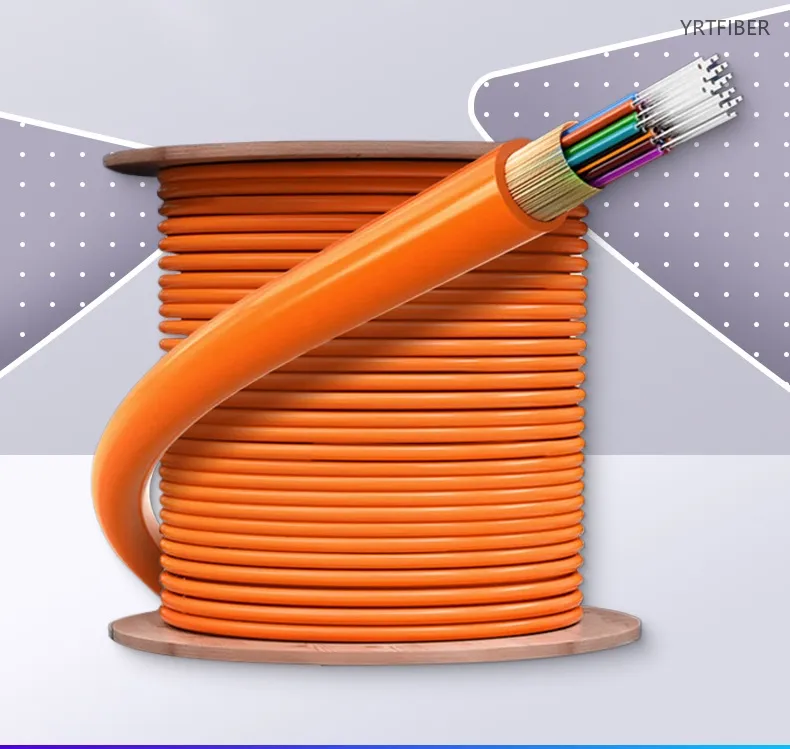
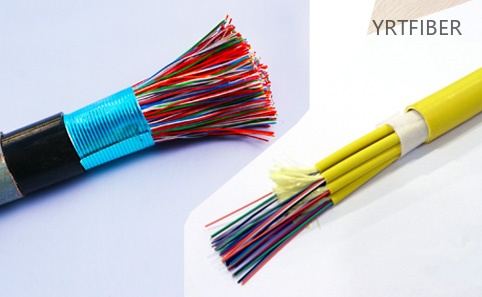
GJBFJH Kabel Serat Optik Breakout - Distribusi Dalam Ruangan (G652D / G657A1 / G657A2)
- 1310 nm0.309 – 0.330 dB/km
- 1550 nm0.182 – 0.209 dB/km
- Fibers12 / 12 pass
- Model produkGJBFJH
- Hitungan FiberCoreCount2-48 Cores
- Jenis SeratG652/G657
- Jaket LuarLSZH/PVC
- Tested 1310 nm0.309 – 0.330 dB/km
- Tested 1550 nm0.182 – 0.209 dB/km
- Tested Fibers12 / 12 pass
- Lot Test Report250815001|2025-08-15|Two-page PDF report, sealed with the reel|/uploads/down/test-report/YRTFIBER-Breakout-12Core-Test-Report-250815001.pdf
What is GJBFJH indoor fiber cable
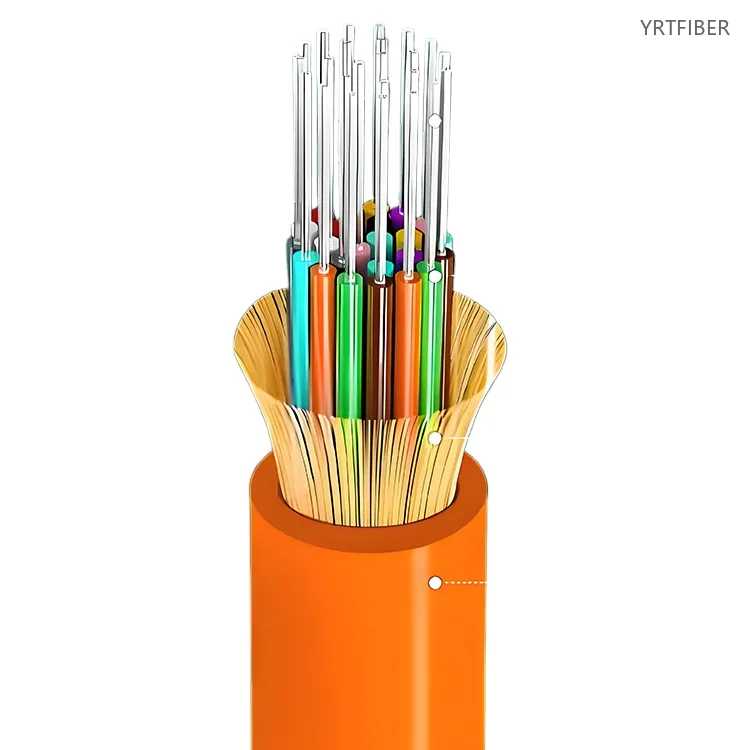
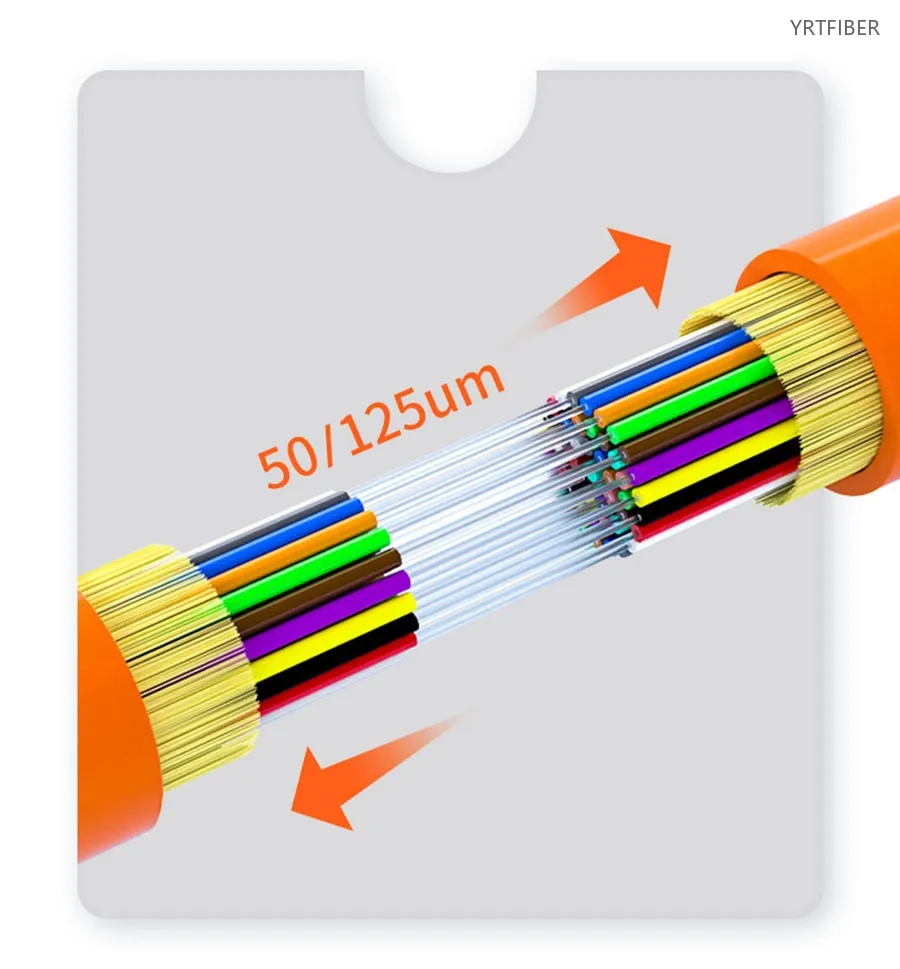
GJBFJH indoor optical cable is an indoor fiber optic cable that uses a branched bundle distribution structure, specially designed for demanding indoor environments such as data centers, enterprise networks, and fiber-to-the-home applications. It provides multiple single-mode fiber options including G652D, G657A1. and G657A2. It features low insertion loss and high return loss, and the G657 series additionally offers excellent bend resistance. The cable uses a flame-retardant, low-smoke, halogen-free jacket reinforced with high-strength aramid yarn, making it compact in structure with a small bending radius. The unique branched design makes on-site connector termination easier, and the color-coded fibers allow for quick identification. It complies with IEC 60794-1-2. RoHS, and IEC 60332-1 flame-retardant standards, and is widely suitable for indoor interconnection scenarios such as building backbone cabling and security system installation.
GJBFJH Breakout Fiber Optic Cable Spesifikasi parameter
- Spesifikasi parameter
- KARAKTERISTIK OPTIK
| Optical fiber categoryFiber type | Attenuation (20 ℃) | Injection bandwidth (OFL) | Effective bandwidth | 10G Ethernet Link Length SX | Minimum bending radius | |||
|---|---|---|---|---|---|---|---|---|
| 1310/1550nm | 850/1300nm | |||||||
| Typical value | Value | Typical value | Value | |||||
| Satuan | dB / Km | dB / Km | dB / Km | dB / Km | MHz · Km | MHz · Km | m | mm |
| G652D | 0.36/0.22 | 0.5/0.4 | --- | --- | --- | --- | --- | 16 |
| G657A1 | 0.36/0.22 | 0.5/0.4 | --- | --- | --- | --- | --- | 10 |
| G657A2 | 0.36/0.22 | 0.5/0.4 | --- | --- | --- | --- | --- | 7.5 |
| 50/125 | --- | --- | 3.0/1.0 | 3.5/1.5 | ≥500/500 | --- | --- | 30 |
| 62.5/125 | --- | --- | 3.0/1.0 | 3.5/1.5 | ≥200/500 | --- | --- | 30 |
| YA TUHAN | --- | --- | 3.0/1.0 | 3.5/1.5 | ≥1500/500 | ≥2000 | ≤300 | 30 |
| YA TUHAN | --- | --- | 3.0/1.0 | 3.5/1.5 | ≥3500/500 | ≥47000 | ≤550 | 30 |
| BI-YA TUHAN | --- | --- | 3.0/1.0 | 3.5/1.5 | ≥1500/500 | ≥2000 | ≤300 | 7.5 |
| BI-YA TUHAN | --- | --- | 3.0/1.0 | 3.5/1.5 | ≥3500/500 | ≥47000 | ≤550 | 7.5 |
Optical properties
| G.652 | G.655 | 50/125μm | 62.5/125μm | |
|---|---|---|---|---|
| attenuation (+20℃) | ≤3.0dB/km @850nm | ≤3.0dB/km @850nm | ||
| ≤1.0dB/km @1300nm | ≤1.0dB/km @1300nm | |||
| ≤0.36dB/km @1310nm | -- | |||
| ≤0.22dB/km @1550nm | ≤0.23dB/km @1550nm | |||
|
bandwidth (Class A) |
≥500MHZ·km @850 | ≥500MHZ·km @850 | ||
| ≥1000MHZ·km @1300 | ≥600MHZ·km @1300 | |||
|
Numerical aperture |
0.200±0.015NA | 0.275±0.015NA | ||
|
cutoff wavelength |
≤1260nm | ≤1480nm |
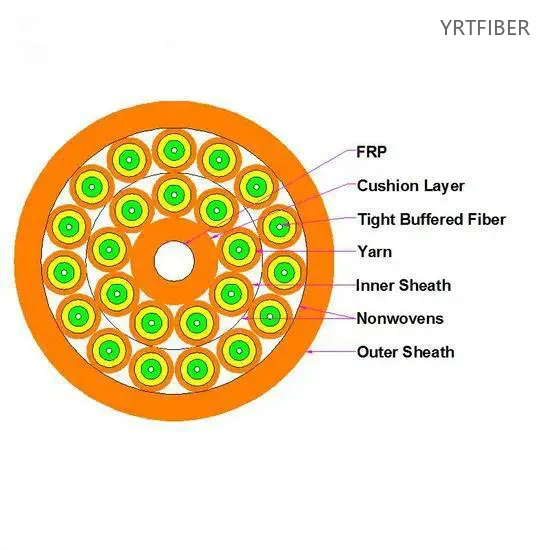
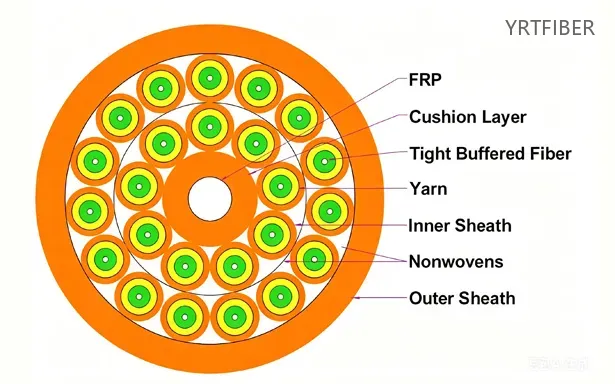
Struktur & Komposisi Produk
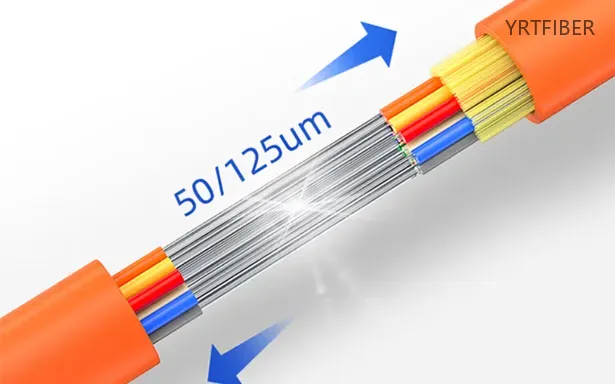
FRP:Non-metallic central strength member (glass fiber reinforced plastic), provides tensile and compressive support for the optical cable while maintaining all-dielectric and lightning-proof characteristics.
Cushion Layer:Cushion layer, wrapped around the central strength member, cushions the lateral pressure of the sub-cables and protects the tight-buffered optical fibers from extrusion.
Tight Buffered Fiber:Tight-buffered optical fiber, where the fiber is directly and closely wrapped with a protective buffer layer, forming an independent fiber unit that facilitates direct connector termination.
Yarn:High-strength aramid yarn or similar fibers, used as the tensile reinforcing element within the sub-cable, enhancing flexibility and tensile strength.
Inner Sheath:Inner sheath (sub-cable sheath), covering the tight-buffered fibers and yarns, forming independently separable sub-units for branch wiring.
Nonwovens:Nonwoven wrapping tape, used to bind and secure the cable core, providing thermal insulation, cushioning, and helping the optical cable structure to be more uniform.
Outer Sheath:Outer sheath, made of flame-retardant low-smoke zero-halogen (LSZH) material, providing the overall optical cable with final environmental protection and flame-retardant performance.
Manfaat dari GJBFJH Breakout Fiber Optic Cable
Outstanding Transmission Performance
Extremely low insertion loss and high return loss ensure signal integrity
Excellent bend resistance, with G657A1/A2 variants performing particularly well
Robust and Durable Construction
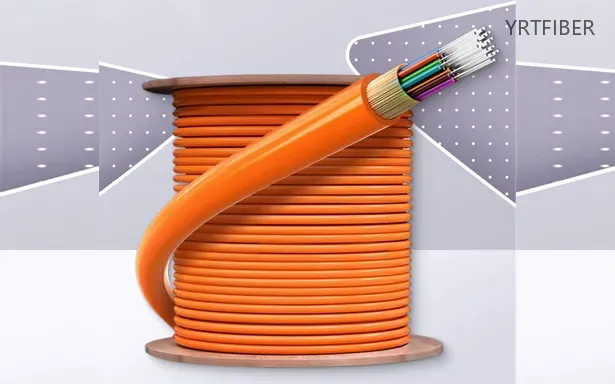
Flame-retardant, low-smoke, halogen-free (LSZH) jacket enhances safety level
High-strength aramid yarn reinforcement provides reliable tensile strength
Compact structure with small bending radius, suitable for confined environments
Convenient Installation Features
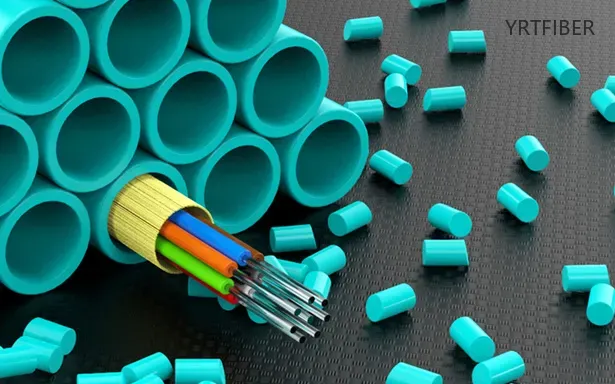
Branch design makes on-site connector termination easier
Flexible structure allows easy deployment in narrow spaces
Fiber color coding for clear, quick identification
Aplikasi Rekayasa GJBFJH Breakout Fiber Optic Cable
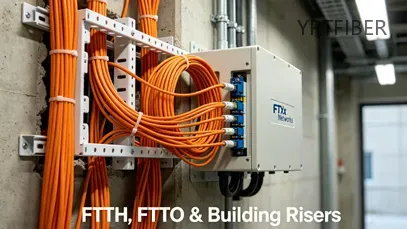
Multi-Floor Building Backbone
GJBFJH is ideal as a vertical riser cable in office buildings, MDUs, and hotels. Its SZ‑stranded sub‑units allow installers to access individual fibers on any floor without cutting the entire cable – simply open the jacket, extract the required sub‑unit, and route it directly to a subscriber or terminal box. LSZH sheath ensures fire safety in occupied riser shafts.
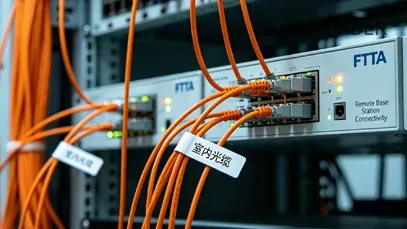
FTTH / FTTB Distribution to Apartments
In FTTH projects, the main cable from the building entrance can be terminated in the basement. Individual 2.0mm sub‑units are then routed horizontally through conduits to each apartment’s ONT. The dry (gel‑free) design keeps termination clean, and G.657 bend‑insensitive fiber supports tight corner routing inside walls.
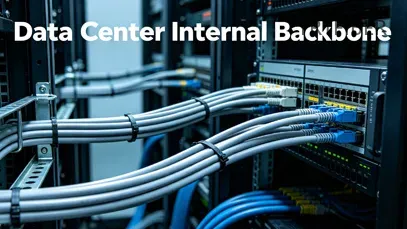
Data Center & Equipment Room Patching
Between ODFs, switches, and servers, GJBFJH eliminates breakout kits – each sub‑unit can be directly connectorized and plugged into active equipment. Small diameter and all‑dielectric construction save space and require no grounding. Available with single‑mode or multi‑mode fibers up to 48 cores.
Perbandingan Produk:
| Feature / Dimension | GJBFJV (Branch/BPON Cable) | GJFJV (Distribution Cable) | GJXH (Bow-type Drop Cable) |
|---|---|---|---|
| Structural Features | Stranded loose tube design, several 900µm tight-buffered fibres as sub-units, aramid yarns and non-metallic central strength member [7†L3-L4]. Flame-retardant PVC or LSZH outer sheath. | Tight-buffered 900µm fibres (2–144 cores), aramid yarns strength member, flame-retardant PVC or LSZH outer sheath [10†L3-L4]. | Flat “figure‑8” cross‑section, two parallel FRP strength members with central fibre core, LSZH sheath [18†L5-L6]. Designed for G.657 bend‑insensitive fibre [24†L6]. |
| Fiber Core Capacity | 2–48 cores [8†L2-L3] (typical: 2–24 cores) [9†L13-L14]. | 2–144 cores [3†L2-L3]. | 1–4 cores (typical 1–2 cores) [24†L9-L10]. |
| Typical Applications | Building vertical/horizontal backbone cabling, multi‑floor branch termination, LAN, telecom equipment interconnects, indoor/outdoor transitional wiring (with UV‑resistant LSZH) [2†L3-L4]. | Indoor distribution backbone, equipment room patching, riser/plenum cabling, FTTB (Fiber‑to‑the‑Building) [6†L17-L18]. | FTTH drop cable from distribution box to ONT, indoor wall/ceiling routing, residential broadband access [18†L5-L6]. |
| Engineering Pros | ① Stranded layer structure – supports mid‑span branching without disturbing entire cable; ② High tensile strength (200/660 N) [19†L10-L11]; ③ All‑dielectric – immune to EMI, no grounding; ④ LSZH variant available for fire‑rated spaces; ⑤ Good flexibility for duct/tray routing [6†L10-L12]. | ① Simple, compact design – low‑cost multi‑core indoor distribution; ② Good flexibility and bend performance; ③ Compatible with standard connector termination; ④ Lightweight, easy installation [10†L5-L8]. | ① Ultra‑compact flat profile (3.0×2.0mm) [24†L9]; ② Excellent bend resistance (static: 5H, dynamic: 10H) [24†L10-L11]; ③ G.657 fibre compliant – tight corner routing; ④ Easy strip with no tools; ⑤ LSZH standard – fire‑safe for residential/office use [18†L5-L6]. |
| Engineering Cons | ① Larger diameter (7.2–12.5mm) and heavier (45–148 kg/km) [19†L10-L13]; ② Higher cost per core than GJFJV; ③ Requires careful management of branch sub‑units; ④ Limited to ≤48 cores – not ideal for high‑capacity backbone. | ① No central strength member – less resistant to longitudinal compression; ② Branching requires entire cable stripping – labour‑intensive for mid‑span access; ③ Not recommended for multi‑floor distributed termination. | ① Very low fibre capacity (≤4 cores); ② Low tensile strength (100/200 N) [24†L9]; ③ Not suitable for vertical riser or long runs; ④ Requires additional support/conduit in high‑density cable trays. |
| Fire Safety / Sheath | PVC (default) or LSZH. LSZH meets strict building fire codes for plenum/riser spaces; PVC is flame‑retardant but halogen‑emitting. | PVC (OFNR/OFNP) or LSZH. LSZH variant mandatory for public buildings, tunnels, data centers with strict low smoke/halogen‑free requirements [1†L17-L18]. | LSZH (standard) or PVC (option). LSZH mandated for residential/office indoor compliance. |
| Cost (Relative) | Medium – stranded construction and multiple sub‑units increase material and labour cost. | Low – simple construction, most economical multi‑core indoor distribution. | Very low – minimal material, mass‑produced for FTTH last‑metre. |
| Maintenance Difficulty | Low – sub‑units allow isolated repairs; lighter per‑sub‑unit handling, but higher cable mass requires planning. | Low – easy access, simple termination; mid‑span branching requires stripping entire jacket – more disruptive for repairs. | Very low – simple flat shape, easy routing; field termination requires dedicated tools; but low fibre count limits maintenance flexibility. |
GJBFJH Breakout Fiber Optic Cable Panduan Seleksi
Building backbone cabling between GJBFJV, GJFJV and GJXH:
For multi‑floor backbone cabling where frequent mid‑span branching is required to feed individual floors or rooms, GJBFJV is the preferred choice. Its stranded sub‑unit design allows you to access and terminate specific fibres without disturbing the rest of the line – a significant labour saving for distributed termination projects such as large office buildings, campuses, or retrofit deployments.
For simple point‑to‑point runs between equipment rooms or distribution frames (MDF/IDF) where the cable is terminated only at both ends and mid‑span access is not required, GJFJV is the best‑value solution. It supports a wide fibre count range up to 144 cores, its compact dimensions (4.8–6.2mm for 4‑12 cores) and low weight reduce material and transport cost, and it offers the same mechanical performance at a much lower price.
For last‑metre drop cabling from the building distribution point to the end user (e.g., home or office ONT), GJXH is the obvious choice. Its ultra‑compact flat profile, excellent bend resistance with G.657 fibre, and easy no‑tool stripping make it ideal for routing through tight corners, behind walls, under carpets, or in shallow conduits.
Fire safety and building code compliance:
All three cables are available in LSZH (Low Smoke Zero Halogen) sheathing, which is mandatory for public spaces, high‑rise risers, tunnels, data centers, and any occupied area where low smoke and halogen‑free requirements are enforced. For buildings without strict fire codes, PVC‑sheathed versions (standard for GJFJV and GJBFJV) offer lower cost but emit dense smoke and halogen gases when burned.
Core count and deployment strategy:
| Requirement | Recommended Cable |
|---|---|
| Multi‑floor backbone with distributed termination (branch at each floor) | GJBFJV |
| Point‑to‑point equipment room runs, high core counts (24–144 cores) | GJFJV |
| FTTH drop, ONT connection, indoor final metre, small office/home runs | GJXH |
Cost‑performance summary:
GJXH is the lowest‑cost solution for 1‑4 core last‑metre connections, offering ultra‑compact dimensions and excellent bend performance at minimal material cost.
GJFJV provides the most cost‑effective multi‑core indoor distribution for point‑to‑point backbone runs, with wide core count flexibility and low per‑core cost.
GJBFJV commands a cost premium over GJFJV for equivalent core counts, but this premium is justified by the labour savings and reduced disruption when performing mid‑span branch terminations on multi‑floor installations.
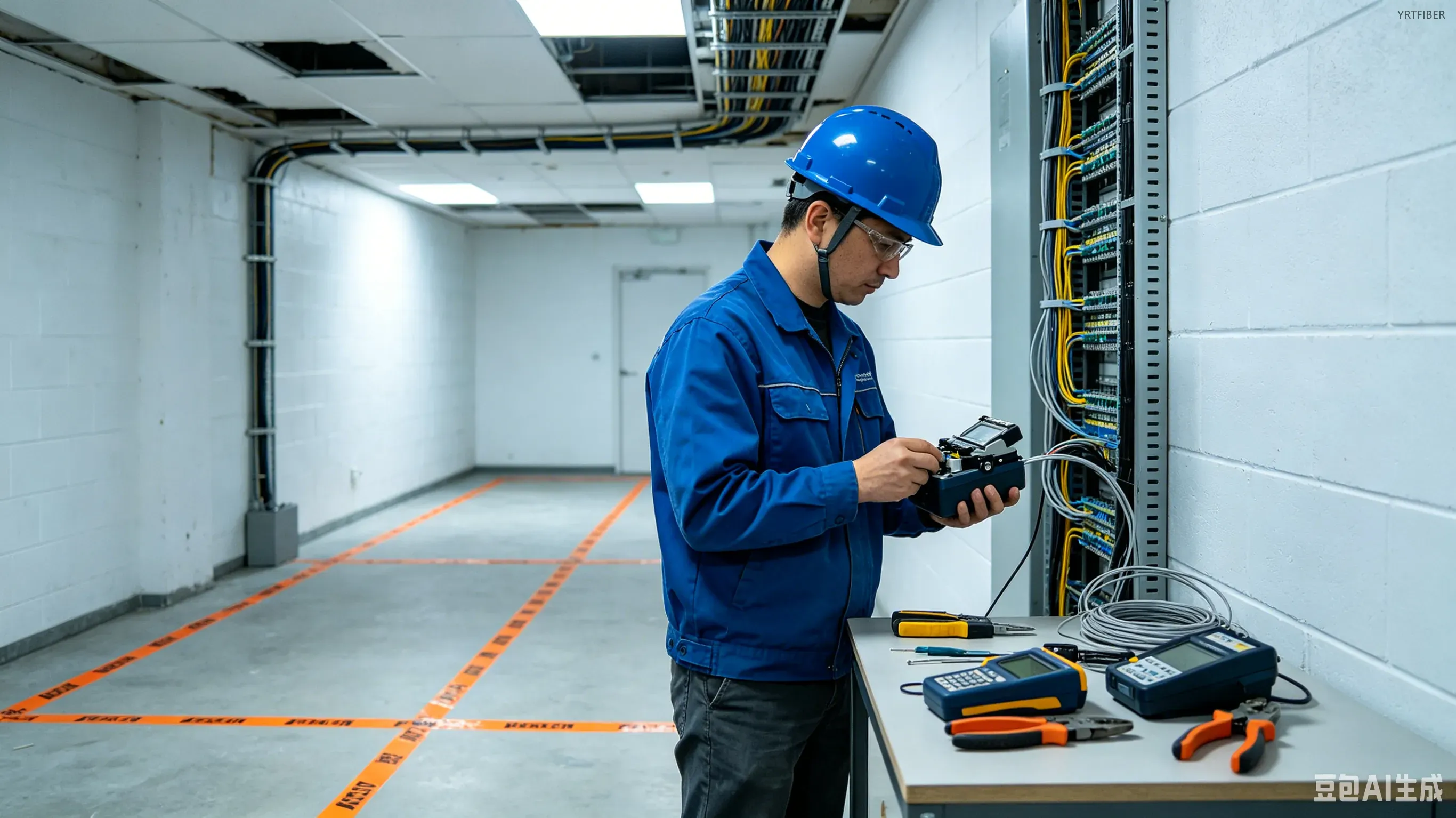
GJBFJH Indoor Breakout Cable – Short Installation Guide
1. Environment & Inspection
Installation temperature: -5°C to +50°C (operating/storage: -20°C to +60°C). Inspect the cable reel and outer sheath for any visible damage before installation.
2. Cable Routing & Pulling
Place cable in trays, conduits, or cable shafts. Avoid sharp bends, crushing, or over-tensioning. Maximum pulling tension: 440 N for 4‑core, 660 N for 6‑24 core, 1320 N for 24‑48 core (short‑term). Maintain bending radius ≥20D during pulling, ≥10D static
3. Mid‑Span Branching (Key Feature)
Locate the built‑in ripcord and SZ‑stranded sub‑units. Strip the outer jacket using the ripcord to expose individual 2.0 mm sub‑units (each containing 900µm tight‑buffered fibre + aramid yarns). Carefully extract required sub‑units without disturbing others. Store unused sub‑units in the splice enclosure.
4. Termination & Splicing
Each sub‑unit has its own reinforcement and sheath – no breakout kit needed. Strip the sub‑unit jacket to access the 900µm tight‑buffered fibre. Clean and connectorize directly, or splice to drop cables. Gel‑free, dry construction keeps termination clean and sanitary.
5. Acceptance Testing
Perform OTDR test to verify attenuation meets specifications. Check continuity and insertion loss for each terminated fibre.
Unduh Katalog Produk YRTFIBER
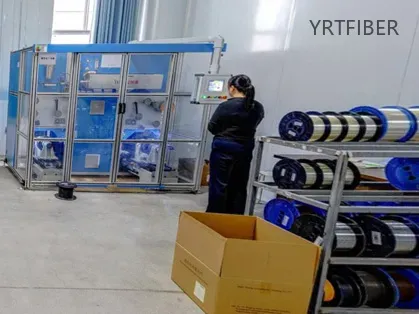
Tembakan Nyata Pabrik
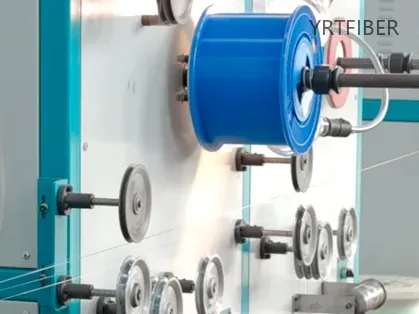
1. Fiber Drawing and Screening Workshop
The factory is equipped with advanced vertical fiber drawing towers, using PCVD or OVD processes, capable of mass production of low-loss single-mode fibers such as G.652.D and G.657.A1. Drawing speed up to 2800 m/min, with double-layer acrylic resin applied online to ensure fiber strength and geometric consistency. After drawing, the tension screening machine automatically removes breakpoints, ensuring zero defects per kilometer of fiber optics.
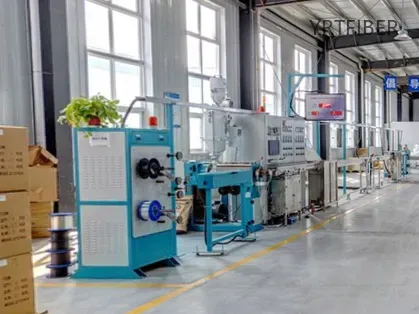
2. Loose Fiber Extrusion and Paste Filling Line
We have multiple high-speed loose sleeve extrusion production lines, where PBT or PE materials are precisely molded into loose tubes with an outer diameter of 1.8~2.5mm. The sleeve is automatically filled with thixotropic water-blocking paste, with online control of remaining length (±0.05%). After extrusion, ultrasonic cleaning and real-time feedback with a diameter laser diameter gauge ensure uniform casing wall thickness and bubble-free fabrication.
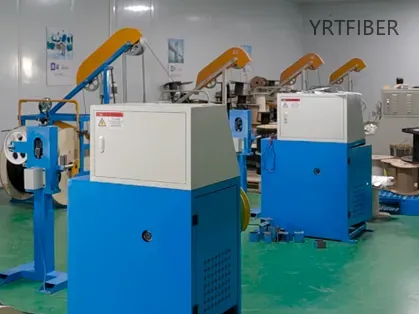
3. Cable forming and metal armor production line
The factory is equipped with SZ stranding cable machines (maximum twisting pitch 30mm, 144 cores) and wire/steel strip armoring forming tables. It can complete the twisting and longitudinal wrapping of central reinforcement parts, loose sleeve tubes, filling ropes, and armor layers in one go. Steel strip welding uses continuous laser welding, adjustable welding speed, and is equipped with eddy current flaw detection. After cable formation, it immediately enters the double-sheath extrusion machine to produce PE or LSZH outer sheaths.
4. Quality inspection and environmental simulation laboratory
The laboratory is CNAS certified and equipped with OTDR, dispersion analyzers, tensile/compressive testing machines, high and low temperature circulation chambers (-40°C~85°C), and salt spray corrosion testers. Every batch of products passes 100% of the full tests before leaving the factory, including attenuation, tensile, flattening, temperature cycling, water seepage, and flame retardant (IEC 60332). The intelligent data management system can trace the complete production process of each reel.
Pemesanan & pengiriman
Jumlah pesanan minimum, waktu produksi, dan dokumen yang menyertai setiap pesanan.
Pemesanan
- Pesanan minimum1 km (1 drum)
- Waktu produksi≤ 300 km: sekitar 15 hari kerja. Di atas 300 km: dikonfirmasi bersama pesanan.
- PembayaranT/T 30% uang muka, sisanya terhadap salinan B/L. L/C at sight diterima.
- InspeksiLaporan uji pabrik dan uji petik saat tiba. Inspeksi pihak ketiga menambah 7 hari kerja.
Cara memesan
- 1Kirim spesifikasi dan jumlah.
- 2Penawaran dan datasheet dalam 24 jam.
- 3Konfirmasi PI, bayar uang muka, produksi dimulai.
Pengiriman & pemuatan
Pemuatan kontainer (referensi)
| Jumlah serat | Berat drum | Drum per 40HQ | km per 40HQ |
|---|---|---|---|
| 144F | 780 kg | 20–23 | 80–92 km |
| 288F | 1,350–1,550 kg | 16–20 | 64–80 km |
Dihitung dengan drum 4.000 m kabel luar loose-tube. Rencana pemuatan akhir dikonfirmasi sebelum pengapalan.
Diameter serat dan kabel berbeda tiap model, sehingga ukuran drum akhir — dan jumlah drum yang muat dalam satu 40HQ — ikut berbeda. Angka di atas adalah nilai tipikal yang mendekati muatan sebenarnya; untuk angka pasti silakan konsultasikan dengan manajer penjualan kami.
- Pelabuhan pengapalanQingdao · Guangzhou · Shenzhen
- PengemasanDrum kayu atau baja, 2–5 km per drum, penandaan metrik tiap 1 m.
Dokumen pengiriman
- Sertifikat uji pabrik
- Kurva OTDR per drum (dua arah, 1310/1550 nm)
- Tabel drum / panjang / atenuasi
- Packing list dengan berat kotor dan bersih
- Deklarasi RoHS dan CE DoC
- Instruksi pengangkatan
Pengemasan & penandaan model ini
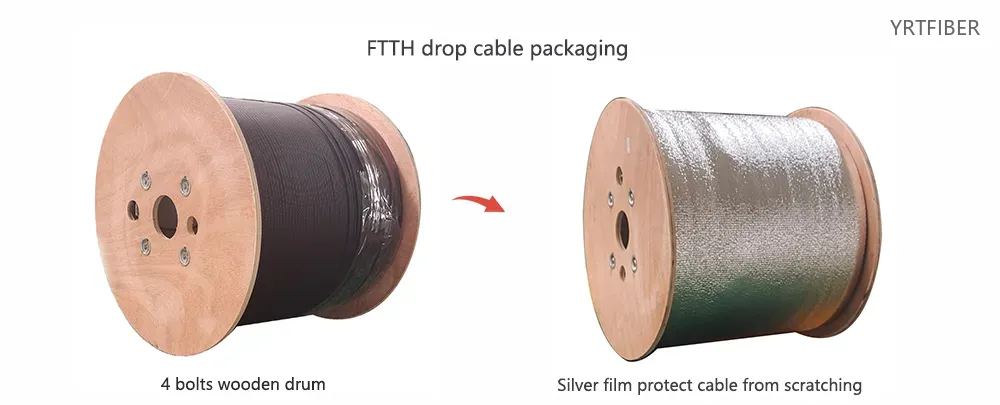
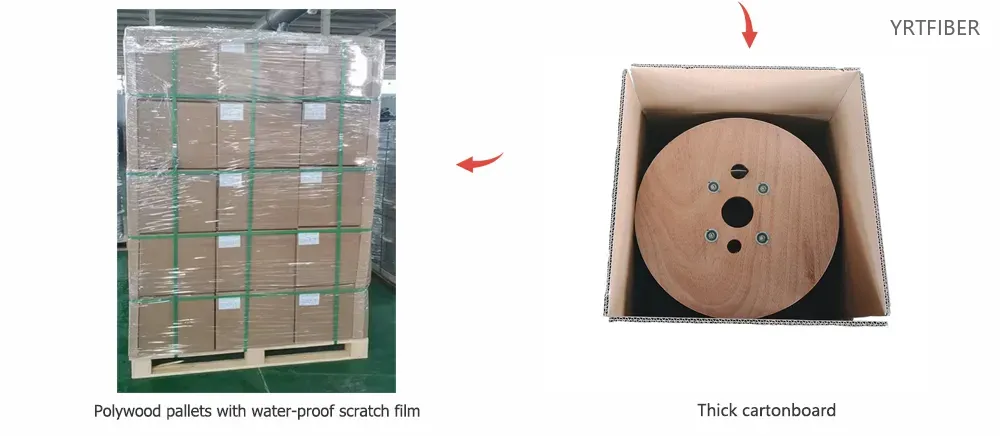
PersyaratanPackaging:
- 1: Semua kabel harus dililitkan pada gulungan kayu yang dirawat yang tidak dapat dikembalikan
- 2: Ujung kabel harus diamankan dengan kuat ke gulungan dan dilindungi dengan waterproof tutup menyusut
- 3: Setiap gulungan harus mencakup:
Setiap gulungan harus berisi yang berikut:
Lapisan luar pelindung pembungkus plastik
Memperkuat bilah kayu untuk memastikan stabilitas
Setidaknya 1 meter ujung kabel gratis disediakan untuk pengujian
Panjang gulungan standar 3000 m (dengan toleransi yang diizinkan ± 2%)
Identifikasi Kabel:
Jaket luar harus menampilkan:
- 1 Penomoran sekuensial unik setiap 1m (± 1% varians diizinkan)
2. Tanda pengulangan tambahan pada interval 1 meter harus mencakup:
Kode produk dan jumlah serat
Identifikasi produsen
Tanggal produksi (bulan / tahun)
Panjang kabel total
Standard Kemasan Dimensi:
| Length | Container | Size (L×W×H) | Net Mass | Total Mass |
|---|---|---|---|---|
| 2 km | Kumparan kayu | 90 × 75 × 90 cm | 156 kg | 220 kg |
| 3 km | Kumparan kayu | 100 × 68 × 100 cm | 240 kg | 280 kg |
| 4 km | Kumparan kayu | 109 × 75 × 109 cm | 300 kg | 368 kg |
| 5 km | Kumparan kayu | 129 × 72 × 129 cm | 400 kg | 480 kg |
Technical Referensi:
Diameter dan berat kabel bergantung pada jumlah serat dan konstruksi — lihat tabel spesifikasi di atas.
Jarak rentang maksimum bergantung pada jenis kabel dan desain instalasi — tanyakan kepada kami untuk rute Anda.
- 3 Hubungi tim penjualan untuk spesifikasi teknis lengkap
Spool Menandai Standar:
Tanda permanen (tinggi minimal 25-30mm) harus muncul di kedua sisi setiap gulungan:
- 1 Nama dan merek dagang perusahaan
- 2 Berisi panjang kabel
- 3 Spesifikasi kabel (jenis / jumlah serat)
- 4 Orientasi berliku
- 5 Pengukuran berat (kotor / bersih)
Catatan: Semua bahan kemasan kayu harus menjalani perawatan fumigasi yang tepat sebelum digunakan.
Pertanyaan yang Sering Diajukan & Pertanyaan Cepat
GJBFJH Breakout Fiber Optic Cable FAQ
1. Bagaimana kabel breakout GJBFJH berbeda dari kabel serat dalam ruangan standar?
GJBFJH menampilkan desain breakout yang diperkuat dengan serat yang diperkuat secara individual, menawarkan:
• 3x ketahanan tarik yang lebih tinggi (600N vs 200N tipikal)
• Jaket LSZH dengan rating api IEC 60332-1
• Paket serat pra-terminasi untuk pemasangan yang lebih mudah di pusat data
2. Berapa batas radius tekukan sebenarnya untuk serat G657A1 / A2?
• G657A1: 7.5mm (instalasi) / 15mm (operasional)
• G657A2: 5mm (instalasi) / 10mm (operasional)
Practical example: Can make 90° turns around server rack corners without signal loss
3. Jenis serat apa yang harus saya pilih untuk penyebaran FTTH saya?
Rekomendasi kami:
• G652D: Lari tulang punggung garis lurus (paling hemat biaya)
• G657A1: Area tikungan sedang (tangga gedung apartemen)
• G657A2: Perutean kepadatan tinggi (instalasi rumah pintar)
4. Sertifikasi apa yang dimiliki jaket kabel?
• Kepatuhan penuh dengan:
- IEC 60332-1 api test
- RoHS 2.0 directive
- dokumentasi rating OFNR tersedia atas permintaan
5. Bisakah saya mendapatkan konfigurasi konektor khusus?
Ya, kami menawarkan:
• Setiap kombinasi LC / SC / FC / ST connectors
• APC atau UPC polishing options
• Factory-preterminated rakitan dengan regangan relief
(Lead time: 3-5 days for standard configurations)
Kirim Pertanyaan Anda
Isi formulir di bawah ini dan kami akan menghubungi Anda kembali dalam waktu 24 jam.
Produk Panas

GJYWFJH 2 / 4 Core kabel serat optik lapis baja dalam / luar ruangan, G652D / G657
GJYWFJH 2 / 4 Core kabel serat optik lapis baja dalam / luar ruangan, G652D / G657
GJFJV Kabel Serat Optik Dalam Ruangan | OM3 / OM4 / OS2 | Jaringan Gigabit
GJFJV Kabel Serat Optik Dalam Ruangan | OM3 / OM4 / OS2 | Jaringan Gigabit
ADSS-S Single Jacket All-Dielectric Self-Support Kabel Serat Optik Udara
ADSS-S Single Jacket All-Dielectric Self-Support Kabel Serat Optik Udara
1 × 2 PLC Fiber Splitter - Modul ABS dengan Konektor SC / APC, Singlemode, Pigtail 2.0mm
1 × 2 PLC Fiber Splitter - Modul ABS dengan Konektor SC / APC, Singlemode, Pigtail 2.0mm
Rel Geser Rel ODF Rangka Distribusi ODF - Tarik-Keluar Bingkai Distribusi Serat Optik Baki Geser untuk Rak Mount
Rel Geser Rel ODF Rangka Distribusi ODF - Tarik-Keluar Bingkai Distribusi Serat Optik Baki Geser untuk Rak MountArtikel Terkait
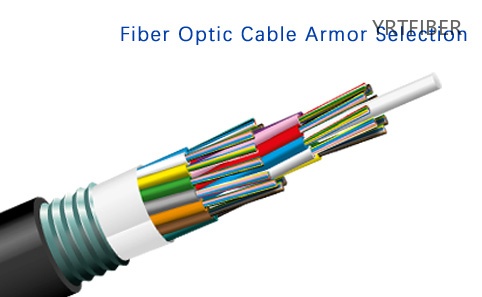
Pemilihan Armor Kabel Serat Optik: Analisis Perbandingan Armor Non-Logam vs. Logam
Pemilihan Armor Kabel Serat Optik: Analisis Perbandingan Armor Non-Logam vs. Logam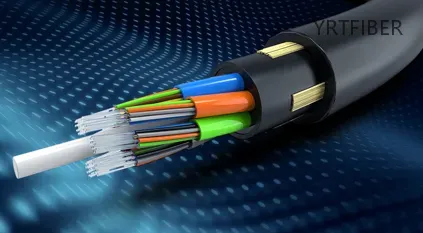
Memahami Skema Warna Kabel Serat Optik Dalam Ruangan
Memahami Skema Warna Kabel Serat Optik Dalam Ruangan