Diferentes Tipos De Cables De Fibra Óptica: Una Visión Completa (Especificaciones, Estándares Y Aplicaciones)

2026-01-09
Tabla de contenido

 Los cables de fibra óptica forman la base de las modernas redes de comunicación de alta velocidad, lo que permite la transmisión de datos a larga distancia con pérdida mínima y fuerte inmunidad a la interferencia electromagnética. A continuación se presenta una descripción general estructurada de los principales tipos de cables, sus detalles técnicos, los estándares aplicables y los casos de uso del mundo real, todos alineados con con las prácticas actuales de la industria.


1. Fibra monomodo (SMF)


SMF está diseñado para comunicaciones de larga distancia y gran ancho de banda, lo que permite que solo un modo de luz viaje a través de un núcleo estrecho.


Parámetro
Especificación
Diámetro del núcleo
8-10 micras
Diámetro del revestimiento
125 micras
Fuente de luz
Diodo láser (1310 nm o 1550 nm)
Distancia máxima
Hasta 100 km +
Ancho de banda
Efectivamente ilimitado (rango de Tbps)
Color de la chaqueta
Amarillo
Estándares Comunes
OS1 (interior), OS2 (exterior / tubo suelto)


Aplicaciones:


Redes troncales de telecomunicaciones

Cables submarinos

Infraestructura de ISP de larga distancia

FTTH (fibra hasta el hogar)

Nota: OS2 es el estándar actual para uso en exteriores y a larga distancia, ofreciendo una atenuación más baja que OS1.
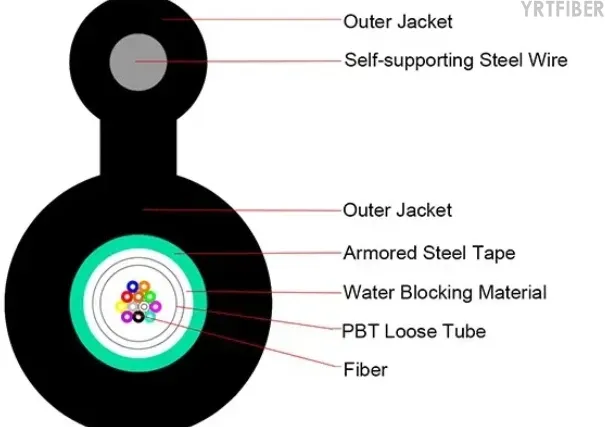
 Diferentes Tipos De Cables De Fibra Óptica: Una Visión Completa (Especificaciones, Estándares Y Aplicaciones)(Paquete y envío1)

2. Fibra multimodo (MMF)


MMF admite múltiples modos de luz y es ideal para distancias más cortas, normalmente utilizando transceptores de bajo costo. Está clasificado por grados OM (Optical Multimode).


Tipo
Tamaño del núcleo
Color de la chaqueta
Distancia máxima (10 Gbps)
Fuente de luz
Ancho de banda (MHz · km)
Estándar
OM1
62,5 µm
Naranja
33 m
LED
200IEEE 802,3
OM2
50 micras
Naranja
82 m
LED
500IEEE 802,3
OM3
50 micras
Agua
300 m
VCSEL
2000TIA-492AAAD
OM4
50 micras
Agua
550 m
VCSEL
4700TIA-492AAAD
OM5
50 micras
Verde lima
150 m (SWDM)
VCSEL
4700TIA-492AAAE


Aplicaciones:


Enlaces de servidor a switch del centro de datos

LAN de campus y empresas

Redes de área de almacenamiento de alta velocidad (SANs)

Nota: OM3 y OM4 son ampliamente utilizados en centros de datos modernos. OM5 admite multiplexación por división de longitud de onda corta (SWDM) para futuras actualizaciones de 40 / 100 / 400 Gbps.
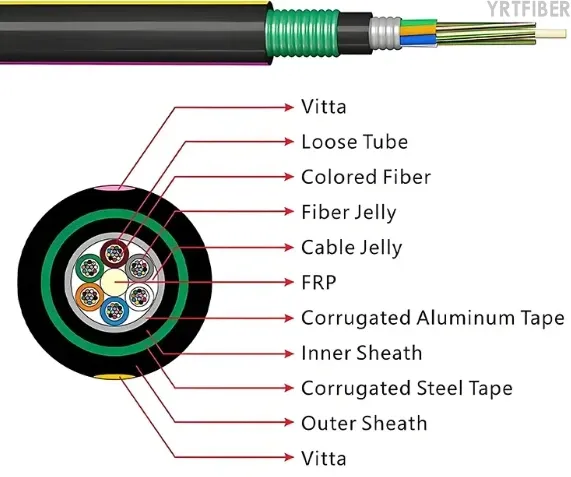
 Diferentes Tipos De Cables De Fibra Óptica: Una Visión Completa (Especificaciones, Estándares Y Aplicaciones)(Paquete y envío2)

3. Construcción de cables y estándares clave


Todos los cables de fibra siguen diseños estructurales estándar y puntos de referencia de rendimiento:

Núcleo / Revestimiento / Revestimiento:

Núcleo: vidrio de sílice de alta pureza (transmite luz)

Revestimiento: sílice de índice de refracción inferior (permite la reflexión interna total)

Revestimiento: capa de acrilato (protección mecánica)


Estándares Clave:


TIA-568-C: estándar de cableado de locales de América del Norte (cubre el rendimiento de la fibra, la polaridad y los conectores)

IEC / ISO 11801: equivalente internacional, ampliamente adoptado en Europa y Asia

ITU-T G.652. D: Especificación SMF común (pico de agua bajo, optimizado para 1550 nm)

Nota: TIA-568 se ha actualizado para incluir LANs ópticas pasivas (PON) y reglas de polaridad del conector de matriz.


4. Tipos de Fibras Especializadas


Fibra Óptica Plástica (POF)


Material: Principalmente PMMA o polímeros fluorados (por ejemplo, CYTOP)

Diámetro del núcleo: 0.5-1 mm (mucho más grande que la fibra de vidrio)


Atenuación:


POF de índice de pasos: 120-200 dB / km a 650 nm

IG-POF de índice graduado: 56-70 dB / km a 850 nm

Ancho de banda: Hasta 10 GHz · km para GI-POF; admite 1-10 Gbps a más de 100 m

Fuente de luz: LED rojo (650 nm) o VCSEL (850 nm)

Ventajas clave: Flexible, resistente a los impactos, fácil de instalar, rentable para un alcance corto


Aplicaciones:


Información y entretenimiento automotriz y redes ADAS

Automatización industrial (PROFIBUS, robótica)

Endoscopia médica y sensores portátiles

Sistemas AV de consumo, conectividad doméstica inteligente

Usos emergentes: textiles fotónicos, retroceso de celdas pequeñas 5G


5. Tecnologías emergentes de fibra


Los siguientes tipos de fibra están bajo investigación y desarrollo activos para usos especializados:


Tipo De Fibra
Nombre completo
Característica Clave
Aplicaciones Primarias
Estado
PCF
Fibra de cristal fotónico
Agujeros de aire de revestimiento con microestructurado
Óptica no lineal, generación de supercontinuum
Etapa de laboratorio / prototipo
HCF
Fibra de núcleo hueco
La luz viaja en el núcleo aéreo
Latencia ultrabaja, entrega láser de alta potencia
Los primeros ensayos comerciales
MCF
Fibra de varios núcleos
Múltiples núcleos en un revestimiento
Multiplexación por división espacial en centros de datos
Despliegues de pilotos


Estas fibras aún no están comercialmente generalizadas debido al alto costo, la complejidad del empalme y la falta de estandarización.


6. Pautas de selección


Elija fibra según la distancia, el ancho de banda, el entorno y el presupuesto:


Caso de uso
Tipo de fibra recomendado
Justificación
Enlaces de larga distancia / submarinos
fibra monomodo OS2
La atenuación más baja, la capacidad más alta, alcance de más de 100 km
Espina / hoja del centro de datos
fibra multimodo OM4 u OM5
Admite 40 / 100 / 400 Gbps en distancias cortas


Explora este tema
We use cookie to improve your online experience. By continuing to browse this website, you agree to our use of cookie.

Cookies

Please read our Terms and Conditions and this Policy before accessing or using our Services. If you cannot agree with this Policy or the Terms and Conditions, please do not access or use our Services. If you are located in a jurisdiction outside the European Economic Area, by using our Services, you accept the Terms and Conditions and accept our privacy practices described in this Policy.
We may modify this Policy at any time, without prior notice, and changes may apply to any Personal Information we already hold about you, as well as any new Personal Information collected after the Policy is modified. If we make changes, we will notify you by revising the date at the top of this Policy. We will provide you with advanced notice if we make any material changes to how we collect, use or disclose your Personal Information that impact your rights under this Policy. If you are located in a jurisdiction other than the European Economic Area, the United Kingdom or Switzerland (collectively “European Countries”), your continued access or use of our Services after receiving the notice of changes, constitutes your acknowledgement that you accept the updated Policy. In addition, we may provide you with real time disclosures or additional information about the Personal Information handling practices of specific parts of our Services. Such notices may supplement this Policy or provide you with additional choices about how we process your Personal Information.


Cookies

Cookies are small text files stored on your device when you access most Websites on the internet or open certain emails. Among other things, Cookies allow a Website to recognize your device and remember if you've been to the Website before. Examples of information collected by Cookies include your browser type and the address of the Website from which you arrived at our Website as well as IP address and clickstream behavior (that is the pages you view and the links you click).We use the term cookie to refer to Cookies and technologies that perform a similar function to Cookies (e.g., tags, pixels, web beacons, etc.). Cookies can be read by the originating Website on each subsequent visit and by any other Website that recognizes the cookie. The Website uses Cookies in order to make the Website easier to use, to support a better user experience, including the provision of information and functionality to you, as well as to provide us with information about how the Website is used so that we can make sure it is as up to date, relevant, and error free as we can. Cookies on the Website We use Cookies to personalize your experience when you visit the Site, uniquely identify your computer for security purposes, and enable us and our third-party service providers to serve ads on our behalf across the internet.

We classify Cookies in the following categories:
 ●  Strictly Necessary Cookies
 ●  Performance Cookies
 ●  Functional Cookies
 ●  Targeting Cookies


Cookie List
A cookie is a small piece of data (text file) that a website – when visited by a user – asks your browser to store on your device in order to remember information about you, such as your language preference or login information. Those cookies are set by us and called first-party cookies. We also use third-party cookies – which are cookies from a domain different than the domain of the website you are visiting – for our advertising and marketing efforts. More specifically, we use cookies and other tracking technologies for the following purposes:

Strictly Necessary Cookies
These cookies are necessary for the website to function and cannot be switched off in our systems. They are usually only set in response to actions made by you which amount to a request for services, such as setting your privacy preferences, logging in or filling in forms. You can set your browser to block or alert you about these cookies, but some parts of the site will not then work. These cookies do not store any personally identifiable information.

Functional Cookies
These cookies enable the website to provide enhanced functionality and personalisation. They may be set by us or by third party providers whose services we have added to our pages. If you do not allow these cookies then some or all of these services may not function properly.

Performance Cookies
These cookies allow us to count visits and traffic sources so we can measure and improve the performance of our site. They help us to know which pages are the most and least popular and see how visitors move around the site. All information these cookies collect is aggregated and therefore anonymous. If you do not allow these cookies we will not know when you have visited our site, and will not be able to monitor its performance.

Targeting Cookies
These cookies may be set through our site by our advertising partners. They may be used by those companies to build a profile of your interests and show you relevant adverts on other sites. They do not store directly personal information, but are based on uniquely identifying your browser and internet device. If you do not allow these cookies, you will experience less targeted advertising.

How To Turn Off Cookies
You can choose to restrict or block Cookies through your browser settings at any time. Please note that certain Cookies may be set as soon as you visit the Website, but you can remove them using your browser settings. However, please be aware that restricting or blocking Cookies set on the Website may impact the functionality or performance of the Website or prevent you from using certain services provided through the Website. It will also affect our ability to update the Website to cater for user preferences and improve performance. Cookies within Mobile Applications

We only use Strictly Necessary Cookies on our mobile applications. These Cookies are critical to the functionality of our applications, so if you block or delete these Cookies you may not be able to use the application. These Cookies are not shared with any other application on your mobile device. We never use the Cookies from the mobile application to store personal information about you.

If you have questions or concerns regarding any information in this Privacy Policy, please contact us by email at . You can also contact us via our customer service at our Site.