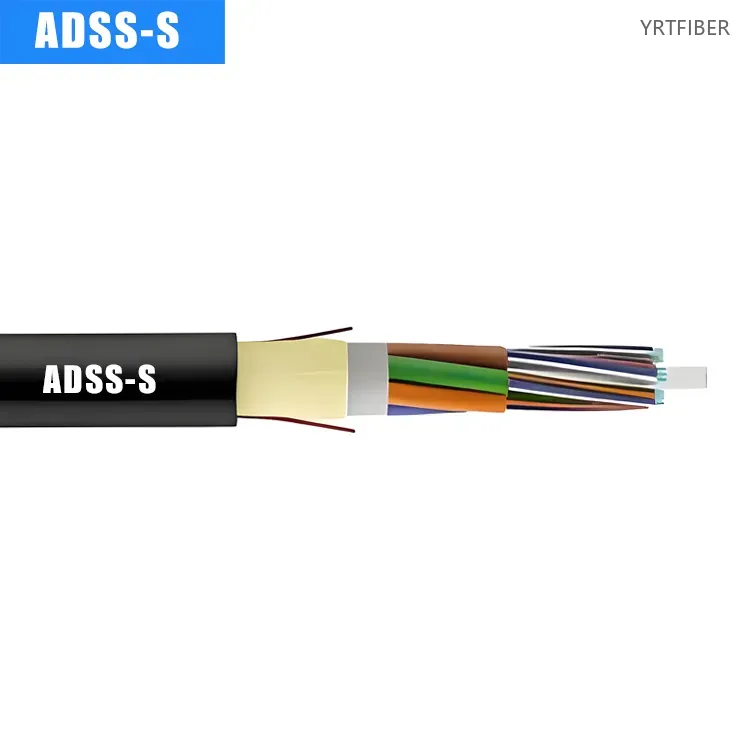
¿Recogiendo cable ADSS? Alcance de inicio con , no recuento de fibra.

2026-04-21
Tabla de contenido

¿Recogiendo cable ADSS? Alcance de inicio con , no recuento de fibra.(Paquete y envío1)

Si obtiene un cable ADSS para un proyecto de servicios públicos, telecomunicaciones o EPC, no comience con cuántas fibras necesita. Eso es al revés. Inicie con la longitud del tramo. Luego verifique el voltaje o el entorno eléctrico. Solo después de eso debería conformarse con el recuento de fibras y la construcción del cable.


Así es como los proyectos de gastos generales reales especifican ADSS. IEEE 1222-2019 trata el ADSS como un cable de servicios generales, por lo que cubre los requisitos mecánicos, eléctricos y de instalación juntos, no solo las especificaciones ópticas.


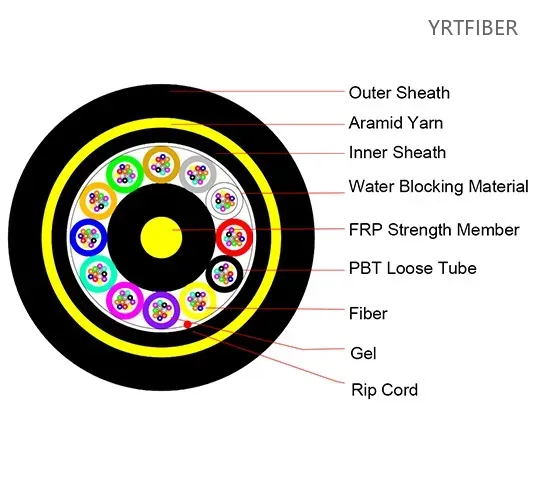
Tomemos como ejemplo la página ADSS-S de YRTFiber. Describe un cable aéreo de una sola chaqueta totalmente dieléctrico autoportante con PE o opciones de chaqueta exterior AT, de 2 a 288 fibras. Pero también hay una tabla técnica que muestra diferentes tensiones de trabajo y rangos de envergadura para diferentes diseños. Eso solo te dice: esto no se trata solo de "¿cuántos núcleos necesito?"


La versión corta - elige en este orden:

Span primero: decide el diseño mecánico básico.


Nivel de voltaje / entorno eléctrico en segundo lugar: le indica si necesita una funda de PE o una funda AT.

La fibra cuenta en tercer lugar: seguro, la capacidad importa, pero debe ajustarse al diseño mecánico y ambiental, no anularlo.

¿Por qué este pedido? Porque ADSS no es solo un portador de fibra. Es un cable aéreo autoportante que tiene que soportar el viento, la tensión, el estrés de la instalación y años de exposición al aire libre. Tanto el alcance de IEEE como la estructura del producto de YRTFiber reflejan eso.


Paso 1: longitud del lapso

Span es tu primer filtro. Afecta directamente a la carga y tensión del cable. En la tabla ADSS-S de YRTFiber, las diferentes filas de diseño muestran la tensión máxima de trabajo diaria, la resistencia a la rotura y los valores de span, aproximadamente desde 100 m hasta 800 m, según la configuración.


Una cosa que también muestra su página (tal vez sin querer) es que no debes confiar en un solo número de tramo de título. El mismo producto se llama "cable aéreo de 150 m de tramo" en el título, las preguntas frecuentes dicen "diseñado para tramos de hasta 150 metros", un bloque técnico dice "tramo máximo de 100 m", pero la lista de características dice "puede alcanzar más de 1000 m", mientras que la tabla muestra diseños de hasta 800 m. ¿Qué da? Simple: el tramo depende de la fila de diseño exacta y de las condiciones de su proyecto. Por lo tanto, lo más seguro es pedirle al proveedor que confirme el diseño de su ruta real, no solo seguir las palabras de marketing.


En pocas palabras: el lapso es una variable de diseño, no una etiqueta fija. ¿Ruta corta y estándar? Una chaqueta única más ligera podría funcionar. ¿Ruta más larga o cargas más altas? Obtenga una confirmación de diseño específica del lapso antes de realizar el pedido.


Paso 2: Nivel de voltaje o entorno eléctrico

Una vez que conozca el alcance, mire el entorno eléctrico. Ahí es donde elige entre la funda de PE y AT. La página ADSS-S de YRTFiber lista ambos como opciones de chaqueta exterior, con refuerzo de hilo de aramida en el interior.


La práctica de la industria (basada en estándares como YD / T 980-2002, DL / T 788-2016, GB / T 18899-2002) dice: si el potencial de espacio en el área de instalación no es superior a 12 kV, vaya con polietileno negro (funda de clase A). Si es superior a 12 kV, desea poliolefina resistente al seguimiento (funda de clase B). En lenguaje sencillo de adquisición: PE para entornos eléctricos menos severos, AT cuando necesite una mayor resistencia de seguimiento.


Muchos compradores solo buscan por voltaje de línea nominal, pero la verdadera pregunta de ingeniería es la tensión eléctrica real en la posición de instalación. IEEE 1222 incluso incluye un anexo sobre la minimización de campos eléctricos utilizando cálculos de potencial espacial, así es como esto es fundamental para el diseño ADSS.
¿Recogiendo cable ADSS? Alcance de inicio con , no recuento de fibra.(Paquete y envío2)


Así que desde una perspectiva de compra:


¿Telecomunicaciones aérea estándar o ruta de servicios públicos de bajo riesgo? La funda de PE probablemente esté bien.

¿Entorno de campo eléctrico más duro? Ve a con AT.

Explora este tema
We use cookie to improve your online experience. By continuing to browse this website, you agree to our use of cookie.

Cookies

Please read our Terms and Conditions and this Policy before accessing or using our Services. If you cannot agree with this Policy or the Terms and Conditions, please do not access or use our Services. If you are located in a jurisdiction outside the European Economic Area, by using our Services, you accept the Terms and Conditions and accept our privacy practices described in this Policy.
We may modify this Policy at any time, without prior notice, and changes may apply to any Personal Information we already hold about you, as well as any new Personal Information collected after the Policy is modified. If we make changes, we will notify you by revising the date at the top of this Policy. We will provide you with advanced notice if we make any material changes to how we collect, use or disclose your Personal Information that impact your rights under this Policy. If you are located in a jurisdiction other than the European Economic Area, the United Kingdom or Switzerland (collectively “European Countries”), your continued access or use of our Services after receiving the notice of changes, constitutes your acknowledgement that you accept the updated Policy. In addition, we may provide you with real time disclosures or additional information about the Personal Information handling practices of specific parts of our Services. Such notices may supplement this Policy or provide you with additional choices about how we process your Personal Information.


Cookies

Cookies are small text files stored on your device when you access most Websites on the internet or open certain emails. Among other things, Cookies allow a Website to recognize your device and remember if you've been to the Website before. Examples of information collected by Cookies include your browser type and the address of the Website from which you arrived at our Website as well as IP address and clickstream behavior (that is the pages you view and the links you click).We use the term cookie to refer to Cookies and technologies that perform a similar function to Cookies (e.g., tags, pixels, web beacons, etc.). Cookies can be read by the originating Website on each subsequent visit and by any other Website that recognizes the cookie. The Website uses Cookies in order to make the Website easier to use, to support a better user experience, including the provision of information and functionality to you, as well as to provide us with information about how the Website is used so that we can make sure it is as up to date, relevant, and error free as we can. Cookies on the Website We use Cookies to personalize your experience when you visit the Site, uniquely identify your computer for security purposes, and enable us and our third-party service providers to serve ads on our behalf across the internet.

We classify Cookies in the following categories:
 ●  Strictly Necessary Cookies
 ●  Performance Cookies
 ●  Functional Cookies
 ●  Targeting Cookies


Cookie List
A cookie is a small piece of data (text file) that a website – when visited by a user – asks your browser to store on your device in order to remember information about you, such as your language preference or login information. Those cookies are set by us and called first-party cookies. We also use third-party cookies – which are cookies from a domain different than the domain of the website you are visiting – for our advertising and marketing efforts. More specifically, we use cookies and other tracking technologies for the following purposes:

Strictly Necessary Cookies
These cookies are necessary for the website to function and cannot be switched off in our systems. They are usually only set in response to actions made by you which amount to a request for services, such as setting your privacy preferences, logging in or filling in forms. You can set your browser to block or alert you about these cookies, but some parts of the site will not then work. These cookies do not store any personally identifiable information.

Functional Cookies
These cookies enable the website to provide enhanced functionality and personalisation. They may be set by us or by third party providers whose services we have added to our pages. If you do not allow these cookies then some or all of these services may not function properly.

Performance Cookies
These cookies allow us to count visits and traffic sources so we can measure and improve the performance of our site. They help us to know which pages are the most and least popular and see how visitors move around the site. All information these cookies collect is aggregated and therefore anonymous. If you do not allow these cookies we will not know when you have visited our site, and will not be able to monitor its performance.

Targeting Cookies
These cookies may be set through our site by our advertising partners. They may be used by those companies to build a profile of your interests and show you relevant adverts on other sites. They do not store directly personal information, but are based on uniquely identifying your browser and internet device. If you do not allow these cookies, you will experience less targeted advertising.

How To Turn Off Cookies
You can choose to restrict or block Cookies through your browser settings at any time. Please note that certain Cookies may be set as soon as you visit the Website, but you can remove them using your browser settings. However, please be aware that restricting or blocking Cookies set on the Website may impact the functionality or performance of the Website or prevent you from using certain services provided through the Website. It will also affect our ability to update the Website to cater for user preferences and improve performance. Cookies within Mobile Applications

We only use Strictly Necessary Cookies on our mobile applications. These Cookies are critical to the functionality of our applications, so if you block or delete these Cookies you may not be able to use the application. These Cookies are not shared with any other application on your mobile device. We never use the Cookies from the mobile application to store personal information about you.

If you have questions or concerns regarding any information in this Privacy Policy, please contact us by email at . You can also contact us via our customer service at our Site.