

 English
 Español
 Português
 لالعربية
 Русский
 Bahasa Indonesia
 Türkçe
 Bahasa Melayu

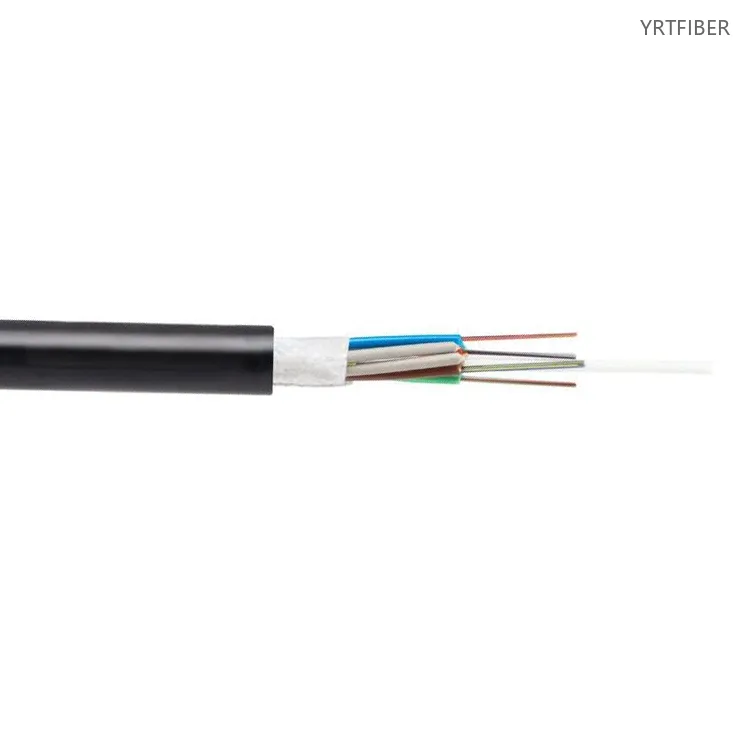
Câble fibre optique non métallique gyfty | 2-288 cœurs | câble extérieur non blindé g.652d / g.655
Good mechanical and temperature properties
High-strength loose casing, resistant to hydrolysis
Special casing filler plays a key role in protecting optical fibers
Anti-extrusion, good flexibility
Single fiber-reinforced plastic as a central reinforcement
Light weight, small diameter, easy installation
What is GYFTY fiber optic cable
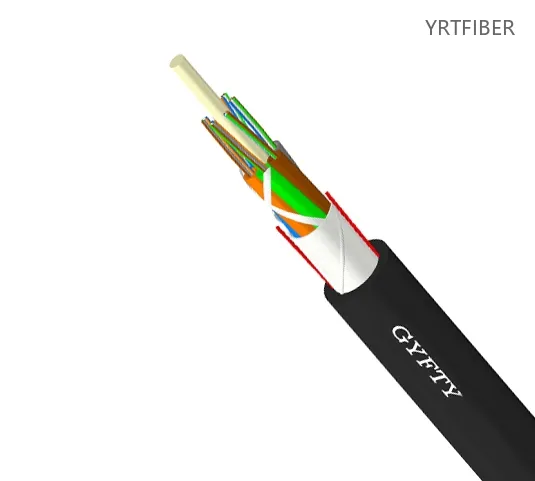
GYFTY (loose tube, non-metallic, gel-filled) fiber optic cable is a fully dielectric cable that places 250 μm optical fibers into high-modulus plastic loose tubes filled with waterproof filler, which are then stranded around a central fiber-reinforced plastic (FRP) non-metallic strength member, and finally sheathed with PE, offering excellent mechanical and temperature properties, light weight, small diameter, and high resistance to electromagnetic interference, making it ideal for overhead and duct installations in power line areas or lightning-prone environments.
GYFTY Non-Metallic Fiber Optic Cable Paramètres de spécification
- Paramètres de spécification
- CARACTÉRISTIQUES OPTIQUES
propriétés optiques
| G.652 | G.655 | 50 / 125μm | 62.5/125 μm | ||
| Atténuation (+ 20 ℃) | @ 850nm | ≤ 3,0 dB / km | ≤ 3,0 dB / km | ||
| @ 1300nm | ≤ 1,0 dB / km | ≤ 1,0 dB / km | |||
| @ 1310nm | ≤ 0,36 dB / km | ≤ 0,40 dB / km | |||
| @ 1550nm | ≤ 0,22 dB / km | ≤ 0,23 dB / km | |||
| Bande passante (classe A) | @ 850nm | ≥ 500 MHz · km | ≥ 200 MHz · km | ||
| @ 1300nm | ≥ 1000 MHz · km | ≥ 600 MHz · km | |||
| Ouverture numérique | 0,200 ± 0,015NA | 0,275 ± 0,015NA | |||
| Longueur d'onde de coupure de câble | ≤ 1260nm | ≤ 1480nm | |||
| Stockage / Température de fonctionnement | -40℃ ~+70℃ | ||||
Paramètres techniques
| Modèle | Nombre de fibres | Tube | Poids (kg / km) | Résistance à la traction N | Écraser N / 100mm | Rayon de courbure mm |
| GYFTY-2 ~ 36F | 2~36 | 6 | 88 | 600/1500 | 300/1000 | 10D / 20D |
| GYFTY-38 ~ 72F | 38~72 | 6 | 112 | 600/1500 | 300/1000 | 10D / 20D |
| GYFTY-74 ~ 96F | 74~96 | 8 | 155 | 600/1500 | 300/1000 | 10D / 20D |
| GYFTY-98 ~ 120F | 98~120 | 10 | 185 | 600/1500 | 300/1000 | 10D / 20D |
Structure et composition du produit
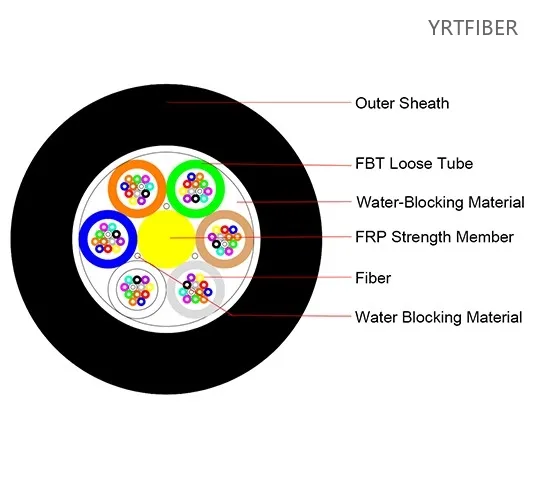
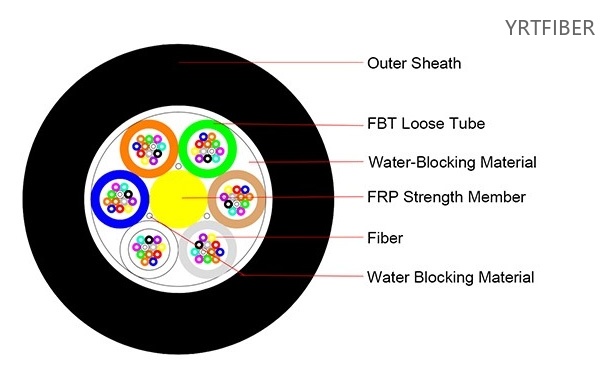
Outer Sheath (Outer Jacket): Made of polyethylene (PE) through extrusion molding, it protects the internal cable cores from mechanical damage, ultraviolet rays, and environmental corrosion, while providing good water resistance and insulation performance.
FBT Loose Tube: A loose tube made of high-modulus plastic (usually PBT, here referred to as FBT), which holds the optical fibers inside and is filled with waterproof fiber paste, providing a buffer space and lateral-pressure protection for the fibers.
Water-Blocking Material:A thixotropic fiber paste filled inside the loose tube that effectively prevents water from penetrating longitudinally along the tube while cushioning micro-bends in the fiber, ensuring long-term transmission stability.
FRP Strength Member: A glass fiber-reinforced plastic rod located at the center of the optical cable, serving as a non-metallic tensile element to withstand the tension during laying and usage and ensure the overall roundness and compactness of the cable.
Fiber: The medium for transmitting optical signals, usually 250μm colored optical fiber, placed inside the loose tube to achieve high-speed, large-capacity data communication.
Water-Blocking Material: Water-blocking grease or water-blocking yarn/powder filled in the gaps of the cable core (between the loose tube and the sheath), further preventing water from migrating longitudinally along the core and enhancing the overall water resistance of the optical cable.
Avantages de GYFTY Non-Metallic Fiber Optic Cable
Superior mechanical and environmental performance
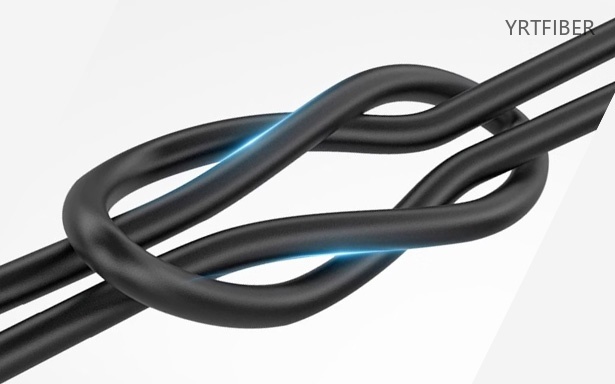
Offers stable operation from -40℃ to +70℃, excellent crush resistance, and good flexibility, ensuring reliable performance under extrusion, bending, and temperature variation.

High-strength loose tube with protective filler
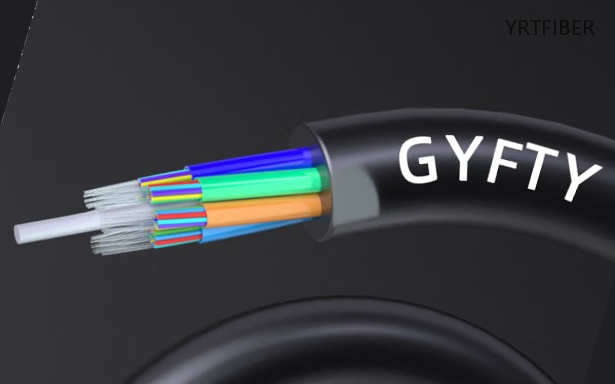
Features a hydrolysis‑resistant PBT loose tube and special thixotropic gel that blocks water, cushions micro‑bends, and effectively protects the optical fibers.
Single FRP central strength member (non‑metallic)
Uses a fiber‑reinforced plastic rod as the only central reinforcement, providing tensile strength while eliminating induced currents and lightning risks.
Lightweight, small diameter, easy installation
Optimized non‑metallic design reduces weight and outer diameter, lowering transport and handling costs, and simplifying duct blowing, overhead lashing, and other field installations.
Applications d'ingénierie GYFTY Non-Metallic Fiber Optic Cable
Special Protection Scenarios
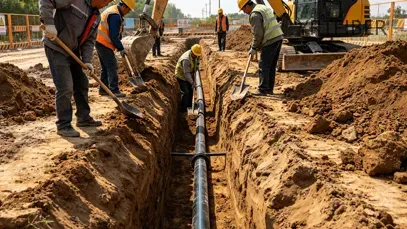
In outdoor or mountainous areas with high requirements for rodent and termite protection, the GYFTY optical cable's chew-resistant characteristics provide long-term reliable physical protection. In coastal industrial areas with high temperature, high humidity, and high salt spray, its all-dielectric properties can also effectively resist corrosion.
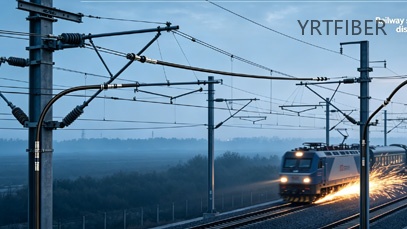
Railway and Transit
GYFTY optical cables are commonly used for communications and signaling systems along railways, and their resistance to electromagnetic interference ensures stable signal transmission in environments with strong traction currents.
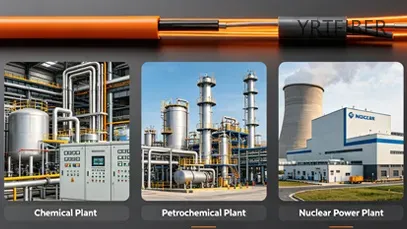
Petrochemical Sites
Chemical plants, refineries, and other facilities have flammable and explosive risks. The metal-free characteristics of GYFTY optical cables can avoid generating sparks, enhancing intrinsic safety levels.
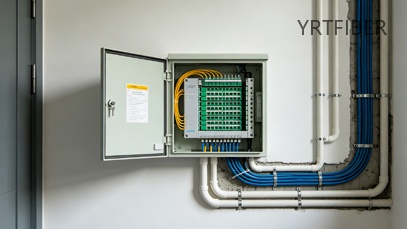
Fiber to the Home (FTTH) Deployment
In areas prone to frequent lightning or severe electrical interference, GYFTY optical cables can be used as the lead-in section from outdoor distribution boxes to the user side, protecting user equipment from lightning strikes and overvoltage damage.
Expédition et emballage
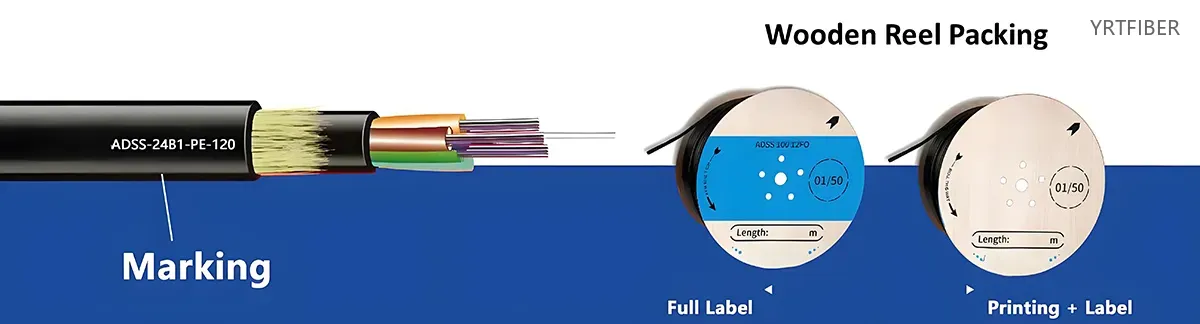
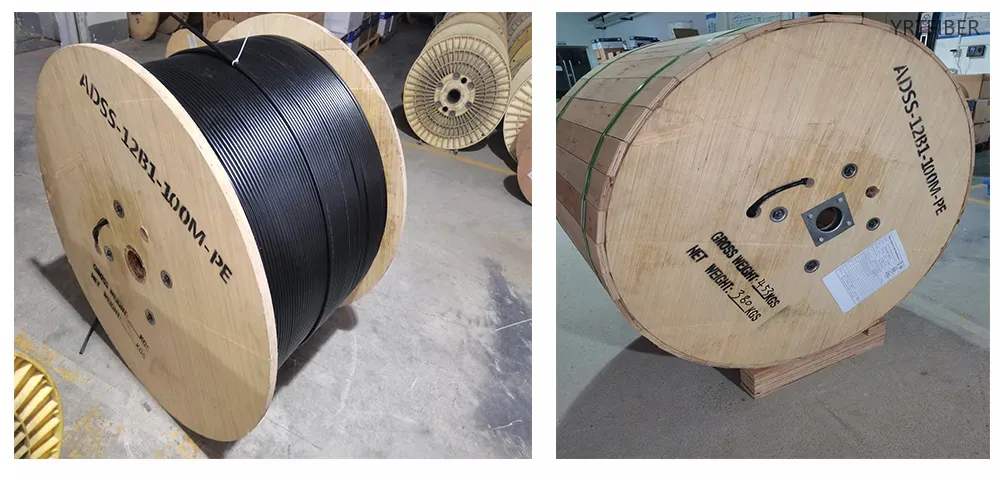
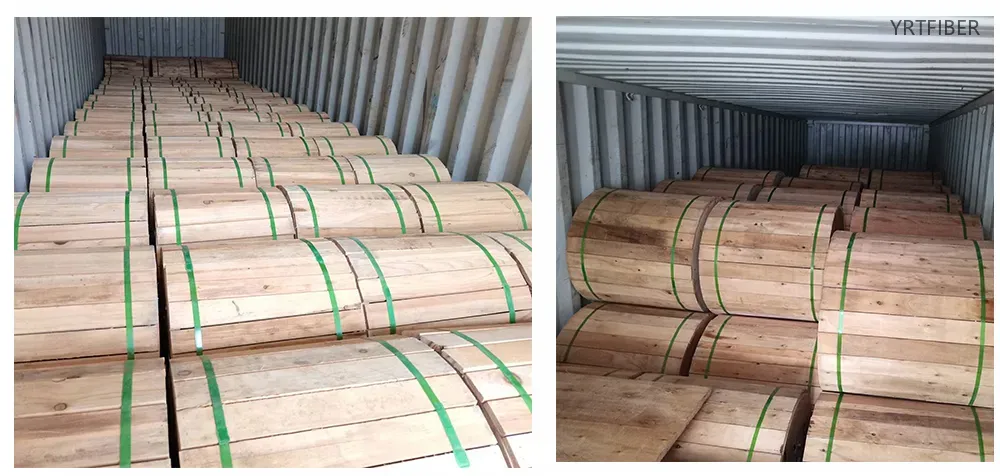
ExigencesPackaging :
- 1 : Tous les câbles doivent être enroulés sur des bobines en bois traitées qui ne sont pas retournables
- 2 : Les extrémités des câbles doivent être solidement fixées à la bobine et protégées par waterproof capuchons rétractables
- 3 : Chaque bobine doit inclure :
- 1、 Protective plastic wrapping layer
- 2、 Reinforcing wooden slats for stability
- 3、 Minimum 1m of free cable end for testing purposes
- 4、 Standard spool length: 3000mm (±2% tolerance allowed)
Identification du câble :
La veste extérieure doit afficher :
- 1 Numérotation séquentielle unique tous les 1m (± 1 % de variance autorisée)
- 2 Marquages répétés supplémentaires à des intervalles de 1 m montrant :
- 1、 Product code and fiber count
- 2、 Manufacturer identification
- 3、 Production date (month/year)
- 4、Total cable length
Standard dimensions de l'emballage :
| Length | Container | Size (L×W×H) | Net Mass | Total Mass |
|---|---|---|---|---|
| 2 km | Bobine en bois | 90 × 75 × 90 cm | 156 kg | 220 kg |
| 3 km | Bobine en bois | 100 × 68 × 100 cm | 240 kg | 280 kg |
| 4 km | Bobine en bois | 109 × 75 × 109 cm | 300 kg | 368 kg |
| 5 km | Bobine en bois | 129 × 72 × 129 cm | 400 kg | 480 kg |
Technical Référence :
- 1 Diamètre du câble standard : 10,0 mm
- 2 Distance maximale de la portée : 100m
- 3 Contactez l'équipe de vente pour les spécifications techniques complètes
Normes de marquage des bobines :
Des marques permanentes (hauteur minimale de 25 à 30 mm) doivent apparaître des deux côtés de chaque bobine :
- 1 Nom et marque de l'entreprise
- 2 Longueur du câble contenue
- 3 Spécifications du câble (type / nombre de fibres)
- 4 Orientation de l'enroulement
- 5 Mesures de poids (brut / net)
Remarque : Tous les matériaux d'emballage en bois doivent subir un traitement de fumigation approprié avant d'être utilisés.
Comparaison des produits:
GYFTY vs GYTA vs GYTS vs GYFTA
| Feature / Dimension | GYFTY (Non-Metallic, No Armor) | GYTA (Aluminum Tape Armor) | GYTS (Steel Tape Armor) | GYFTA (Non-Metallic + Aluminum Tape Armor) |
|---|---|---|---|---|
| Structure Type | Stranded loose tube around FRP (non-metallic) central strength member. Non-metallic construction throughout. | Stranded loose tube around metallic central strength member (steel wire). | Stranded loose tube around metallic central strength member (steel wire). | Stranded loose tube around FRP (non-metallic) central strength member. Aluminum tape armor (APL). |
| Armor / Protection | No metallic armor. Aramid yarn water-blocking layer + PE outer sheath. | Corrugated aluminum tape (APL) longitudinally applied + PE sheath. | Corrugated steel tape (PSP) longitudinally applied + PE sheath. | Corrugated aluminum tape (APL) + PE sheath. All-dielectric aside from aluminum tape. |
| Fiber Core Capacity | 2 – 144 cores (up to 288 cores in some designs) | 2 – 144 cores (up to 432 cores) | 2 – 144 cores (up to 432 cores) | 2 – 144 cores (up to 288 cores) |
| Typical Applications | Aerial, duct. High‑voltage areas, lightning‑prone regions, substations, environments requiring no grounding. | Duct, aerial (with messenger). Long‑haul backbone, metropolitan networks, wet/coastal areas (corrosion‑resistant). | Duct, aerial (with messenger), direct burial. Harsh environments requiring high crush resistance, rodent protection. | Duct, aerial. High‑voltage areas needing better moisture barrier than GYFTY, but with non‑metallic central member. |
| Engineering Pros | Fully dielectric – no grounding required, immune to EMI/lightning, safe near power lines. Lightweight, easy to install. UV‑resistant PE sheath, water‑blocking compound. | Excellent moisture/corrosion resistance (aluminum does not rust). Lighter and more flexible than steel armor. Good for long‑term duct installation. | High crush resistance and mechanical protection. Excellent for rodent/bullet protection in direct burial. Strong moisture barrier with PSP tape. | Combines dielectric central member (no induced current) with aluminum armor for moisture protection. Better corrosion resistance than steel armor. Lighter than GYTS. |
| Engineering Cons | No armor – weaker crush resistance, vulnerable to rodent attack. Not suitable for direct burial or high mechanical stress environments. | Lower crush resistance than steel armor (aluminum is softer). Not ideal for direct burial or rocky terrain. Metallic, requires grounding near power lines. | Heavier and stiffer than GYTA. Steel tape can corrode if sheath damaged. Metallic, requires grounding, may induce current near HV lines. | Aluminum armor has lower crush resistance than steel. Still requires care in rocky direct burial. Cost higher than GYFTY. |
| Cost (Relative) | Low – simple non‑armored construction, most economical for low‑core‑count non‑hazardous aerial/duct installations. | Medium – aluminum tape is cheaper than steel, but metallic construction adds moderate cost. | Medium to high – steel armor increases material and shipping costs, but good value for high‑protection needs. | Medium to high – non‑metallic member plus aluminum armor costs more than GYFTY but less than GYTS for similar protection in sensitive electrical environments. |
| Maintenance Difficulty | Low – lightweight, easy handling, no grounding required. However, lack of armor means higher risk of damage, requiring more frequent inspections. | Low – good corrosion resistance reduces long‑term issues; easier mid‑span access than steel armor. | Moderate – heavier and stiffer, harder to splice mid‑span; must inspect for rust at sheath damage points. | Low to moderate – lighter than GYTS; aluminum corrosion resistance good, but aluminum armor is softer and may dent, requiring careful handling. |
| Grounding Requirement | None – fully dielectric, no induced current. | Required – metallic components can induce current near power lines. | Required – same as GYTA. | Not required for central member, but aluminum tape is metallic and may require grounding in HV environments. |
GYFTY Non-Metallic Fiber Optic Cable Guide de sélection
1 : Engineering selection between GYFTY, GYTA, GYTS and GYFTA:
For aerial or duct installation in high-voltage environments, GYFTY is recommended due to its all-dielectric construction, which eliminates the need for grounding and prevents induced current in lightning-prone or power-line adjacent areas. For applications requiring a dielectric cable with better moisture protection than GYFTY but without the weight of steel armor, GYFTA can be an ideal choice. For pipe-laying in wet or coastal areas, GYTA is suitable for its corrosion resistance, lighter weight, and good moisture barrier. For direct burial, rodent protection, or high mechanical stress scenarios, GYTS provides superior crush resistance but its steel armor is heavier and needs extra rust inspection at sheath damage points.
2 : Flame retardancy and UV resistance considerations:
All four cables are primarily designed for outdoor use with UV-resistant PE sheaths and water‑blocking gel for moisture protection, meeting standards like IEC 60794-1 and YD/T 901. They are not flame‑retardant, so they are not suitable for indoor riser/plenum spaces unless a specific LSZH variant (e.g., GYTZS, GYTZA) is specified.
3: Non‑metallic vs. metallic cable applications:
GYFTY and GYFTA offer non‑metallic or partially non‑metallic constructions that reduce electrical risks when installed near live power lines. This makes them suitable for high‑voltage corridors, telecommunication towers, and wind farms where electromagnetic interference is a concern. GYTA and GYTS, with metallic central strength members, are cost‑effective for general outdoor backbone networks but require proper grounding and are not recommended directly on HV transmission towers.
GYFTY Cable Installation Instructions (Short)
Minimum bending radius: Dynamic (during pulling): 20× cable diameter; Static (after installation): 10× cable diameter.
Maximum tensile load: Long‑term: ≤600 N; Short‑term: ≤1500 N. Do not exceed to avoid fiber strain.
Cable pulling: Use a swivel pulling grip to prevent twisting. For duct installation, apply lubricant and avoid sharp edges.
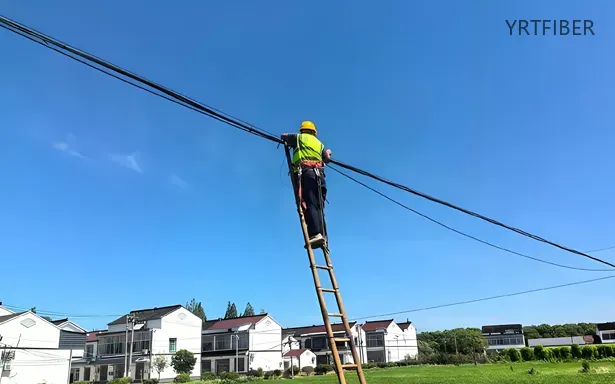
Aerial installation: Suitable for lashed or duct‑mounted aerial use. Maintain proper sag and clearance from power lines.
Storage & handling: Keep cable ends sealed to prevent moisture ingress. Do not step on or crush the cable.
Temperature range: Installation: -10℃ to +60℃; Operation: -40℃ to +70℃.
Télécharger le catalogue de produits YRTFIBER
Prise de vue réelle d'usine
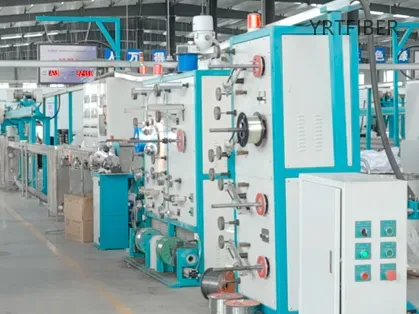
1. Factory Optical Cable Production Workshop
The workshop features an integrated production line covering fiber coloring, secondary sheathing, cable stranding, and double‑layer jacket extrusion. It is clearly divided into dedicated zones: fiber coloring area, loose tube extrusion area, cable stranding area, armored jacket area, and testing & packaging area.
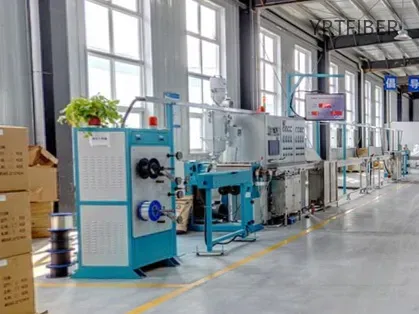
2. Delivery Time
Custom orders are scheduled and executed strictly according to the contract. A dedicated person is assigned to follow up on each order and ensure on‑time delivery as agreed.
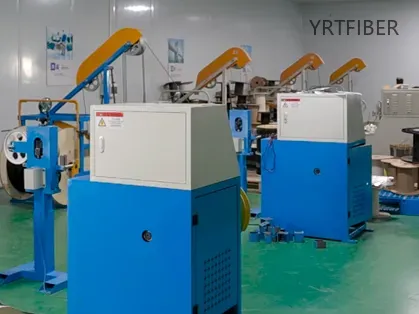
3. Production Line Stability
Spare extruder heads and dual‑station pay‑off racks guarantee uninterrupted production during specification changes or maintenance. Key consumables (steel tape, PE materials, water‑blocking compounds) are monitored by online automatic alerts that remind operators when stock levels run low.
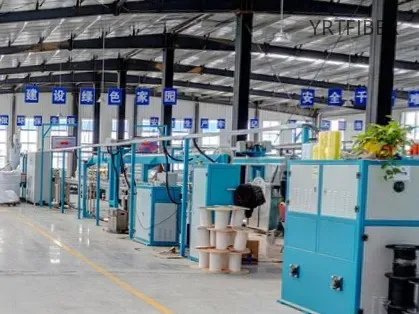
4. OEM / ODM
Customization is available based on customer drawings or samples, including jacket color, print content, spool size, and packaging method. Neutral packaging (no factory logo), customer brand labeling, and custom film wrapping printing are all supported. For ODM services, engineers coordinate the entire process from structural design and material selection to sample production.
Foire aux questions et enquête rapide
GYFTY Non-Metallic Fiber Optic Cable FAQ
1. Qu'est-ce qui différencie GYFTY des câbles blindés comme GYTS ou GYTA?
GYFTY est un câble à fibre optique non-metallic et non blindé, qui utilise du fil d'aramide pour sa résistance à la traction au lieu d'un blindage en acier ou en aluminium. Cela le rend lightweight, diélectrique et résistant aux interférences électromagnétiques (EMI) - idéal à proximité des lignes électriques ou dans les zones bruyantes.
2. Ce câble convient-il pour une installation aérienne ou de conduit?
Oui. GYFTY est couramment utilisé dans les déploiements aériens overhead ou les installations de conduits où les éléments métalliques ne sont pas autorisés. Il n'est pas recommandé pour un enfouissement direct sans conduit en raison de son manque de blindage.
3. Quelle est la capacité du cœur de fibre de ce câble?
Le câble GYFTY prend en charge 2 à 288 cœurs de fibres monomodes G.652D ou G.655, offrant une flexibilité pour le déploiement du réseau dorsal, métropolitain ou d'accès.
4. La conception entièrement diélectrique améliore-t-elle la sécurité ou les performances?
Absolument. La construction all-dielectric garantit que le câble est non-conductive, ce qui améliore considérablement la sécurité dans les zones high-voltage ou sujettes à la foudre. Cela élimine également le risque de boucles de terre ou de conduction électrique à travers le câble.
5. Quels sont les cas d'utilisation idéaux pour le câble GYFTY?
GYFTY est mieux utilisé dans :
CouloirsHigh-voltage ou itinéraires de lignes électriques
Réseaux télécoms aériens
EMI-sensitive environnements (par exemple, sous-stations)
Déploiements FTTx et longue durée sans métal
Envoyez votre demande
Remplissez le formulaire ci-dessous et nous vous répondrons dans les 24 heures.


