

 English
 Português
 لالعربية
 Русский
 Bahasa Indonesia
 Français
 Türkçe
 Bahasa Melayu

The customer's specification sheet is just one page, with 14 lines of parameters. It has two places where the clauses conflict with each other, and four things it doesn't mention at all—two of which directly affect how many units can be loaded per container and the delivery lead time.
What follows is not a claim that we met every requirement. It is a record of how each of those points was handled, including one sheath decision we got wrong in the first quotation and changed.
The following are the requirements for the client's project:
Type : Monomode G.652.D
Diamètre du cœur : 8.6 - 9.2 µm
Diamètre de la gaine : 125 µm ± 1 µm
Diamètre du revêtement primaire : 245 ± 10 µm
Atténuation maximale :
≤ 0.35 dB/km à 1310 nm
≤ 0.22 dB/km à 1550 nm
Bande de transmission : 1260 nm - 1625 nm
Dispersion chromatique : ≤ 3.5 ps/(nm·km) à 1310 nm ; ≤ 18 ps/(nm·km) à 1550 nm
PMD (Polarization Mode Dispersion) : ≤ 0.2 ps/√km
Nombre total de fibres : 144 et 288 brins
Structure : Tube libre (Loose tube) ou structure centrale tubée (Central Tube) selon l'usage
Nombre de tubes : 12 tubes × 12 fibres chacun et 24 tubes × 12 fibres chacun
Matériau du tube : PBT
Remplissage : Gel hydrofuge ou équivalent pour protection contre l'humidité
élément de renfort : FRP ou acier galvanisé
Gaine intérieure : PE noire anti-UV
Gaine extérieure : PEHD anti-rongeurs et résistante aux UV
Résistance à l'écrasement : ≥ 2000 N/10 cm
Résistance à la traction : ≥ 1500 N
Rayon de courbure : ≥ 20 × D (installation), ≥ 10 × D (en service)
Température de fonctionnement : -40 °C à +70 °C
Longueur touret : 4000 ml
Marquage : Identification métrique tous les 1 mètre, XXXX - type de câble - année de fabrication - Métrique - numéro de lot
Exemple : XXXXX-G652D-2025-1200ml-XXX
Les câbles et fibres optiques doivent être conformes aux normes suivantes :
ITU-T G.652.D
IEC 60793-1. IEC 60794-1
ISO/IEC 11801
EN 50173
RoHS et CE
Project passport (Simplified version)
1. What the customer asked, and what we answered
The left column quotes the French original so the customer can check it clause by clause. ⚠️ marks a point needing clarification, 🔧 a value we tightened on our own initiative, 📌 something we added.
A note on ml. The customer's 4000 ml does not mean millilitres — it is mètre linéaire, linear metres. The abbreviation appears twice in the original, with two different meanings: 4000 ml in the drum-length clause is the full drum length, while 1200 ml in the marking example is the metre mark at the 1.200-metre point, not a drum length. Machine translation renders both as "millilitres", and that misreading is common enough that we wrote both meanings into our technical response — otherwise it becomes an argument at acceptance.
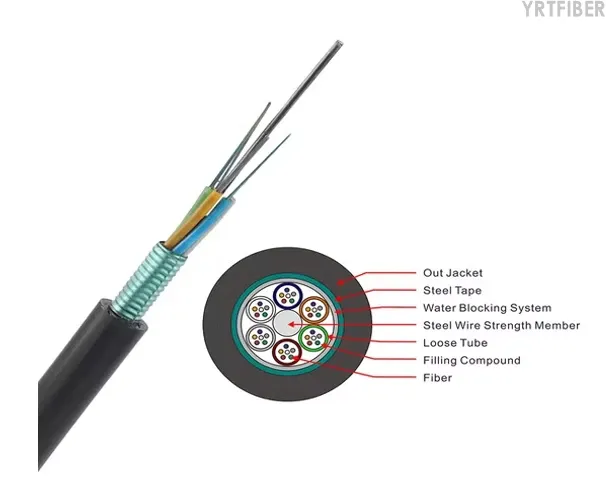
2. The designation says gyts. The construction clause allows central tube.
Structure : Tube libre ou structure centrale tubée selon l'usage. The customer specifies GYTS by name in the type field, then permits a central-tube construction in the structure field.
Both cannot be true. GYTS is defined in the YD/T 901 family as stranded loose tube + corrugated steel tape armour + PE outer sheath. Central tube is a different designation altogether (GYXTW, GYXTS and similar), with different mechanics, different bend behaviour, and no compatibility of type code.
We quoted GYTS and raised the conflict as a separate line item, asking the customer to confirm whether the type code or the construction clause takes precedence. We did not make that call for them — a wrong type code on the drum is a customs problem and an acceptance problem at the same time.
This is the only place in the whole specification where we asked the customer to change their own document.
3. Why 288F is 24 × 12 — and how that reaches the container count
The customer gave two fibre counts, 144F and 288F, and only two tube arrangements, 12×12 and 24×12. It looks like a stranding choice. It ends up as a logistics number.
The 144F drum is also 4.000 m, at roughly 780 kg, which gives 32 drums per container,In reality, it can only hold about 20 to 23 disks. — about 81-93 km.
This is the part of the project that is easiest to miss. The tender is written in kilometres; the shipment is priced in containers. Within one project, 144F and 288F do not have the same freight cost per kilometre. We put that into the quotation notes, which is more useful than explaining it after the cable reaches port.
On fibres per tube: at the same 288F, putting 24 fibres in each tube means thicker tube walls and a larger tube OD, so the stranded cable gets bigger and the drum gets heavier. At a fixed fibre count, tube count and fibres-per-tube trade off against each other — fewer tubes is not automatically better. 24×12 is where cable diameter and bend performance balance for this project, and it is what we quoted.
4. Four things the specification does not say
None of these four appear in the customer's document. We filled them in the technical response and asked for confirmation rather than waiting for an addendum — two of them change the delivery schedule.
1. Tensile is given as a single number. The original says ≥ 1500 N. It does not separate short-term from long-term, and it does not state the fibre strain permitted during loading. Those two numbers determine the strength-member cross-section and the sheath thickness, so "quote 1.500 N and move on" is not an option. We answered 1.500 N short-term / 600 N long-term, with a fibre strain limit of 0.15% under load.
2. "Moisture protection" has no pass criterion. The original says Gel hydrofuge ou équivalent and stops there — no test method, no acceptance limit. Testing to IEC 60794-1-22-F5 (1 m water column, 3 m sample, 24 h, no leakage) is industry practice, but industry practice is not a contract clause, and the customer can table a different method at acceptance. So we wrote the method into the response.
3. Drum specification is not stated — and this one blocks container loading. A 4.000 m 288F cable needs a large barrel. Too small a barrel and the cable sits on the drum at a bend tighter than the ≥20 × D installation radius the same document requires; a large barrel increases the outside diameter of the whole drum, which changes how many fit in a 40HQ. Drum specification and container count are one problem, not two.
4. Acceptance method is not stated. Factory acceptance, sampling on arrival, or third-party witness — three different scopes of testing and three different lead times. We quoted factory acceptance + sampling on arrival; third-party witness adds 7 working days.
5. A 110 K temperature window, and the compound it forces
The requirement is -40 °C à +70 °C. That is a 110 K span.
Extreme low temperature in Cameroon does not reach −40 °C. The figure most likely comes from the European standards template behind the document — the same page cites EN 50173 and ISO/IEC 11801. both European cabling standards. We did not argue the point. Meeting it costs a limited amount, so we met it. But we put the cost into the technical response so the customer knows what they are paying for.
The cost lands on the filling compound.
A 24-tube core has a lot of void. Conventional compound thickens noticeably at low temperature, the relative movement between tubes and sheath is restricted during a −40 °C bend, and that shows up directly as low-temperature excess attenuation. So this project uses a low-temperature compound, tested to IEC 60794-1-22-F1 over two cycles from −40 to +70 °C, with excess attenuation ≤ 0.05 dB/km.
The other side of that trade is drip. Soften the compound and the margin at +70 °C falls. We ran a compound-flow test on the same samples; result excellent.
Low-temperature flexibility and high-temperature non-drip are opposing requirements. You find a window; you do not take both extremes. That sentence went into the technical note to the customer, and it is also why we do not simply write "fully compliant from −40 to +70 °C".
6. The steel tape already stops rodents. What is the repellent for?
GYTS has double corrugated steel tape armour. That is a physical barrier — rodents do not chew through it. It is why the customer named GYTS in the first place, and it is the core value of this construction over unarmoured duct cable.
The customer then added anti-rongeurs to the outer sheath. The two are not redundant, but their priority is very different:
The steel tape carries almost all of the protection. That comes from the construction and does not decay with time.
The chemical repellent only matters in three places: the tape overlap, areas where the sheath is scored during installation, and the transition at each cable end after stripping.
So the additive is worth having, but not at maximum concentration — raise the loading and sheath tensile strength and heat-ageing life fall. That trade does not pay.
The actual construction: modified HDPE base + repellent system, outer sheath nominal 2.0mm.
One more thing we told the customer without being asked: the repellent is slow-release and decays with time and UV exposure. Over a 25-year service life, the steel tape is what still works. That is in the technical proposal document, not just in a sales conversation.
7. The first version — which we replaced ourselves
Our first quotation followed the specification exactly: fully imported additive system in the outer sheath. The safest position, requiring no explanation of any deviation.
Two problems. It priced 5-10% above the second version, and the imported additive carried a 1-2-week lead time against a required delivery ,The second problem mattered more than the first — price is negotiable, a delivery date is not.
So we ran a comparison: same HDPE base, two formulations, heat-aged together at 100°C for 168 h, then measured active-ingredient retention and repellent performance. Result: domestic system retained ≥90%, difference within 3%.
On that basis we moved to the domestic system and spent the saving on 0.2 mm of extra outer sheath thickness.
The logic: trade chemical margin for structural margin. Chemical systems decay; thickness does not. Over 25 years, 0.x mm of extra sheath holds its value better than a higher additive loading.
We should also state what that decision cost. The thicker sheath adds roughly 10-12 kg/km, about 40-45 kg per 288F drum, and 20-23 the number of drums per 40HQ. That is a cost created by our own choice, not by the customer's requirement.
8. What was tested after sampling
The two items marked * — impact and repeated bending — are type tests. They were not repeated on this sample; the figures reference historical data from the same 288F construction platform. Everything else was measured on these samples.
Why there is no photograph of a test report here: the full records, per-drum OTDR traces and attenuation data all exist, but the reports carry the customer's name and the route location. Ask for them by project number and we will send them. This is as far as a public page can go.
9. Delivery:
Shipping documents (buyers tend to care about this more than about photographs — it decides whether customs and acceptance clear in one pass):
Mill Test Certificate, per batch
Per-drum OTDR trace, bidirectional, 1310 / 1550 nm
Drum number — length — attenuation cross-reference
Packing list with gross weight, net weight and outside diameter per drum
RoHS declaration · CE Declaration of Conformity
Lifting instructions: drum centre of gravity, lifting points, no laying on its side
One note on the third item: the final metre mark on each drum, the drum number and the OTDR trace must agree. This is the first thing a receiving inspector checks — a mismatch between the metre mark and the trace at 3.000 m invalidates the whole drum. We cross-check all three per drum before sealing.
10. What this page does not tell you
Customer name, route alignment and contract value are withheld at the customer's request. Not by our preference.
Items marked 【reference】 are taken from fibre datasheets and structural calculation, not from cabled measurements. Cabling changes them slightly through stranding and sheath compression; shipping OTDR governs.
The repellent data is in-house accelerated ageing only, with no third-party certification. If you need a third-party report, give us four weeks' notice and we will arrange it.
Drum weights are calculated from the construction. Final figures follow the process card, within 【TBD】%.
We have no other disclosable projects in Cameroon, so we cannot offer you a local reference. What we can offer is the parameters and records in this file.
11. Timeline
12. Related technical pages
GYTS outdoor cable — full type list and parameter table
Direct-buried cable selection — armour and sheath choice for burial
Duct cable selection — air-blown versus pull-through
Armoured cable selection — steel tape vs steel wire vs double armour
Aerial cable selection — the same construction overhead
13. Three questions actually asked on this project
Q: Can 288F be built as 12 tubes × 24 fibres? A: Technically yes, but 24 fibres per tube means a larger tube OD, which increases stranded cable diameter and drum weight and reduces drums per container. The specification only offered 12×12 and 24×12; we quoted 24×12.
Q: Can the 4.000 m drum be changed to 2.000 m? A: Yes, and it halves drum weight, which makes lifting easier. Two costs: the splice count doubles, and on a long route every splice is a point of attenuation and failure; and the drum count doubles, complicating container loading and on-site drum handling. Unless the site road or lifting equipment rules it out, we do not recommend it.
Q: Is 1.500 N enough tensile for 288F? A: As a short-term figure it is adequate. But the specification gives no long-term value and no permitted fibre strain. We answered 1.500 N short-term / 600 N long-term and stated the strain limit under load — those two numbers say far more about whether the cable survives pulling than the single 1.500 N does.
Technical parameters reviewed by Anna, Engineering (Anna is an industry expert with 15 years of technical experience in the fiber optic cable industry, having served more than a thousand fiber optic cable projects around the world over the past 15 years.). For questions on parameters, processes or alternatives, contact email : [email protected] / WhatsApp: +8615099905597.


