

 Español
 Português
 لالعربية
 Русский
 Bahasa Indonesia
 Français
 Türkçe
 Bahasa Melayu

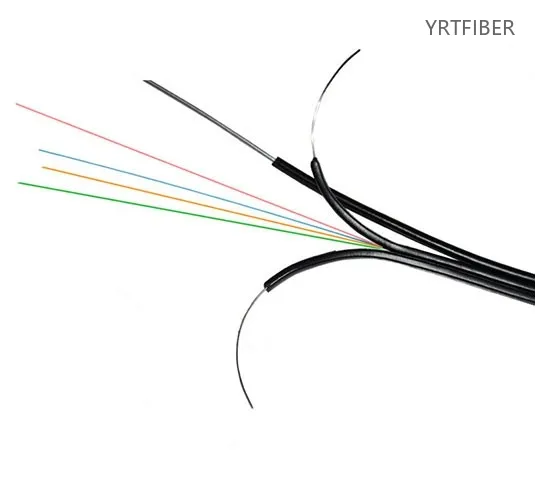
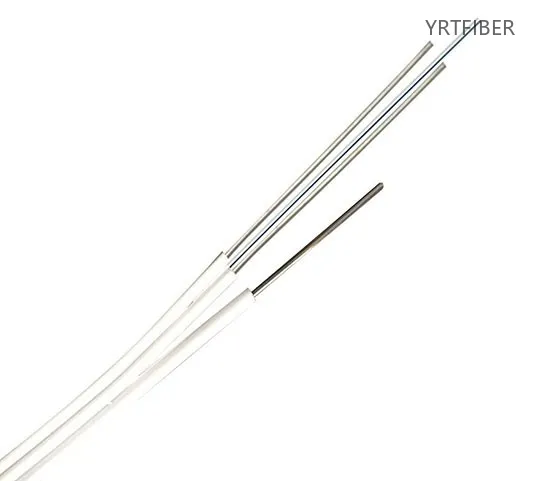
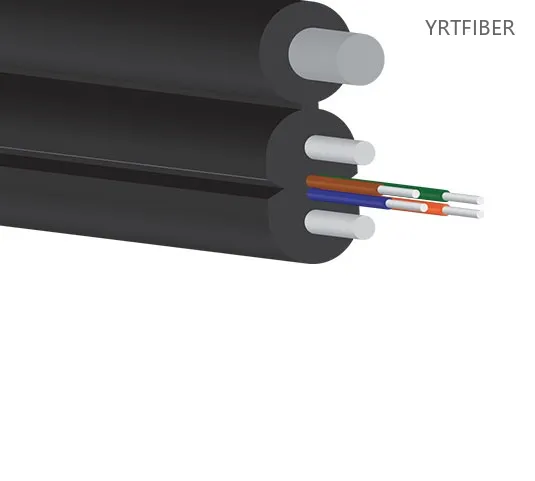
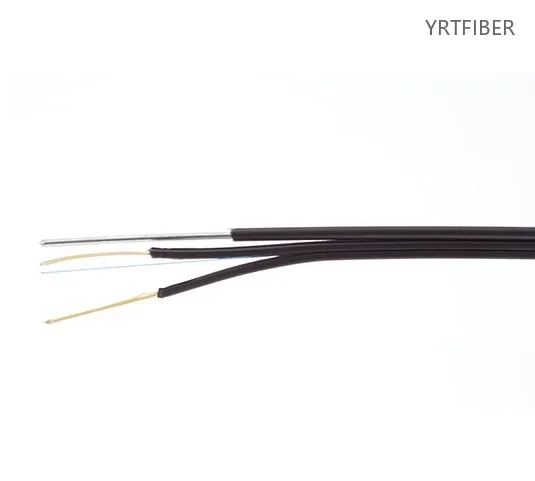
GJYXCH Self-Supporting FTTH Drop Cable – Steel Wire Strength Member, 1/2/4 Core, G652D/G657A
Self-supporting structure with steel wire enhances aerial suspension strength.
Available in 1-core, 2-core, and 4-core configurations.
G652D and G657A fibers support long-distance and tight bending applications.
Flame-retardant, UV-resistant, and waterproof outer jacket for outdoor environments.
Lightweight, compact, and easy to install or pull through conduits.
What is GJYXCH Self‑Supporting FTTH Drop Cable?
The GJYXCH self‑supporting FTTH drop cable is an aerial drop cable specifically engineered for fiber‑to‑the‑home (FTTH) networks. Its defining feature is an integrated steel wire strength member that gives the cable true self‑supporting capability, meaning it can be suspended directly between poles or buildings without requiring a separate messenger wire. This design greatly simplifies aerial installation and reduces hardware costs.
The cable is available in 1‑core, 2‑core, and 4‑core configurations, using G.652D or G.657A single‑mode fibers. G.652D ensures stable high‑speed transmission over longer distances, while G.657A provides excellent bend resistance for tight‑radius routing inside homes or near termination points. The outer jacket is flame‑retardant, UV‑resistant, and waterproof, making it suitable for prolonged outdoor exposure. Lightweight and compact, the GJYXCH is also easy to pull through conduits when underground sections are needed, offering a versatile solution for last‑mile aerial FTTH deployments.
GJYXCH Self-Supporting FTTH Drop Cable Specification parameters
- Specification parameters
- OPTICAL CHARACTERISTICS
| Fiber Core | 1 | 2 | 4 |
| Cable Dimension (mm) | (2.0±0.1) × (5.2±0.1) | (2.0±0.1) × (5.2±0.1) | (2.0±0.1) × (5.2±0.1) |
| Cable Weight (kg/km) | 20 | 20.5 | 22 |
| Tensile Strength (N) Long term | 300 | ||
| Tensile Strength (N) Short term | 600 | ||
| Crush(N/100mm) Long term | 2200 | ||
| Crush(N/100mm) Short term | 1000 | ||
| Bend Radius (mm) Static | 15 | ||
| Bend Radius (mm) Dynamic | 30 | ||
| Cable Cut-off Wavelength | ≤1260nm | ||
| Attenuation(+20℃)@1310nm | ≤0.45 dB/km | ||
| Attenuation(+20℃)@1550nm | ≤0.30 dB/km | ||
| Trans/Storage/Operating Temperature | -20℃~+60℃ | ||
| Installation Temperature | -5℃~+50℃ | ||
| Out sheath/Jacket | LSZH or PVC | ||
Note: 1. The cable dimension and weight are in accordance with tight-buffered fiber with 0.9mm outer diameter; 2. Cable dimension refers to the overall height and width of the self-supporting drop cable structure. 3. The minimum bend radius (static) is 5H when G657 fiber is used. | |||
Product Structure & Composition
Fiber Types
G652D and G657A single-mode
Strength Member
Galvanized steel wire or FRP (optional)
Jacket Material
LSZH, PE, or PVC available as needed
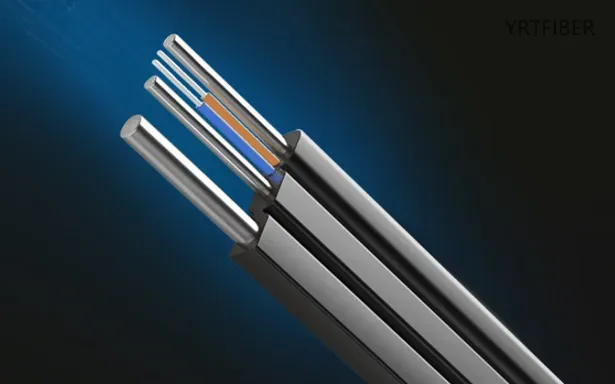
Benefits of GJYXCH Self-Supporting FTTH Drop Cable
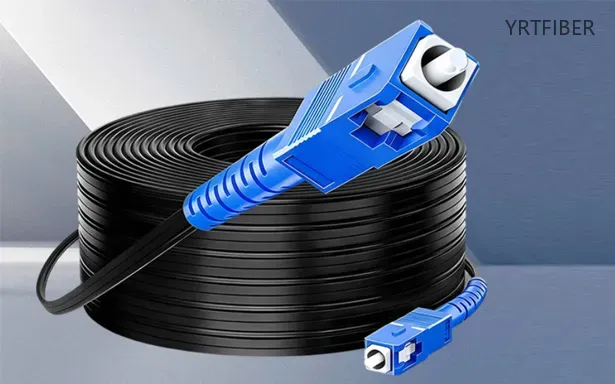
Enhanced Self-Supporting Steel Strand Structure
Self-supporting structure with steel strands enhances aerial suspension strength.
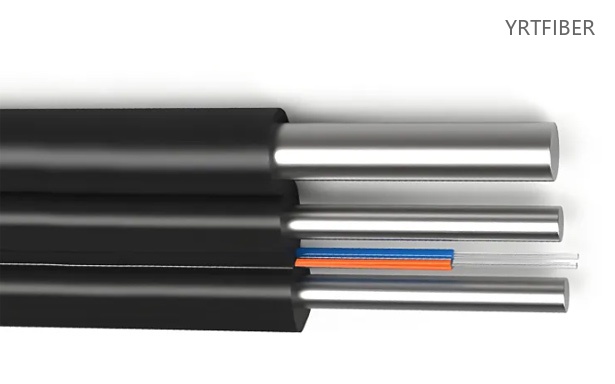
Long-Distance and Bend-Insensitive Fiber Options
G652D and G657A fibers support long-distance transmission and tight bending applications.
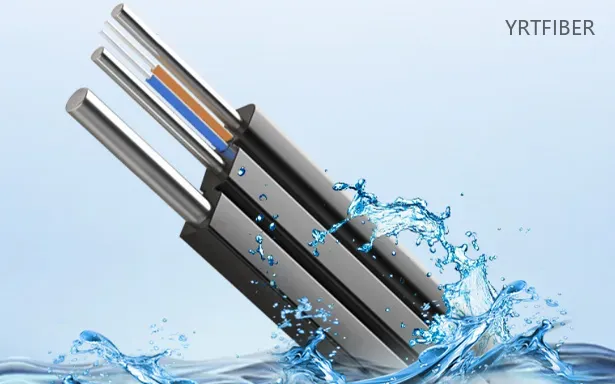
Weatherproof, Flame-Retardant, and Waterproof Outer Jacket
Flame-retardant, UV-resistant, and waterproof outer jacket suitable for outdoor environments.
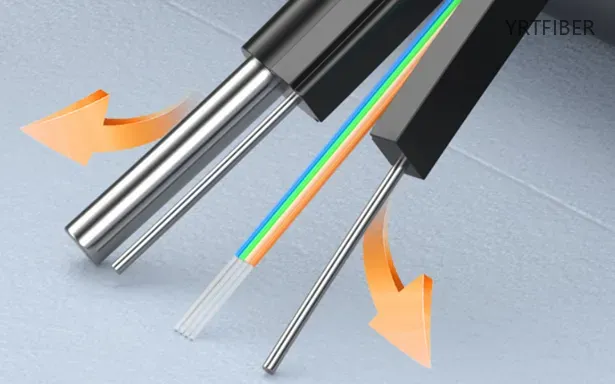
Lightweight and Compact Design
Lightweight, compact design that is easy to install or pull through conduits.
Engineering Applications GJYXCH Self-Supporting FTTH Drop Cable
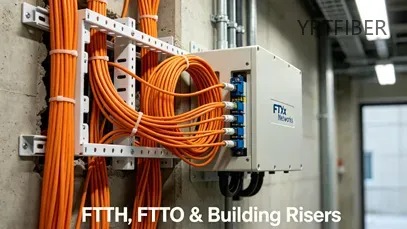
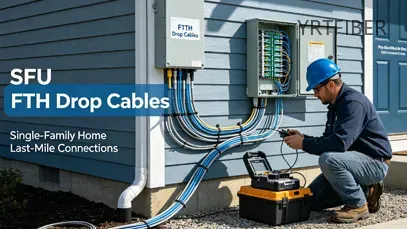
Aerial FTTH Drop Connection
The GJYXCH is primarily used as the final aerial drop from a pole-mounted MST to a home or small business. Its integrated steel messenger eliminates separate lashing wires, saving material and labor. UV-resistant and waterproof jacket ensures outdoor durability, while G.657A fiber handles tight bends at building entry.
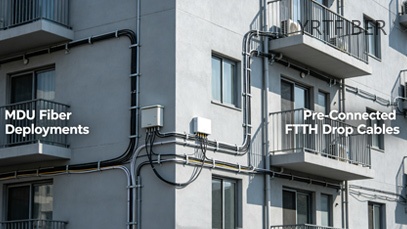
MDU Façade and Riser Cabling
In MDUs, GJYXCH runs vertically along building façades or from pole to rooftop boxes, then fans out to individual units. Lightweight and self-supporting, it avoids sagging. Flame-retardant sheathing meets fire codes, and bend-insensitive fiber navigates exterior obstacles like eaves and windows.
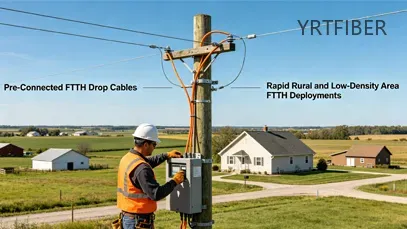
Rural Aerial Broadband
For rural areas where trenching is costly, GJYXCH offers economical aerial deployment on existing poles over 50-100m spans. Its steel strength member resists wind/ice loads. Available in 2-4 cores for future upgrades, and waterproof construction prevents moisture ingress, ensuring reliable high-speed transmission.
Indoor/Outdoor Transition
Though aerial-focused, GJYXCH can be pushed through short conduits or wall penetrations. Its compact jacket and G.657A fiber allow tight-radius bends inside premises without splicing, simplifying entry and improving long-term reliability.
Shipping & Packaging
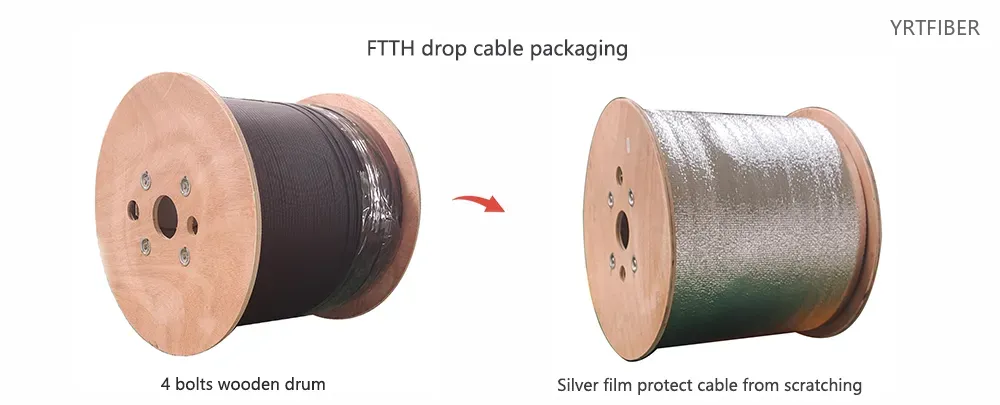
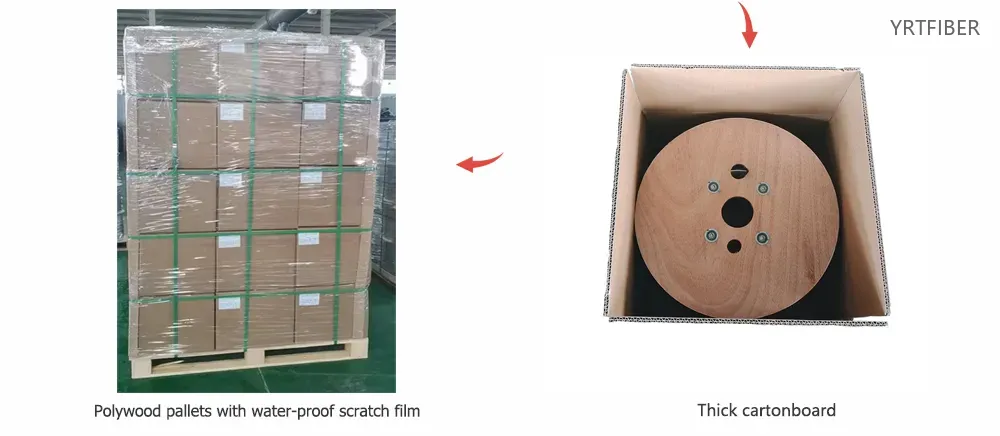
Packaging Details
Each roll contains 1–5 KM of cable, typically packed in steel drums. Customized packaging solutions are available upon client request.
Sheath Marking
White hot foil indentation is applied at 1-meter intervals with the following information:
a. Supplier name: YRTFIBER(or as specified by the customer)
b. Standard code including product type, fiber type, and fiber count
c. Year of manufacture (valid for 7 years)
d. Length indication in meters
Port of Shipment
Available ports: Qingdao, Guangzhou, Shenzhen
Estimated Lead Time
| Quantity (KM) | Estimated Delivery Time |
|---|---|
| 1–300 | Approx. 15 days |
| ≥300 | Delivery time to be negotiated |
Note
The packaging details above are for reference only. Final packing size and weight will be confirmed before shipment.
Product Comparison:
GJYXCH vs GJXH
| Contrast dimensions | GJYXCH self-supporting butterfly introduction optical cable | GJXH indoor butterfly introduction optical cable |
|---|---|---|
| Structure and core features | additional steel wire (or steel wire rope) is added on the outside of the GJXH optical cable as a reinforcement suspension wire, forming a self-supporting "figure-8" structure that can bear weight in the air without the need for additional suspension wires. It comes with a built-in metal suspension wire and can withstand a 50-meter flying span pulling device . | The basic form of butterfly (leather cable) optical cables is that the fiber is located at the center, with two parallel reinforcement pieces placed on both sides, then extruded into LSZH sheaths to form the forming. The structure is simple and flat. No built-in suspension wire, and does not have self-supporting overhead capability. If used outdoors, it must be installed on a channel or an existing pole . |
| Typical application scenarios | Outdoor self-supporting overhead access (last 1 kilometer), direct installation along building exterior walls, short-distance flying spans between towers (typical span <50 meters), and outdoor introduction segments of the FTTH network. | Entire indoor environment: installed in vertical shafts, conduits, cable trays, inside walls, ceilings, cabinets, and other indoor environments. It is classified as a pure indoor optical cable . |
| Tensile strength | Long-term/short-term: 300/600 N integrated steel suspension wires, specially designed to withstand overhead tension and wind load . | Long-term/short-term: 100/200 N tensile strength mainly comes from parallel steel on both sides (wire/FRP) . |
| Minimum bending radius | Static/Dynamic: 15/30 mm G.657A1/A2 bend-insensitive fiber must maintain this radius value in both static (post-installation) and dynamic (installation) conditions | Static/Dynamic: 5H/10H (H is short axis length). At a typical cross-section of 3.0×2.0mm, H=2.0mm, so the static is only 10mm, and the dynamic is 20mm. Features flexible design, suitable for indoor scenarios with frequent bending. |
| Reinforced components | Parallel reinforcement on both sides (steel wire or FRP) + special steel suspension wire on the outside. | It consists only of two parallel reinforcement pieces on both sides, and the material can be steel wire or FRP (non-metallic reinforced core) |
| Outer sheath material | LSZH (Low Smoke Halogen-Free Flame Retardancy), PE can be optionally used for long-term outdoor UV exposure; Meet environmental protection and safety requirements | LSZH (Low Smoke Halogen-Free Flame Retardancy), specifically designed for indoor fire safety . |
| Core count range | 1, 2, and 4-core. | 1, 2, 4, 6, 8, and 12 cores . |
| Flattening force (long-term/short-term). | 1000/2200 N/100mm dual reinforcement + suspension wire provides excellent compression protection for fiber | The optical performance of 1000/2200 N/100mm is comparable to GJYXCH, but the sheath is thinner . |
| Operation/installation temperature | Operating temperature: -20~+60°C; Installation: -5~+50°C (recommended), suitable for temperature zone coverage engineering installation scenarios . | Operating temperature: -20~+60°C; Installation: 0~+50°C (recommended) fully meets typical indoor temperate climate conditions . |
| Reference weight for optical cables | 1-2 cores about 20-21 kg/km; 4-core about 21 kg/km . | 1-4 cores are about 8-11 kg/km (slight differences depending on sheath material) . |
| Relative cost | Moderate (materials and high tensile structure determine cost) . | Low (simple structure, low material consumption, suitable for large-scale indoor installation) . |
| Summary of key points for model selection | Strong tensile strength, built-in suspension wire, strong rigidity, specially designed for outdoor overhead structures. | Lightweight and soft, with an extremely small bending radius, compact and economical, suitable for indoor use only. |
GJYXCH Self-Supporting FTTH Drop Cable Selection Guide
Please select the type of optical cable according to the actual laying path and environment, and do not use indoor optical cables as a substitute for outdoor aerial-specific models.
1. When the optical cable needs to pass through outdoor aerial routes
(such as pole towers and installation along exterior walls), be sure to choose GJYXCH.
Its built-in steel messenger wire can bear the entire aerial tension (600N short-term tensile strength). Indoor optical cable GJXH has a risk of breaking under outdoor wind load.
GJYXCH comes pre-integrated with a steel messenger wire, so there is no need for additional binding of steel ropes, making on-site aerial installation highly efficient.
For environments exposed to UV aging, its PE outer sheath option is more robust and weather-resistant, ensuring an outdoor service life of over 20 years.
2. When the optical cable is laid entirely indoors, choose GJXH.
Its soft and lightweight structure, extremely small bending radius (about 10mm for static 5H), and low-smoke, halogen-free, environmentally friendly characteristics make it fully suitable for tight spaces such as ceilings and cabinets.
Economical in price and very lightweight, it is suitable for large-scale FTTH gigabit deployments to homes. There are no issues when deployed inside ducts or vertical shafts.
3. Special mixed scenarios:
When the optical cable mainly enters the building exterior walls and passes through both outdoor and indoor sections: it is recommended to choose GJYXCH. With its high tensile strength and weather resistance, it allows a seamless one-step entry indoors, avoiding the joint attenuation at outdoor building transition boxes.
Installation Instructions for GJYXCH Self‑Supporting FTTH Drop Cable (Indoor Use)
Handling - Do not twist or kink the cable. Keep the bending radius ≥ 30 mm during installation.
Routing - Use the integrated steel wire messenger for self‑supporting spans. For indoor runs, secure the cable with clips every 0.5–1 m.
Pulling - Pull only by the strength member (steel wire), not by the sheath or optical fiber. Maximum tensile load: 150 N (short term).
Bending - Avoid sharp bends. Minimum dynamic bending radius: 30 mm; static: 15 mm.
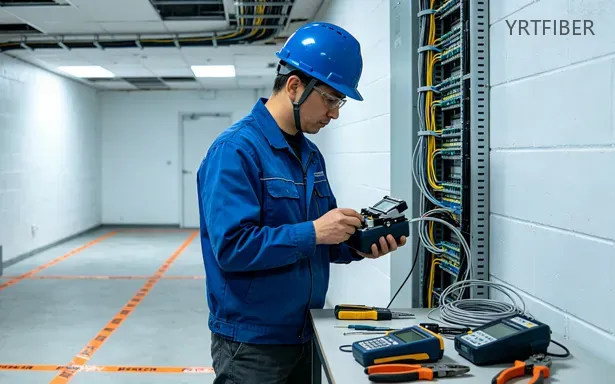
Termination - Strip carefully using a mid‑span or end‑access tool. Do not expose the fiber to excessive force. Clean and inspect connectors before mating.
Safety - Keep away from heat sources, sharp edges, and chemical solvents.
Note - For outdoor-to‑indoor transitions, use a proper drip loop and seal the entry point to prevent moisture ingress.
Download YRTFIBER Product Catalog
Factory Real Shot
1. Smart Manufacturing Base with Massive Production Capacity
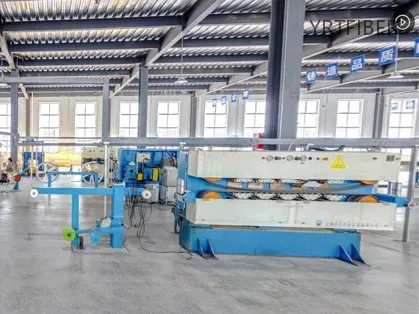
YRT Communication Technology is situated in Puyang, Henan Province, spanning over 60 acres of industrial facilities. The factory operates with an annual output value of RMB 100 million and employs more than 230 skilled technicians and engineers. With an extensive cable production experience of over 150,000 km and annual patch cord production exceeding 10 million pieces, the facility solidifies its position as a leading manufacturer of high-performance FTTH drop cables.
2. High-Efficiency Automated Production Lines
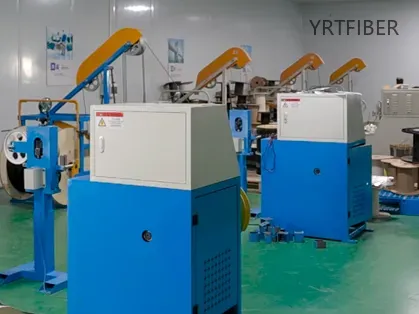
The facility is equipped with 21 professional production lines, including 7 dedicated butterfly cable lines and 8 jumper cable lines. These modern production platforms are capable of manufacturing FTTH drop cables such as GJYXCH, GJXH, GJXFH as well as outdoor and indoor optical cables. Advanced extrusion and controlling equipment ensures consistent dimensional quality, stable process speeds, and excellent surface finishes for the final cable sheathing. The dust-free workshop environment and high-performance processing machinery guarantee stable, reliable manufacturing all year round.
3. Strict Quality Control and Comprehensive Testing System
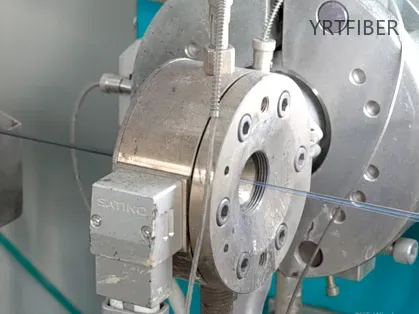
YRT has established a complete and rigorous quality management chain, covering raw material inspection, in-process monitoring, and final product validation. The test center is furnished with the latest optical, mechanical, and environmental testing instruments to ensure precise and reliable cable performance. Each batch of cables is systematically tested for mechanical strength, environmental durability, and optical transmission characteristics to fully meet international standards.
4. Certified Management System and Global Supply Capability
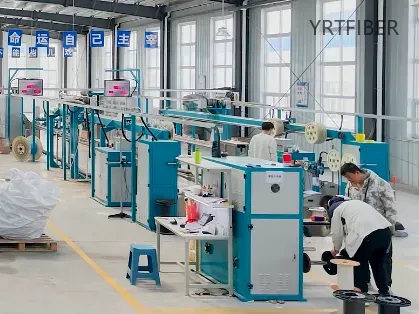
The company has obtained ISO9001, ISO14001, and ISO45001 management system certifications, demonstrating its excellent control over quality, environment, and occupational health. Thanks to the integrated vertical supply chain and large-scale production capacity, YRT is able to offer fast delivery lead times and flexible packaging solutions to customers worldwide. With the combination of high-quality raw materials, automated machinery, and dedicated workers, the factory ensures that every meter of fiber optic cable meets the highest industry expectations.
Frequently Asked Questions & Quick Inquiry
GJYXCH Self-Supporting FTTH Drop Cable FAQ
Q2: What fiber counts are available?
A2: 1-core, 2-core, and 4-core options are offered.
Q3: What fiber types are used?
A3: G652D and G657A single-mode fibers.
Q4: Is the cable suitable for outdoor use?
A4: Yes, it's UV-resistant, flame-retardant, and waterproof.
Q5: Where can this cable be applied?
A5: In FTTH networks, aerial drop wiring, and rural broadband projects.
Send Your Inquiry
Fill out the form below and we'll get back to you within 24 hours.


