

 Español
 Português
 لالعربية
 Русский
 Bahasa Indonesia
 Français
 Türkçe
 Bahasa Melayu

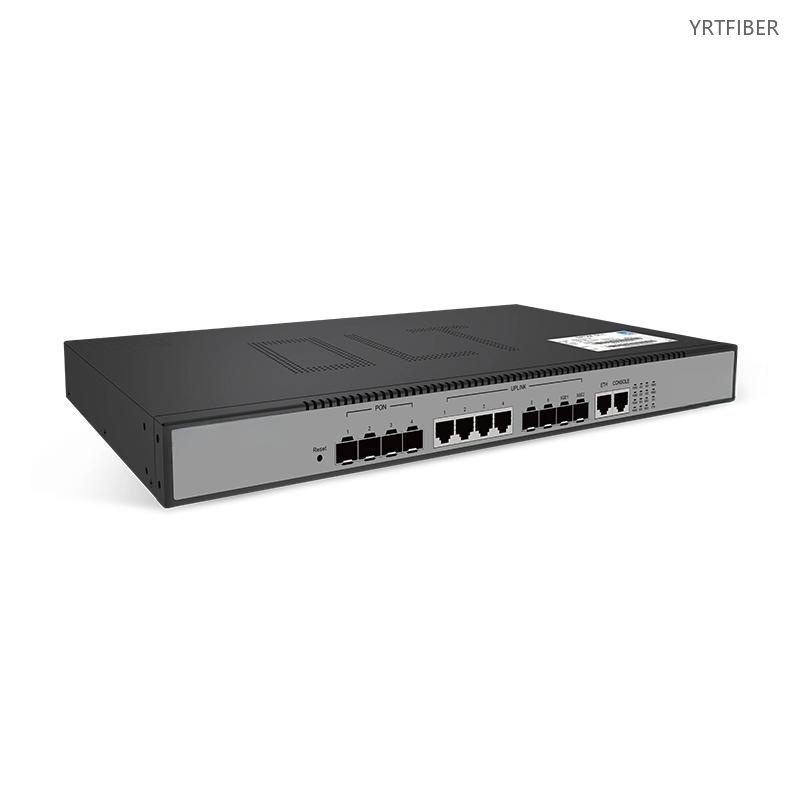
4-Port GPON OLT 1U – Supports 512 ONUs with 4×10G SFP+ Uplinks for FTTH Networks
Compact 1U chassis, suitable for central offices, wiring closets, and outdoor cabinets.
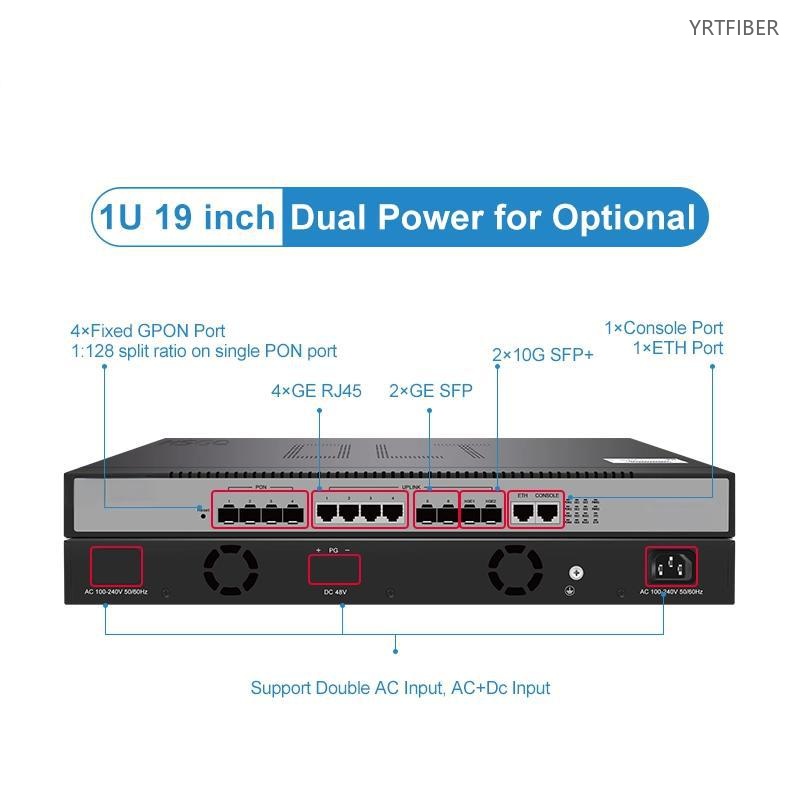
4 GPON downlink ports, max split ratio 1:128. supporting up to 512 ONUs per device.
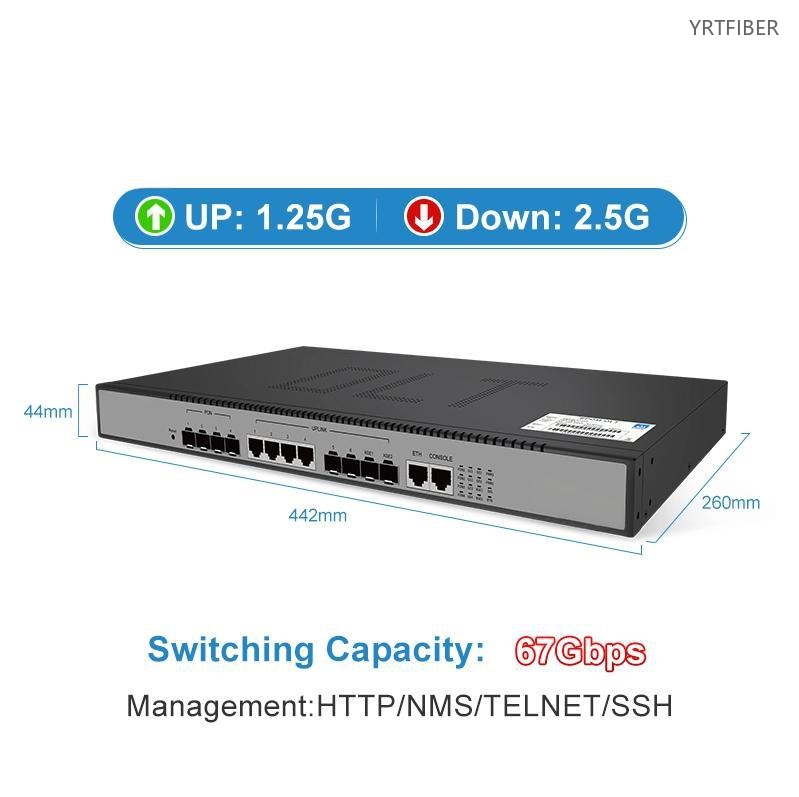
GPON speeds: 1.244 Gbps upstream / 2.488 Gbps downstream.
Flexible uplink interfaces: 4×GE RJ45 + 4×10G SFP+ (compatible with GE SFP).
Comprehensive L2/L3 routing protocols and IPv6 support.
Multiple management options (CLI, WEB, SNMP, Telnet, SSH, NMS).
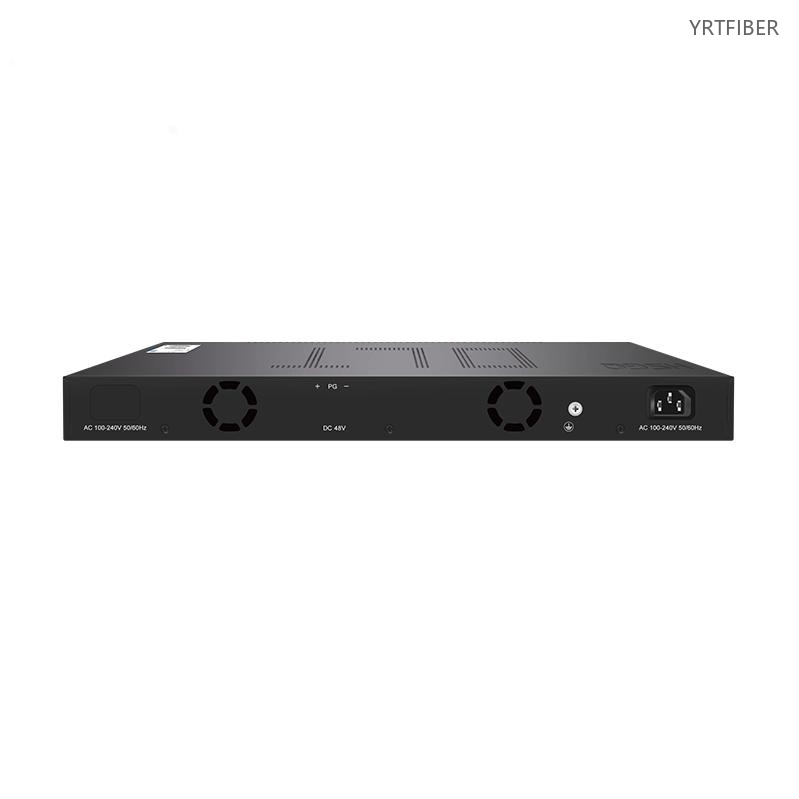
Redundant power supplies (AC+AC or AC+DC) for high reliability.
Full QoS, security authentication, VLAN, and traffic control features.
Supports ONU auto‑discovery, auto‑configuration, and remote batch firmware upgrades.
What is a 4‑Port GPON OLT 1U?
The 4‑Port GPON OLT 1U is a compact, high‑performance optical line terminal designed for fiber‑to‑the‑home (FTTH) and FTTx access networks. Housed in a 1U 19‑inch rack‑mountable chassis, it provides four GPON downlink ports – each supporting up to 1:128 split ratios – along with multiple Gigabit and 10‑gigabit uplink interfaces for flexible upstream connectivity. Compliant with ITU‑T G.984/G.988 standards, it offers rich Layer 2/Layer 3 switching capabilities, comprehensive QoS, and robust security features. The device supports up to 512 ONUs, making it an ideal solution for small to medium‑sized ISPs, campus networks, enterprise access, and remote or cost‑sensitive deployment scenarios where reliable, high‑speed broadband access is required.
4-Port GPON OLT Specification parameters
- Specification parameters
- OPTICAL CHARACTERISTICS
| PON Features | Details |
|---|---|
| Authentication & Management | SN / SN+Password / LOID / LOID+Password / LOID+LOID Password authentication modes |
| DBA algorithm, particle size 64Kbit/s | |
| Standard OMCI management function | |
| ONU batch software upgrade | |
| PON port optical parameter detection | |
| Auto registration of ONU bound with default profile |
Security Features
| Security Category | Details |
|---|---|
| User Security | Anti-ARP-spoofing; Anti-ARP-flooding; Port isolation; MAC address binding to the port and MAC address filtering |
| Device Security | Support the control layer to prevent a variety of DoS attacks and virus attacks against the CPU; Hierarchical management and password protection of users; SSHv2 Secure Shell; Login security IP via Telnet |
| Network Security | User-based MAC and ARP traffic examination; Restrict ARP traffic of each user and force-out users with abnormal ARP traffic; Dynamic ARP table-based binding; IP+VLAN+MAC+Port binding; L2 to L7 ACL flow filtration on first 80 bytes of user-defined packet; Port-based broadcast/multicast suppression and auto-shutdown of risky ports; DHCP Option 82 and PPPoE+ upload user’s physical location |
Service Features
| Function | Details |
|---|---|
| QoS | Rate-limit to packet sending/receiving speed of port or user-defined flow, with general flow monitor and two-speed tri-color monitor; CAR (Committed Access Rate), Traffic Shaping, and flow statistics; Packet mirroring and redirection of interface or custom flow; Priority marking for ports or custom flows, supporting 802.1p and DSCP-priority remarking; Super queue scheduler for ports or flows, with 8 priority queues and SP, WRR, or SP+WRR scheduling; Congestion avoidance with Tail-Drop and WRED |
| ACL | Standard and extended ACL; Time Range ACL; Flow classification and definition based on source/destination MAC, VLAN, 802.1p, ToS, DiffServ, source/destination IP (IPv4/IPv6), TCP/UDP port, protocol type, etc.; L2–L7 deep packet filtering up to 80 bytes of IP packet head |
| IPv4 | DHCP Relay; DHCP Server; DHCP Snooping; Static Routing |
| Multicast | IGMPv1/v2/v3 Snooping; IGMP Fast Leave; IGMP Proxy |
Maintenance
| Function | Details |
|---|---|
| Network Maintenance | Port real-time, utilization and transmit/receive statistics Powerful WEB GUI Data Logging and RFC 3164 BSD syslog protocol Ping |
| Device Management | Console port, Telnet, SSH management Out-band management SNMPv1/v2 RMON (Remote Monitoring) 1, 2, 3, 9 groups MIB SNTP Fan management |
L2 Features
| Function | Details |
|---|---|
| MAC | MAC Black Hole; Port MAC Limit; 64K MAC (packet exchange chip cache 2MB) |
| VLAN | 4K VLAN entries; Port-based VLAN classification; Uplink VLAN Swap and VLAN Remark |
| Spanning Tree | STP / RSTP / MSTP; Loop detection |
| Port | Support link aggregation; Port mirroring |
| Service Port | Auto configuration of service port by profile; VLAN transparent / tag / stacking / aggregation |
Reliability
| Protection Type | Details |
|---|---|
| Loop Protection | Loopback-detection |
| Link Protection | RSTP / MSTP (recover-time) Link aggregation (recover-time) |
| Device Protection | 1+1 power hot backup |
Product Specification
| Specification | Details |
|---|---|
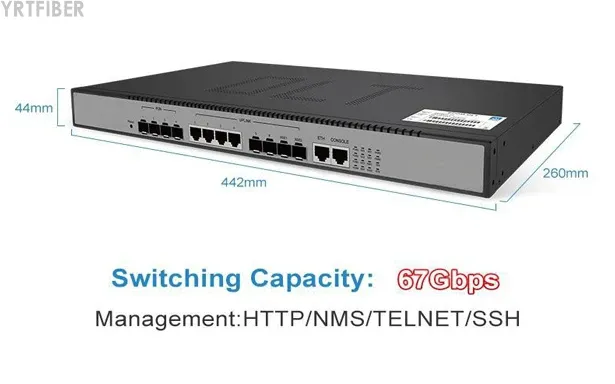
| Switching Capacity | 67Gbps |
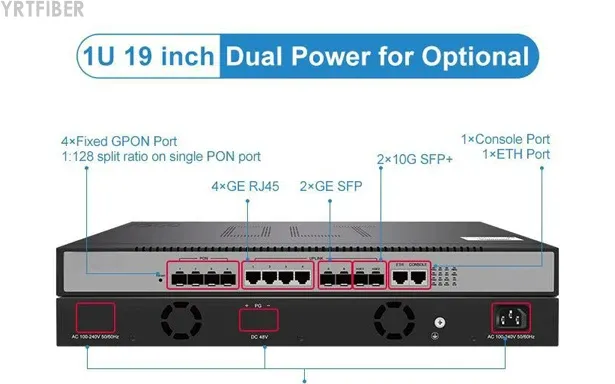
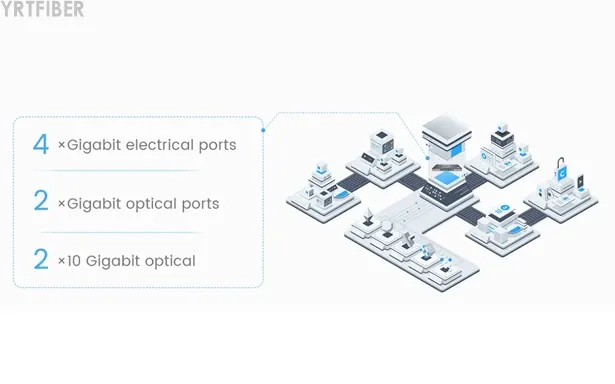
| Service Port | 4*PON port, 4*GE RJ45, 2*GE SFP port, 2*10GE SFP+ port |
| Redundancy Design | Dual power supply Support double AC input, double DC input and AC+DC input |
| Power Supply | AC: input 100~240V 50/60Hz |
| Power Consumption | 50W |
| Dimensions (W × D × H) | 440mm × 44mm × 380mm |
| Weight (Full-Loaded) | ≤5kg |
| Environmental Requirements | Working temperature: -10°C~55°C Storage temperature: -40°C~70°C Relative humidity: 10%~90%, non-condensing |
| Max Transmission Distance | 20km |
| Max Splitting Ratio | 1:128 |
Product Structure & Composition
Chassis and Form Factor
1U high, 19‑inch standard rack‑mount chassis – space‑saving for central offices and compact cabinets.
GPON Downlink Ports
Four GPON ports, each providing 2.488G downstream / 1.244G upstream, supporting up to 1:128 split ratio – serving up to 512 ONUs per device.
Uplink and Management Interfaces
4×GE RJ45 + 4×10G SFP+ (or GE SFP combo) for flexible uplinks; dedicated console and out‑of‑band management ports for local/remote administration.
Power Supply and Cooling
Dual redundant power modules (AC+AC or AC+DC); built‑in active fans ensure reliable operation across various environments.
Benefits of 4-Port GPON OLT
Hardware Design
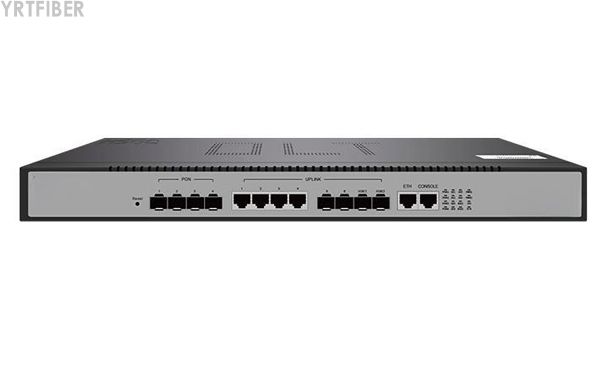
1U 19‑inch rack‑mount chassis, dual redundant power modules (AC+AC or AC+DC) for high availability.
GPON Performance
Four GPON ports – each 2.488G downstream / 1.244G upstream, supporting up to 1:128 split ratio; serves up to 512 ONUs per device (e.g., 128 subscribers at 1:32. 256 at 1:64).
Uplink and Network Features
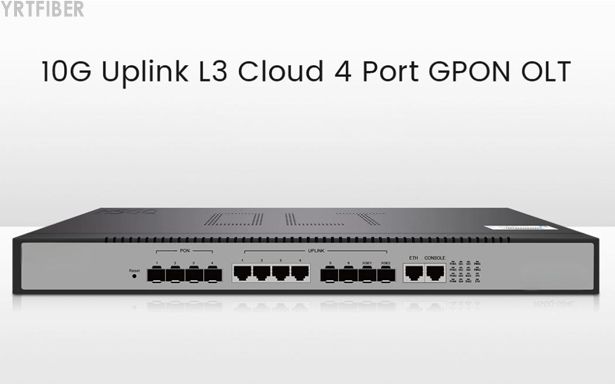
4×GE RJ45 + 4×10G SFP+ (or GE SFP combo) uplinks. Rich L2/L3 capabilities – VLAN (4096), QinQ, LACP, STP/RSTP/MSTP, ERPS, and routing (RIP, OSPF, BGP, IPv6). Comprehensive QoS and DBA for service differentiation (voice, video, data).
Management and Interoperability
ONU auto‑discovery, auto‑configuration, remote batch upgrade. ITU‑T G.984/G.988 compliant – interoperable with multi‑vendor ONUs via OMCI, avoiding vendor lock‑in.
Engineering Applications 4-Port GPON OLT

FTTH and FTTx Access Networks
Ideal for FTTH/FTTx, connecting CO to subscribers via splitters. Compact size and high capacity suit town ISPs, residential clusters, and new developments.

Campus and Enterprise Networks
Provides high‑speed fiber connectivity to buildings/departments; supports triple‑play for unified communications, IP surveillance, and smart buildings.

Remote and Cost‑Sensitive Deployments
Balanced port density, performance, and affordability for remote or cost‑constrained areas. Low power (≤45W) and compact footprint enable small equipment rooms, outdoor cabinets, and FTTM.

Smart City and IoT Infrastructure
Delivers reliable high‑bandwidth connectivity for video surveillance, environmental monitoring, IoT gateways, and distributed public infrastructure.
Shipping & Packaging
Product Comparison:
4‑Port GPON OLT 1U vs. 8‑Port GPON OLT 1U
| Feature / Dimension | 4‑Port GPON OLT 1U | 8‑Port GPON OLT 1U |
|---|---|---|
| GPON Ports | 4 | 8 |
| Maximum ONUs | 512 (128 per port) | 1,024 (128 per port) |
| Typical Subscriber Capacity (1:64 split) | 256 subscribers | 512 subscribers |
| Uplink Ports | 4×GE RJ45 + 4×10G SFP+ | 4×GE RJ45 + 4×10G SFP+ |
| Switching Capacity | ~103 Gbps | 126 Gbps or higher |
| Chassis Height | 1U | 1U |
| Power Consumption | ≤45W | Higher (typically 60‑80W) |
| Typical Applications | Small ISPs, town‑level networks, remote sites, campus edge | Medium ISPs, urban deployments, higher‑density access |
| Cost (Relative) | Lower CAPEX; balanced cost per port | Higher CAPEX; lower cost per subscriber at scale |
| Best For | Initial deployments, distributed nodes, cost‑sensitive projects | Higher‑density urban networks, subscriber growth |
4-Port GPON OLT Selection Guide
How to Choose the Right 4‑Port GPON OLT
Selecting a 4‑port GPON OLT requires careful evaluation of several key factors to ensure it meets your network requirements.
First, assess your subscriber capacity needs. With a 1:32 split ratio, a 4‑port OLT supports up to 128 subscribers; at 1:64, up to 256 subscribers. If you anticipate rapid subscriber growth beyond 500 users, consider whether multiple 4‑port units or an 8‑port OLT would be more cost‑effective in the long term.
Second, evaluate uplink bandwidth requirements. The device offers 4×GE RJ45 and 4×10G SFP+ uplink ports, providing flexibility for connecting to aggregation switches or core routers. Choose the appropriate SFP modules (e.g., 1G or 10G) based on your upstream network capacity.
Third, consider redundancy and reliability. If your network demands high availability, opt for the dual‑power‑supply configuration (AC+AC or AC+DC) to eliminate single points of failure. For less critical deployments, a single power supply may suffice.
Fourth, verify ONU compatibility. The device is interoperable with ONUs from multiple vendors, but it is advisable to confirm compatibility with your existing or planned ONU models to avoid integration issues.
Finally, assess management and operational requirements. The OLT supports CLI, WEB, SNMP, Telnet, and SSH management. Choose the management approach that best fits your team's expertise and network operations workflow.
Installation Instructions
Rack Mounting
Mount the device in a 19‑inch rack using brackets; ensure adequate airflow clearance and secure with four screws. Verify the chassis is level.
Power Connection
Connect power cord(s) to AC/DC inputs. For redundancy, connect both supplies to independent sources. Confirm power LED is on.
Fiber and Uplink Connections
Insert GPON SFP modules and connect fiber cables to splitters. Connect uplink ports (GE RJ45 or 10G SFP+) to upstream network devices using appropriate cables/transceivers.
Management Access Setup
Connect console cable to the management port (Type‑C or RJ45) for initial configuration, or use the management Ethernet port for out‑of‑band access. Configure IP, VLANs, and GPON parameters via CLI or WEB.
ONU Registration and Verification
Verify ONU auto‑discovery and registration via management interface. Monitor connected ONUs, check signal levels, and test connectivity to end‑user equipment to validate deployment.

Download YRTFIBER Product Catalog
Factory Real Shot
Frequently Asked Questions & Quick Inquiry
4-Port GPON OLT FAQ
How many ONUs can this OLT support?
Each GPON port supports up to 128 ONUs, for a total of up to 512 ONUs across four ports.
What are the uplink options available?
Uplink interfaces include GE (RJ45), SFP (1G), and SFP+ (10G), ensuring flexible connectivity to higher-tier networks. Dual power supply configurations are also available for redundancy.
Does the OLT support remote ONU management?
Yes, it complies with ITU‑T G.984.4 / G.988 OMCI protocol—enabling remote provisioning, monitoring, and troubleshooting of ONUs.
Which services does the OLT support?
Supported services include broadband data, voice (VoIP), and IPTV through GPON’s GEM/ATM encapsulation, ideal for triple-play applications.
What management interfaces are supported?
Management is flexible—supports Web GUI, CLI, SNMP, TELNET, and SSH for full device control and monitoring.
Send Your Inquiry
Fill out the form below and we'll get back to you within 24 hours.


