

 Español
 Português
 لالعربية
 Русский
 Bahasa Indonesia
 Français
 Türkçe
 Bahasa Melayu

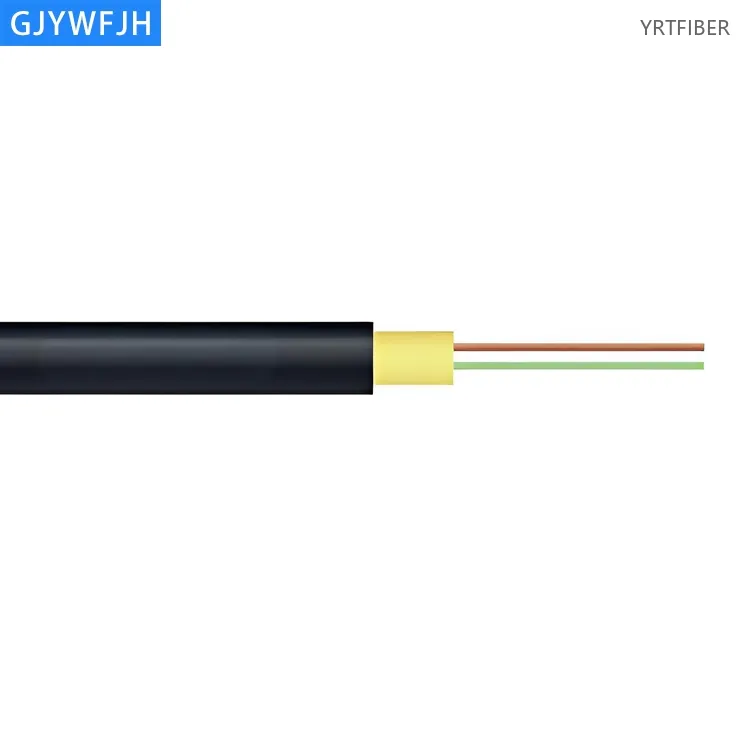
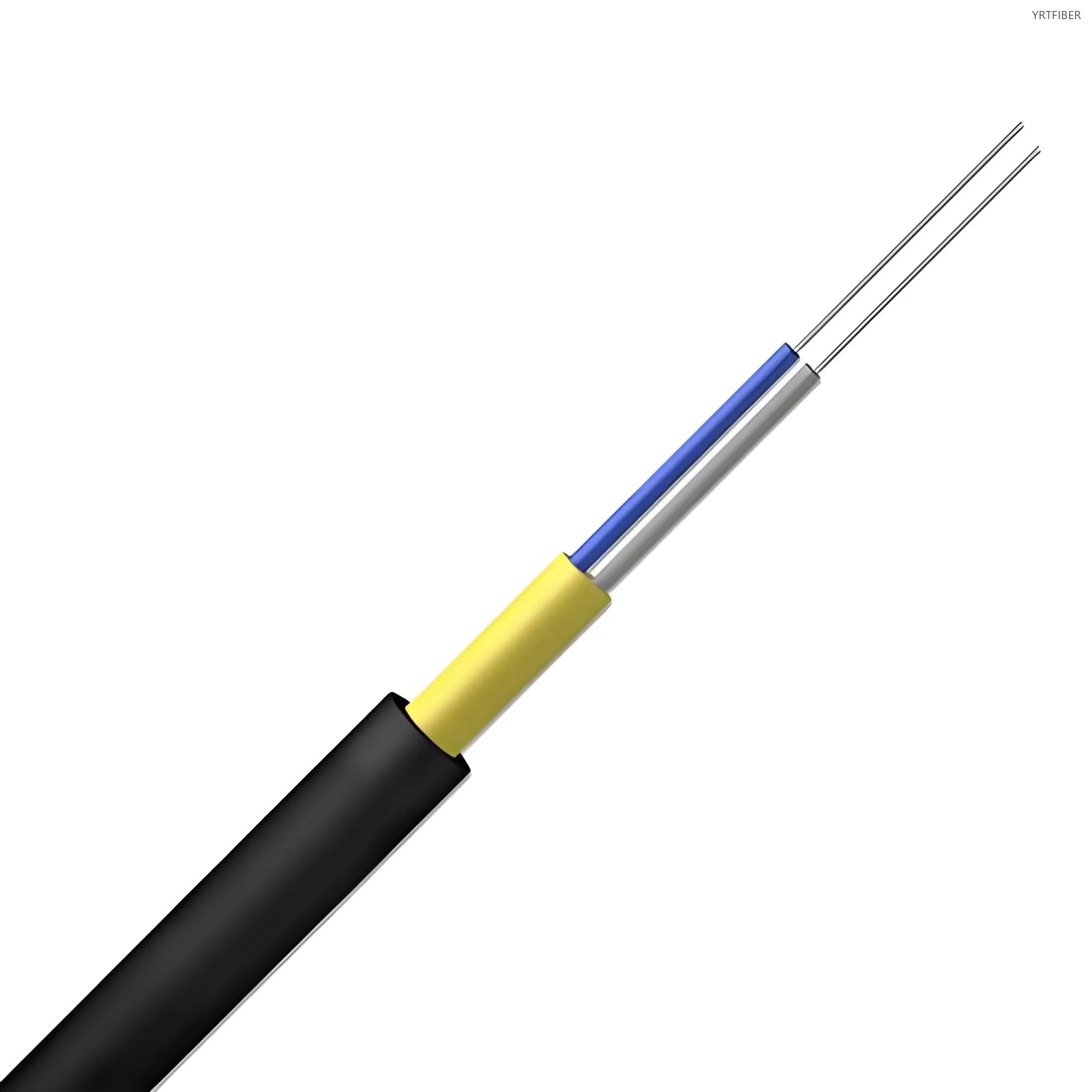
GJYWFJH Indoor/Outdoor Armored Fiber Optic Cable – Tight-Buffered, Aramid Yarn Strength
It has excellent mechanical properties and temperature adaptability.
It has good resistance to side pressure and flexibility, making it easy to install and wire.
Small in diameter, light in weight, easy to connect, and supports high-capacity data transmission.
The outer sheath material is waterproof, flame retardant and environmentally friendly, making it suitable for a variety of environments.
What is GJYWFJH indoor fiber optic cable?
GJYWFJH is a compact indoor/outdoor fiber optic cable designed for high-performance optical transmission. It features a 900µm tight-buffered fiber core reinforced with a layer of aramid yarn to enhance mechanical strength. The outer jacket can be made from various materials such as PVC, LSZH, TPU, or PE, selected based on customer needs to ensure durability, water resistance, flame retardancy, and environmental adaptability. The cable offers excellent side-pressure resistance, flexibility, small diameter, and lightweight construction, making it easy to install and support high-capacity data transmission. Typical applications include 5G base station connectivity (BBU to RRU), smart substations, CATV networks, emergency communication access, and FTTX deployments such as FTTH, FTTO, and data center cabling.
GJYWFJH armored fiber optic cable Specification parameters
- Specification parameters
- OPTICAL CHARACTERISTICS
| Parameter | Value |
|---|---|
| Model NO. | GJYWFJH |
| Certification | RoHS, CE, ISO9001, VDE, CCC |
| Sheath Material | TPU, LSZH, PVC, Zrpo |
| Spec of Fiber Core | G657A1 or G657A2 |
| Fiber Brand | Yofc / Ofs / Corning |
| Transport Package | Drum |
| Origin | HENAN, China |
| Material Shape | Round Wire |
| Core | Double Core |
| Brand | OEM |
| Capacity | 1 Core / 2 Core / 4 Core |
| Storage Temperature | -20 to +60℃ |
| Packing | Wooden Drum |
| Trademark | FiberMania |
| Production Capacity | 10000km/Week |
Specification
| Cable Type | Diameter (mm) | Weight (kg/km) | Tensile Strength (Long/Short, N) | Crush Resistance (Long/Short, N/100mm) | Bending Radius (Dynamic/Static, mm) | Storage Temperature (ºC) |
|---|---|---|---|---|---|---|
| GJYWFJH 2-4 | 5 | 30 | 100/300 | 300/1000 | 20D/10D | -40~+70 |
| GJYWFJH 6-12 | 6 | 50 | 100/300 | 300/1000 | 20D/10D | -40~+70 |
Product Structure & Composition
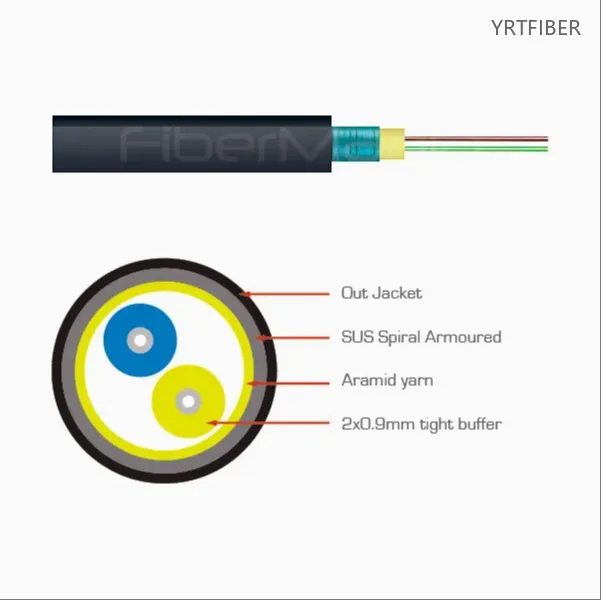
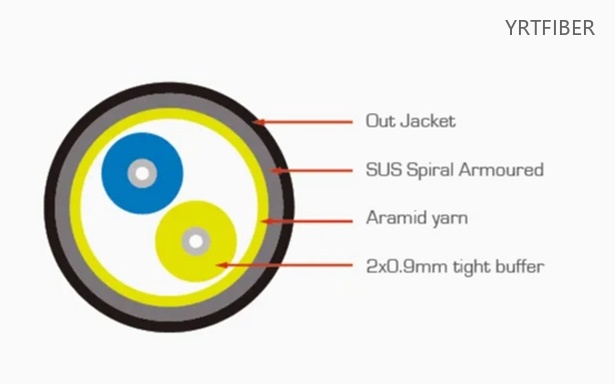
Outer jacket – LSZH/PVC/TPU/PE, waterproof, flame‑retardant, environment‑resistant.
SUS spiral armor – Crush and rodent protection for enhanced durability.
Aramid yarn – High‑strength reinforcement for tensile strength and flexibility.
2×0.9 mm tight buffer – Two 900 µm tight‑buffered fibers, easy termination, no fan‑out required.
G.657A1 and G.657A2 bend-insensitive fibers are suitable for indoor/outdoor routing, tight bends and compact installation spaces.
Benefits of GJYWFJH armored fiber optic cable
Mechanical & Temperature Performance
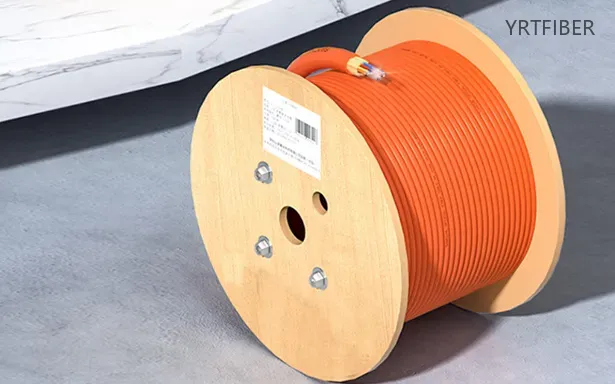
It has excellent mechanical properties and temperature adaptability.
Pressure Resistance & Installation Flexibility
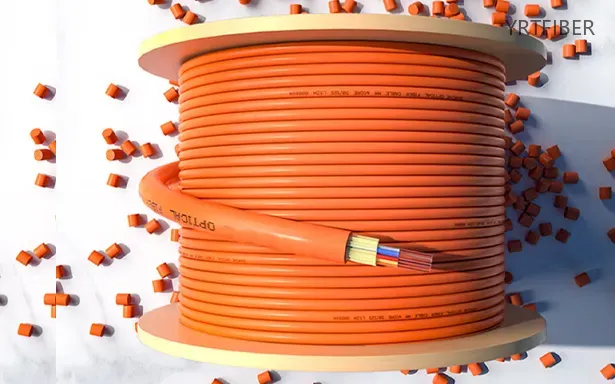
It has good resistance to side pressure and flexibility, making it easy to install and wire.
Compact, Lightweight & High-Capacity, Durable & Eco-Friendly Sheath
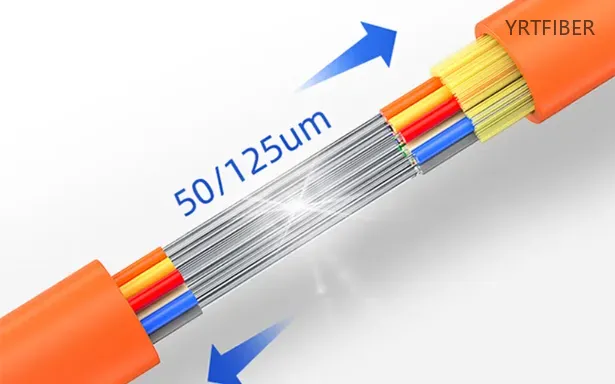
The outer sheath material is waterproof, flame retardant and environmentally friendly, making it suitable for a variety of environments. Small in diameter, light in weight, easy to connect, and supports high-capacity data transmission.
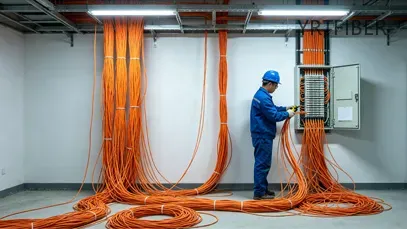
Engineering Applications GJYWFJH armored fiber optic cable
FTTA & Remote Base Station Connectivity
Connects BBU to RRU on tower tops. Compact 4.8mm diameter, aramid yarn reinforced, flexible and crush-resistant.
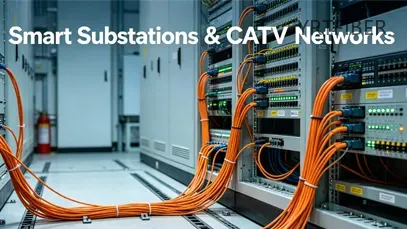
Smart Substations & CATV Networks
Deployed in smart grid and CATV distribution. PE or LSZH jacket offers waterproof, UV-resistant, and flame-retardant protection. Optional armor resists rodents.
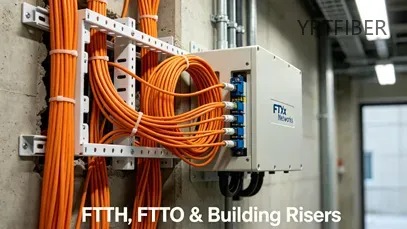
FTTx Networks (FTTH, FTTO & Building Risers)
Used as drop cable for FTTH/FTTO. Small bend radius, lightweight, suitable for cable trays and riser shafts. Supports G652D or G657 fibers.

Data Center Internal Backbone
Flame-retardant LSZH jacket for raised floors. Tight-buffered design allows direct termination to LC/SC/MPO. High crush resistance and low attenuation.
Shipping & Packaging
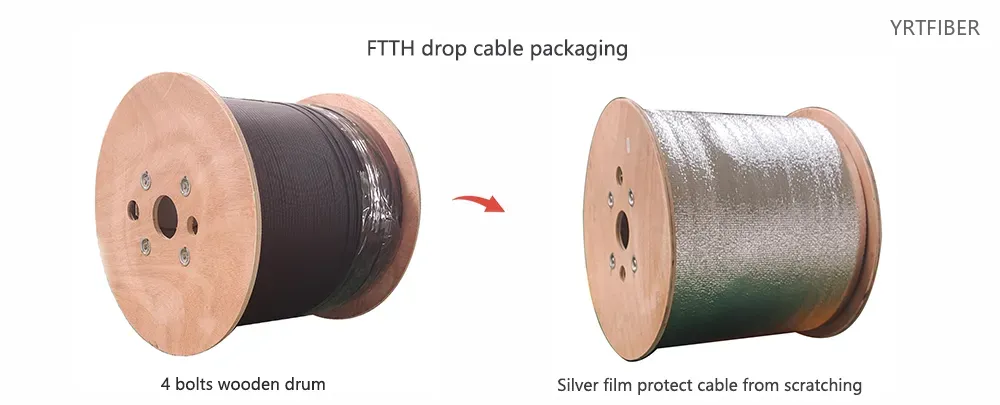
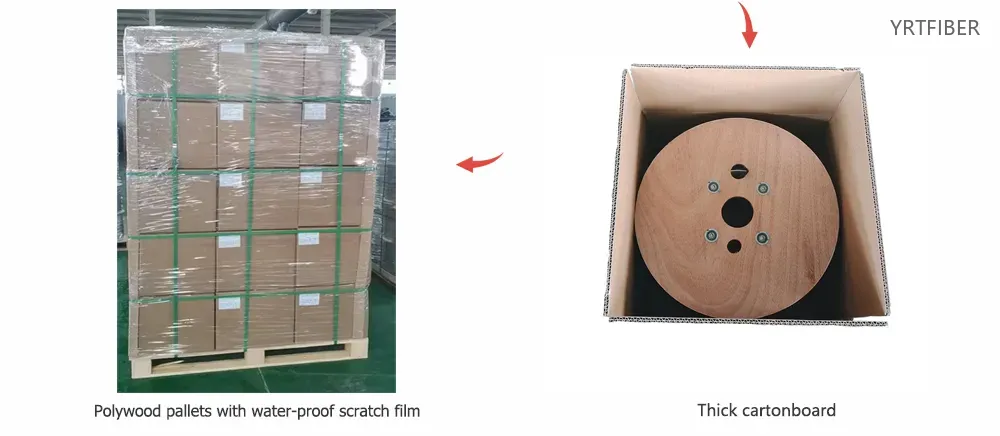
Packaging Details
Each roll contains 1–5 KM of cable, typically packed in steel drums. Customized packaging solutions are available upon client request.
Sheath Marking
White hot foil indentation is applied at 1-meter intervals with the following information:
a. Supplier name: Guanglian (or as specified by the customer)
b. Standard code including product type, fiber type, and fiber count
c. Year of manufacture (valid for 7 years)
d. Length indication in meters
Port of Shipment
Available ports: Qingdao, Guangzhou, Shenzhen
Estimated Lead Time
| Quantity (KM) | Estimated Delivery Time |
|---|---|
| 1–300 | Approx. 15 days |
| ≥300 | Delivery time to be negotiated |
Note
The packaging details above are for reference only. Final packing size and weight will be confirmed before shipment.
Product Comparison:
GJYWFJH vs GJFJH vs GJPFJH
| Feature / Dimension | GJYWFJH (Bundled FTTA Cable) | GJFJH (Distribution Cable) | GJPFJH (Micro-tube Breakout Cable) |
|---|---|---|---|
| Structural Features | 900μm tight‑buffered fibres bundled together; aramid yarn strength member over each fibre; single LSZH/PVC outer sheath. Non‑metallic construction. | Multiple 900μm tight‑buffered fibres, aramid yarn applied over each fibre or over the bundle, PVC or LSZH outer sheath. No central strength member typically. | Micro‑tubes (containing 250μm fibres) as sub‑units; sub‑units stranded around a non‑metallic central FRP strength member; PVC or LSZH outer sheath. |
| Fiber Core Capacity | 1- 4 cores (typical), up to 24 cores in some designs. | 2 - 144 cores (wide range, suitable for high‑density indoor backbone). | 12 - 144 cores (higher core counts). |
| Typical Applications | FTTA (Fiber‑to‑the‑Antenna) - wireless base station horizontal/vertical cabling, BBU to RRU connections; indoor/outdoor transition; smart substations; CATV; FTTx networks. | Indoor distribution backbone, building riser/plenum cabling, equipment room patching, entrance facilities, FTTB, horizontal cabling. | Building vertical wiring (riser cables), telecom equipment interconnects, indoor backbone networks, intra‑building connections. |
| Engineering Pros | ① Small diameter (4.8‑5.0mm for 2‑4 cores) and lightweight, easy installation in tight spaces; ② LSZH sheath - flame‑retardant, low smoke, halogen‑free, safe for indoor/confined spaces; ③ Excellent crush resistance (1000N/100mm short‑term) and flexibility; ④ Bundled design protects individual fibres during handling; ⑤ Suitable for both indoor and outdoor environments; ⑥ Flame‑retardant jacket meets indoor fire safety codes while UV‑resistant variants handle outdoor deployment. | ① Wide fibre count range - scalable from 2 to 144 cores; ② High tensile strength from aramid yarn reinforcement; ③ Good flexibility and bend performance, suitable for riser and plenum spaces; ④ LSZH variant provides flame‑retardancy for fire‑sensitive areas; ⑤ Easy stripping, simplifies termination and connector installation. | ① Each micro‑tube is individually accessible - easy branching without disturbing other fibres; ② Central FRP strength member improves structural integrity and handling; ③ LSZH sheath - fire‑safe for building riser applications; ④ Good mechanical performance (tensile 200/660N, crush 300/1000N/100mm); ⑤ Suitable for vertical wiring where multiple branch points exist. |
| Engineering Cons | ① Limited core count compared to stranded distribution cables; ② PVC variant not flame‑retardant for fire‑sensitive areas; ③ Requires careful selection of outer jacket material for UV‑exposed outdoor runs. | ① No central strength member - may be less resistant to longitudinal compression; ② Branching requires stripping the entire sheath, accessing individual fibres is more labour‑intensive than micro‑tube designs; ③ Not pre‑bundled, individual fibres may tangle during installation. | ① Larger diameter (5.5‑8.0mm) and heavier than bundled designs; ② Accessing sub‑units requires removing the outer sheath and central member - more steps than simply accessing fibres in a bundle; ③ Micro‑tubes can be crushed under high side pressure. |
| Outer Sheath Material | LSZH (standard), PVC, TPU, PE optional depending on application. | PVC (standard) or LSZH (fire‑rated variant). | PVC (standard) or LSZH (fire‑rated variant). |
| Flame Retardancy | LSZH variant - low smoke, halogen‑free, flame‑retardant; meets UL OFNR/OFNP ratings. PVC variant - flame‑retardant but produces halogen smoke. | LSZH variant - same low smoke, halogen‑free flame‑retardant performance; meets UL OFNR/OFCP ratings. PVC variant - flame‑retardant but halogen‑emitting. | LSZH variant - flame‑retardant, low smoke, halogen‑free. PVC variant available. |
| All‑Dielectric (Non‑Metallic) | Yes - no metallic components, immune to EMI, no grounding required. | Yes - aramid yarn strength members, no metal components. | Yes - FRP central member, no metal components. |
GJYWFJH armored fiber optic cable Selection Guide
Engineering selection between GJYWFJH, GJFJH, and GJPFJH:
For FTTA (Fiber‑to‑the‑Antenna) applications, wireless base station cabling, indoor/outdoor transitions (BBU to RRU), smart substations, and confined space wiring where both compact size and flame‑retardancy are critical, GJYWFJH is the optimal choice. Its bundled 900μm tight‑buffered construction keeps the cable small and lightweight (only 4.8‑5.0mm for 2‑4 cores), making it easy to route through narrow pathways, cable trays, or conduits without additional support. The LSZH sheath ensures fire safety when deployed indoors, while UV‑resistant variants are available for outdoor pole‑mounted runs (e.g., on telecom towers).
For general indoor distribution backbone cabling inside buildings (riser and horizontal runs), equipment room patching, and entrance facilities requiring scalable fibre counts from 1 to 4 cores, GJFJH is a reliable and versatile workhorse. Its aramid yarn reinforced construction provides excellent tensile strength, and it is available in both PVC (budget‑friendly) and LSZH (fire‑safe) sheaths to meet varying building code requirements. It is particularly suitable for FTTB (Fiber‑to‑the‑Building) and building backbone networks.
For vertical wiring (riser cables) and indoor backbone installations with frequent branch points requiring easy access to individual fibres without disrupting the entire cable, GJPFJH is the preferred choice. Its micro‑tube design allows installers to access specific sub‑units independently, significantly reducing mid‑span access labour compared to traditional distribution cables. This makes GJPFJH especially valuable in multi‑floor buildings where fibres need to be terminated at different levels.
Cost‑performance summary:
GJYWFJH offers the most compact form factor and excellent crush resistance for low‑core‑count FTTA deployments. Slightly higher per‑core cost than GJFJH due to bundled construction and enhanced side pressure protection.
GJFJH provides the best cost‑performance for general indoor distribution backbone over a wide range of fibre counts, especially in LSZH sheath for fire‑rated riser applications.
GJPFJH has a moderate cost premium over GJFJH for equivalent core counts, justified by its easy‑branch micro‑tube design that reduces labour costs in vertical wiring projects with multiple floors and termination points.
Flame‑retardancy and building code considerations:
All three cables are available in LSZH (Low Smoke Zero Halogen) variants, which meet strict fire safety codes for riser (OFNR) and plenum (OFNP) spaces, emitting minimal smoke and no halogen gases when burned.
PVC variants of all three are flame‑retardant but produce dense smoke and halogen gases during combustion - unsuitable for high‑occupancy, confined, or fire‑sensitive spaces.
When selecting outer jacket material, match the specification to the local building code requirements: LSZH for public spaces and fire‑rated areas; PVC for low‑risk industrial or residential applications.
UV exposure and mixed indoor/outdoor installations:
For cables that transition from indoor risers to outdoor routing (e.g., tower‑mounted RRUs), GJYWFJH offers UV‑resistant LSZH or TPU variants that provide both flame‑retardancy and long‑term solar resistance. Standard GJFJH LSZH and PVC variants are not rated for continuous outdoor UV exposure without additional jacketing, conduit protection, or an outdoor‑rated variant.
Download YRTFIBER Product Catalog
Factory Real Shot
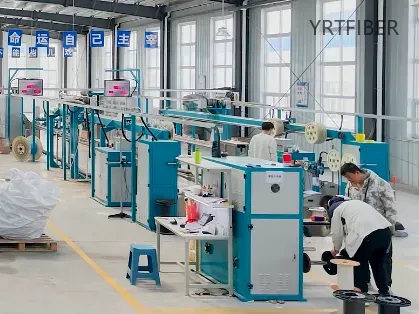
Automated Packaging & Shipping Lines
High-speed automatic coiling, banding, and cartoning lines reduce lead times and ensure consistent, damage‑free delivery to global customers.
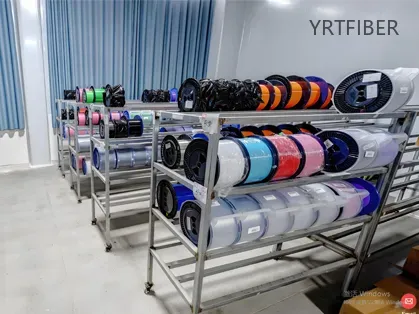
Buffer Stock & Spare Parts Warehouse
A dedicated inventory area for loose tubes, aramid yarn, and LSZH compounds guarantees uninterrupted production and rapid response to urgent orders.
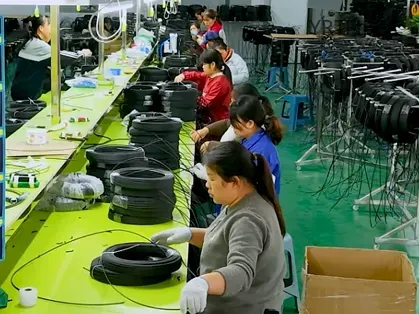
High‑Volume Production Capacity
Multiple parallel sheathing lines and stranding towers operate 24/7, enabling monthly output of over 2,0000 km of GJYWFJH and similar cables.
Advanced Manufacturing Lines
Our factory is equipped with fully automated optical fiber coloring, loose tube extrusion, stranding, and double-sheathing lines.

Frequently Asked Questions & Quick Inquiry
GJYWFJH armored fiber optic cable FAQ
What is the difference between GJYWFJH and GJFJH optical cables?
The main difference lies in their structural design and intended application. GJYWFJH is a bundled-type fiber optic cable that uses a 900μm tight-buffered fiber core, with aramid yarn reinforcement and an optional spiral armor layer, giving it a more compact outer diameter of about 5.0mm. In contrast, GJFJH is a branching-type cable that uses a 2.0mm subunit, resulting in a larger overall diameter of around 7.0mm. GJYWFJH is designed for robust mechanical durability and can handle more demanding environments, while GJFJH is generally better suited for standard indoor routing and splicing.
How is GJYWFJH cable applied in 5G base station connectivity?
In 5G networks, GJYWFJH is extensively used in FTTA architectures to establish the critical fiber link between the Baseband Unit (BBU) located in the equipment room and the Remote Radio Unit (RRU) mounted on the tower top. The cable's robust mechanical strength, flexibility, and resistance to environmental factors make it ideal for these outdoor deployments, ensuring stable and reliable high-capacity data transmission for modern cellular networks. It is a preferred choice for 4G/5G base station FTTA connections.
What role does GJYWFJH play in data center cabling?
GJYWFJH serves as a compact, flame-retardant backbone solution within data centers. Its LSZH jacket ensures compliance with stringent fire safety standards for raised-floor environments and equipment aisles. The cable's tight-buffered design eliminates the need for fan-out kits, allowing for direct termination onto patch panels and high-density connectors. This, combined with its high crush resistance and low optical attenuation, makes it well-suited for high-density cabling environments, server room connections, and supporting large-scale data transmission.
Can GJYWFJH cable be used for home network cabling (FTTH)?
Yes, GJYWFJH is widely deployed in Fiber to the Home (FTTH) networks. It is commonly used for horizontal and vertical cabling that connects fiber distribution hubs to individual residential units or offices. The cable's small diameter, light weight, and excellent bending radius simplify installation in tight spaces, such as within building riser shafts or along baseboards. This makes it a highly practical option for delivering high-bandwidth connectivity directly to end-user premises.
What are the key technical parameters of GJYWFJH cable?
GJYWFJH cable typically has a diameter of approximately 4.8mm and offers excellent mechanical properties. It can withstand a short-term tensile strength of up to 800N and a short-term crush resistance of 3000N/100mm. The cable has a dynamic bending radius of 20 times its outer diameter (D) and a static radius of 15D, providing good flexibility for routing. Its operating and storage temperature range is from -40°C to +70°C. The outer jacket is available in flame-retardant LSZH or other materials, ensuring both durability and fire safety.
What should be considered during the installation of GJYWFJH cable?
When installing GJYWFJH cable, it is crucial to respect the specified bend radius to avoid damage and signal degradation. The minimum dynamic and static bending radii are typically 20D and 15D, respectively, measured from the inner curvature of the cable. While the cable is compact, ensure that pulling tension does not exceed the specified long-term tensile strength (e.g., 400N). As an indoor/outdoor cable, proper grounding considerations for its metallic armor (if present) should be followed to prevent lightning or electrical interference issues. Finally, due to its tight-buffered design, the cable can be terminated directly using standard connectors, which simplifies the process.
Send Your Inquiry
Fill out the form below and we'll get back to you within 24 hours.


