

 Español
 Português
 لالعربية
 Русский
 Bahasa Indonesia
 Français
 Türkçe
 Bahasa Melayu

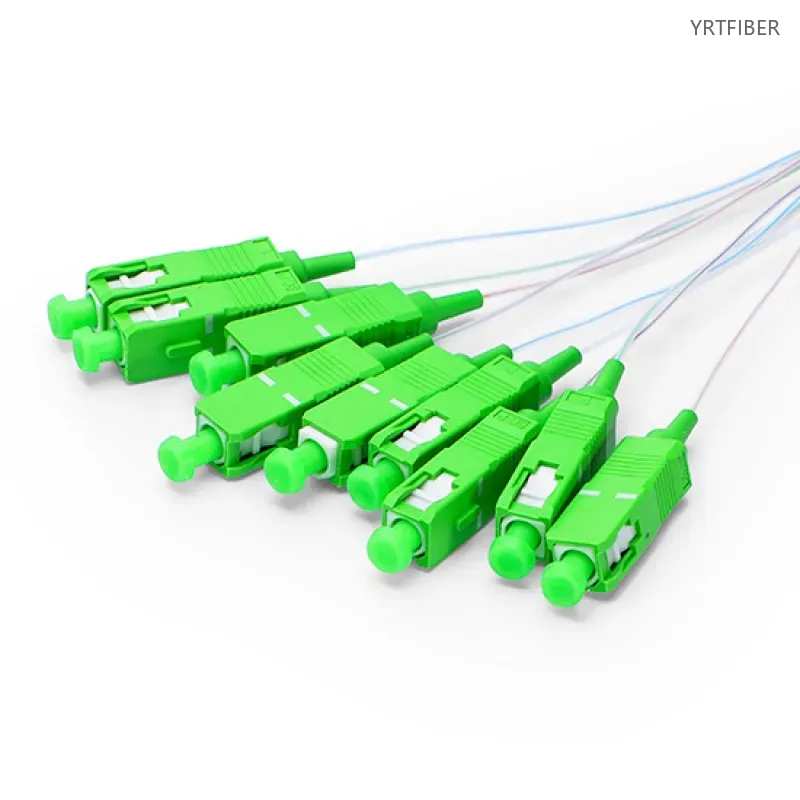
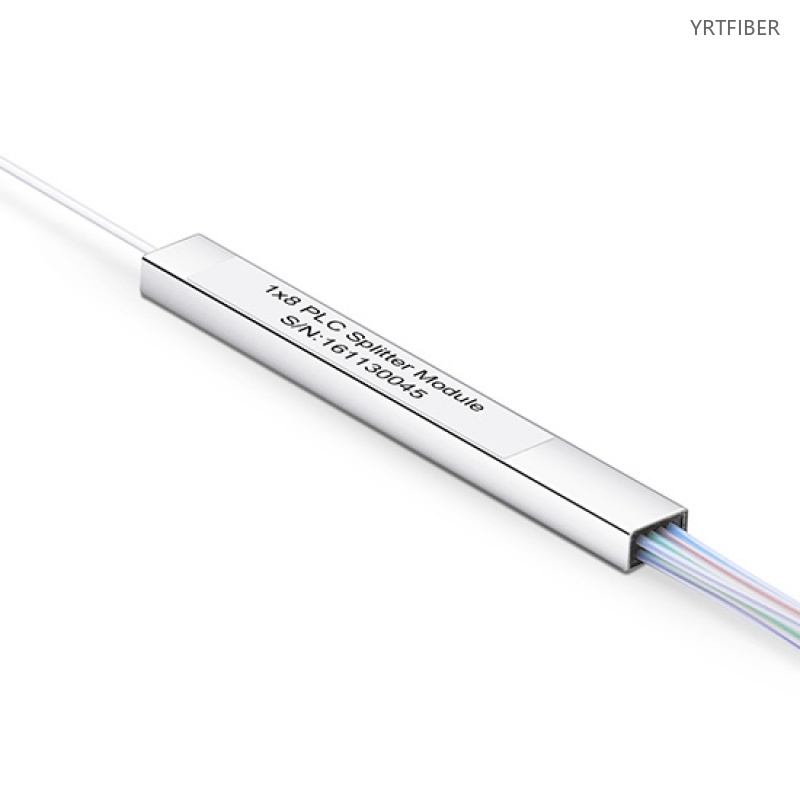
1x8 PLC Fiber Optic Splitter – Steel Tubular Mini Module with SC/UPC Connectors
1x8 configuration for splitting a single optical signal into 8 paths.
Steel tubular mini module for enhanced protection and mechanical stability.
Low insertion loss and high return loss for optimal signal quality.
SC/UPC connectors for easy integration into existing network systems.
Suitable for single-mode fiber (G652D, G657A) in long-distance transmission applications.
What is a 1x8 PLC Fiber Optic Splitter?
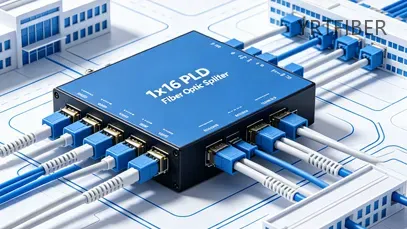
A 1x8 PLC fiber optic splitter in a steel tubular mini module with SC/UPC connectors is a compact and high - performance device designed for optical signal distribution in telecom, LAN, and data center networks. It splits one optical signal into eight paths, offers protection and stability, ensures good signal quality, and is compatible with specific single - mode fibers for long - distance use.
1x8 PLC Fiber Optic Splitter Specification parameters
- Specification parameters
- OPTICAL CHARACTERISTICS
| Package Style | Mini Module |
| Configuration Type | 1×8 |
| Fiber Grade | G.657A1 |
| Fiber Mode | Singlemode |
| Connector Type | SC/APC |
| Split Ratio | Symmetrical |
| Input/Output Fiber Diameter | 900 μm |
| Input/Output Fiber Length | 1.5 m |
| Insertion Loss | ≤ 10.5 dB |
| Return Loss | ≥ 55 dB |
| Loss Uniformity | ≤ 0.8 dB |
| Directivity | ≥ 55 dB |
| Polarization Dependent Loss | ≤ 0.2 dB |
| Temperature Dependent Loss | ≤ 0.5 dB |
| Wavelength Dependent Loss | ≤ 0.3 dB |
| Operating Bandwidth | 1260 – 1650 nm |
| Steel Tube Dimensions (HxWxD) | 0.16″ × 2.36″ × 0.28″ (4×60×7 mm) |
| Temperature | Operating: –40 to 85 °C (–40 to 185 °F)Storage: –40 to 85 °C (–40 to 185 °F) |
Product Structure & Composition
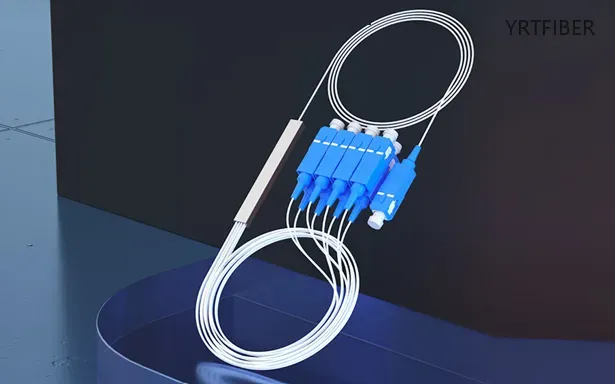
Optical Splitting Core: At the heart of the splitter is the Planar Lightwave Circuit (PLC) - based optical splitting core. This core is engineered to evenly divide the incoming optical signal from the single input port into eight output ports. The PLC technology ensures precise and consistent signal splitting, maintaining the integrity of the optical signal across all output channels.
Steel Tubular Mini - module: The steel tubular mini - module encases the optical splitting core. It provides robust mechanical protection, safeguarding the delicate internal components from physical impacts, vibrations, and other mechanical stresses. The compact design of the module also helps in saving space within network enclosures.
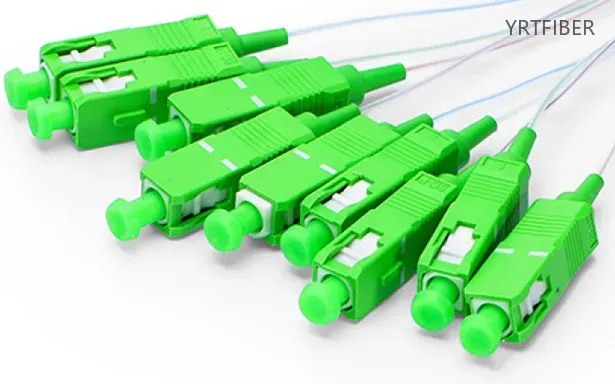
SC/UPC Connectors: The splitter is equipped with SC connectors featuring UPC (Ultra - Physical Contact) polish. The SC connectors offer a secure and easy - to - use connection interface. The UPC polish on the ferrules ensures a low - loss and high - quality optical connection when mated with other fiber optic components.
Benefits of 1x8 PLC Fiber Optic Splitter
High - density Splitting for Various Networks
The 1x8 configuration is highly versatile, catering to different network types. In telecom networks, it can be used to distribute optical signals to multiple subscribers or network nodes. In LANs, it helps in expanding the connectivity to various devices such as computers, servers, and printers. In data centers, it can be utilized for efficient signal distribution within the high - density cabling infrastructure.
Enhanced Protection and Space - saving
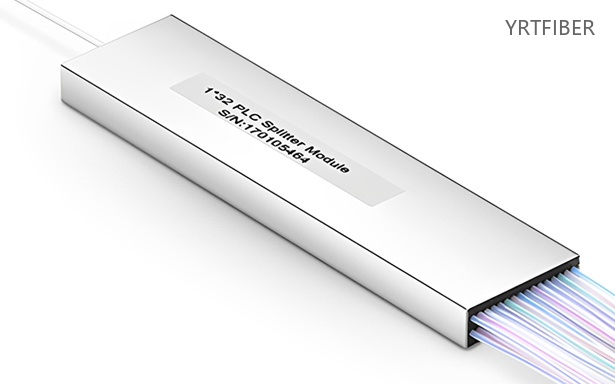
The steel tubular mini - module not only provides excellent protection to the internal optical components but also occupies minimal space. In crowded network enclosures like data center racks or telecom cabinets, this space - saving design allows for more efficient use of available space, enabling the installation of multiple splitters without overcrowding.
Superior Signal Quality
With low insertion loss and high return loss, the splitter ensures that the optical signals are transmitted with minimal degradation. Low insertion loss means that the signal loses very little power as it passes through the splitter, while high return loss prevents signal reflections that could disrupt the overall signal quality. This results in reliable and high - quality data transmission across the split paths.
Seamless Network Integration
The SC/UPC connectors enable easy integration into existing network systems. Since SC connectors are widely used in the industry, the splitter can be quickly and easily connected to other network devices such as patch panels, optical transceivers, and switches, reducing the need for additional adapters or complex installation procedures.
Engineering Applications 1x8 PLC Fiber Optic Splitter

Widely Used in FTTX Projects and Data Communication Centers
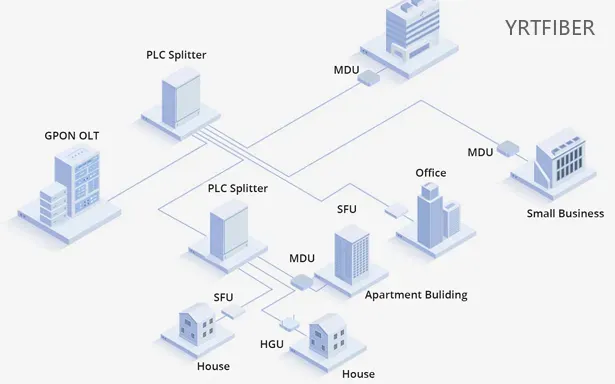
Optical splitter has played an important role in passive optical networks (like EPON, GPON, BPON, FTTX, FTTH, etc.) by allowing a single PON Interface to be shared among many subscribers.
FTTH Floor Distribution
In residential buildings, the 1×8 splitter serves as a secondary node in the corridor cabinet, splitting one OLT signal to 8 homes. With ~10.5 dB loss, it supports drop cables up to 5 km, and its compact package simplifies fusion splicing while reducing termination density.

5G CRAN Fronthaul
Paired with CWDM/LWDM, the splitter fans one DU port to 8 AAUs over a single fiber. It requires low PDL (<0.3 dB) and good uniformity to meet 25G eCPRI sync needs, cutting trunk cores from 16 to just 2 per site.

Data‑Center Link Monitoring & APS
Inserted in‑line on the primary link, one output carries traffic while seven feed monitors (power, OTDR) for real‑time diagnostics. A low‑loss (≤11 dB) 1U module enables 50 ms protection switching, replacing cascaded couplers and reducing failure points.
Shipping & Packaging
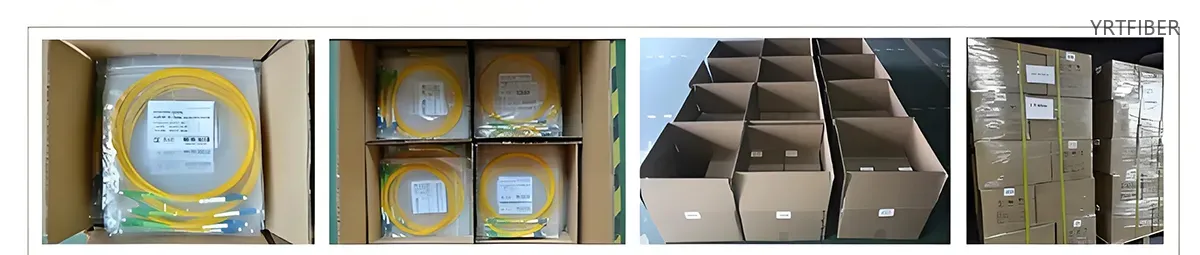

Product Comparison:
| Feature / Dimension | 1×8 PLC Splitter | 1×8 FBT Coupler | 1×4 PLC Splitter |
|---|---|---|---|
| Technology | Planar Lightwave Circuit (PLC) - semiconductor lithography, waveguide on silica substrate | Fused Biconical Taper (FBT) - traditional fusion of multiple fibers | Planar Lightwave Circuit (PLC) - same as 1×8 |
| Wavelength Range | 1260 - 1650 nm (full band) | 850 / 1310 / 1550 nm (single/dual/triple window only) | 1260 - 1650 nm (full band) |
| Split Ratio Options | Standard: 1×2, 1×4, 1×8, 1×16, 1×32, 1×64 | Customizable: 1×2, 1×3, 1×4, 1×8 (asymmetric ratios available) | Standard: 1×2, 1×4, 1×8, 1×16, 1×32, 1×64 |
| Split Uniformity | Excellent - evenly splits light across all outputs | Poor - uniformity degrades as split ratio increases | Excellent - same as 1×8 |
| Insertion Loss (typical) | ~9.8 dB (max), ≤10.5 dB | ~10.8 dB (worst arm) - cascaded from 7 × 1×2 couplers + 6 splices | ~7.2 dB (lower than 1×8) |
| Device Size | Compact - suitable for high-density applications | Large and bulky for multi-channel splitters | Even more compact than 1×8 |
| Reliability / Failure Rate | High - single chip, low FIT | Lower - 7 discrete 1×2 couplers + 6 splices, multiplied failure risk | High - same as 1×8 |
| Relative Cost | Higher for small split ratios; lower per channel for high ratios | Lower for small ratios (1×2, 1×4); higher for 1×8 due to cascading | Lower than 1×8 PLC (fewer outputs) |
| Common Package Types | Bare fiber, ABS module, mini plug-in, fan-out, LGX cassette | Steel tube, ABS module | Same as 1×8 PLC |
| Typical Applications | PON (EPON/GPON), FTTH/FTTx, CATV, data communications, ODN | Smaller networks, short distances, custom asymmetric splits | Smaller PON splits, lower subscriber density, budget-sensitive projects |
1x8 PLC Fiber Optic Splitter Selection Guide
Choose the 1×8 PLC Splitter when:
Deploying modern PON networks (EPON, GPON, XGS-PON) requiring consistent, equal power distribution across all 8 output ports.
Operating across the full 1260-1650 nm wavelength range for maximum flexibility in multi-wavelength applications.
Deploying in environments with wide temperature variations (-40 to 85°c).
Requiring compact form factor for high-density enclosures, cabinets, or ODFs.
Prioritizing long-term reliability and low failure rates.
Choose the 1×8 FBT Coupler only when:
A custom, non-standard split ratio is required (e.g., 1×3. 1×5. 1×7) that PLC cannot provide.
The application is a small network or short-distance deployment where uniformity and wide temperature range are less critical.
Budget is extremely constrained for very small split ratios (1×2. 1×4).
Working with legacy systems that only support specific wavelengths (850nm, 1310nm, 1550nm).
Note: For 1×8 splitting, FBT is generally not recommended due to cascaded construction (7 × 1×2 couplers + 6 splices), resulting in higher insertion loss (10.8 dB vs. 9.8 dB), poorer uniformity (up to 3 dB), higher TDL/PDL, larger size, and increased failure risk. The cost advantage of FBT diminishes at higher split ratios.
Choose the 1×4 PLC Splitter when:
The application only requires 4 output ports - fewer outputs mean lower insertion loss (~7.2 dB) and lower cost than 1×8 PLC.
Subscriber density is low (e.g., small MDUs, rural deployments, or office buildings).
Future expansion to 1×8 is not anticipated - using a smaller splitter now avoids unnecessary loss and cost.
Split ratio guidance:
1×2 - 1×4: Both PLC and FBT are viable; FBT may offer lower cost for custom ratios.
1×8: PLC is strongly recommended for performance and reliability.
1×16 - 1×64: PLC is the only practical choice - FBT cannot maintain acceptable uniformity or loss.
Installation Instructions of 1x8 PLC fiber optic splitter
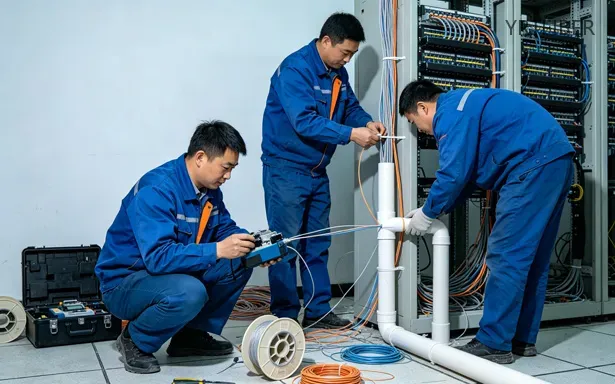
Visually inspect the splitter for damage, clean connectors, and check port labels. Connect the input fiber (G652D/G657A) and the eight output fibers, ensuring firm insertion and clear labeling. Mount the splitter securely in the patch panel or enclosure without straining the fibers. Finally, measure insertion loss at each output port; if readings are too high, re‑clean connectors and inspect for internal damage. Also verify that return loss meets the specified standards.
Download YRTFIBER Product Catalog
Factory Real Shot
State‑of‑the‑Art Manufacturing Facilities
Our 60.000 m²; dust‑proof workshop houses over 21 automated production lines for both single‑core and MPO patch cords. Key equipment includes high‑precision fiber cutters (±0.08 mm tolerance), FLC automatic termination machines, and UV curing systems. These operate in a fully coordinated workflow, achieving a stable daily output of thousands of connectors. A real‑time MES system tracks every production step, ensuring batch‑to‑batch consistency and full traceability.
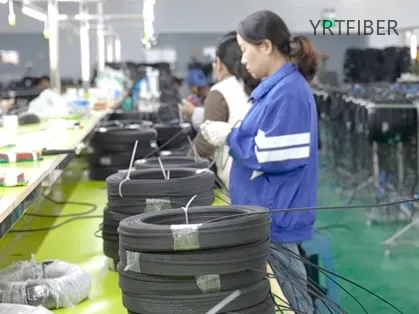
Precision Core Manufacturing Process
The manufacturing sequence starts with micro‑tolerance end‑face cutting (angle tolerance ±0.5°) and six‑axis fusion splicing (core deviation ≤1 μm). After multi‑layer jacketing using LSZH, PVC, or OFNP compounds, the connectors are polished on automated lines to achieve PC, UPC, or APC end‑face finishes. This efficient process yields up to 7.000 high‑quality connectors per 11‑hour shift, with every unit meeting stringent geometric and optical specifications.

Rigorous Quality Assurance & Testing
Every patch cord undergoes 100% inspection, covering interferometric end‑face analysis at 400× magnification, automatic contaminant detection, and insertion/return loss measurements via OTDR. In addition, environmental samples are subjected to temperature cycling, humidity exposure, and pull‑force tests in compliance with IEC/TIA standards. This multi‑layer quality regime verifies both optical performance and mechanical robustness, guaranteeing that only zero‑defect products are shipped to customers.

Frequently Asked Questions & Quick Inquiry
1x8 PLC Fiber Optic Splitter FAQ
Q1: What warranty do you offer for your products?
A1: We provide a two-year warranty, including three months free return for product quality issues and one year of free maintenance.
Q2: Do you offer OEM/ODM services?
A2: Yes, we welcome OEM and ODM orders to meet your specific needs.
Q3: sample available?
A3: Yes, Please contact us for more details.
Q4: How do you handle customer inquiries?
A4: Any inquiry will be replied to within 24 hours. Our team is here to assist you.
Q5: What after-sales service do you provide?
A5: We track your order from production to delivery, ensuring timely updates on the status. Our after-sales service aims to provide continuous support.
Q6: What should I do if I have questions after receiving the goods?
A6: If you have any questions after inspection, feel free to contact us. We’ll provide a solution to resolve any issues.
What is the difference between UPC and other types of connector polish?
UPC (Ultra - Physical Contact) polish provides a highly polished, flat - ended ferrule surface. This design results in low insertion loss, making it suitable for general - purpose optical connections. In contrast, APC (Angled Physical Contact) polish has an angled ferrule surface (usually 8°), which is designed to reduce back - reflection and is used in applications where high return loss is crucial, such as long - distance or high - performance optical links.
Can the 1x8 PLC fiber optic splitter be used with multimode fiber?
No, this splitter is designed specifically for use with single - mode fibers G652D and G657A. Multimode fibers have different optical characteristics, and using them with this splitter may lead to poor signal performance, high insertion loss, and unreliable data transmission. For multimode applications, a splitter designed for multimode fibers should be used.
Send Your Inquiry
Fill out the form below and we'll get back to you within 24 hours.


