

 Español
 Português
 لالعربية
 Русский
 Bahasa Indonesia
 Français
 Türkçe
 Bahasa Melayu

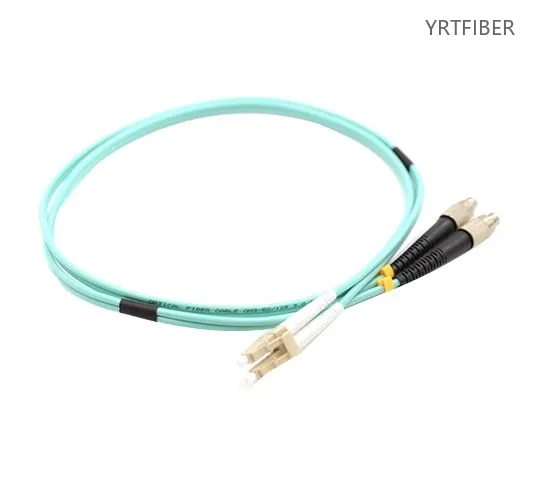
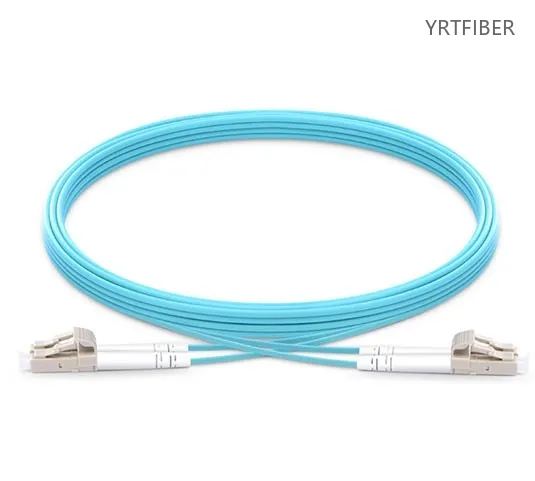
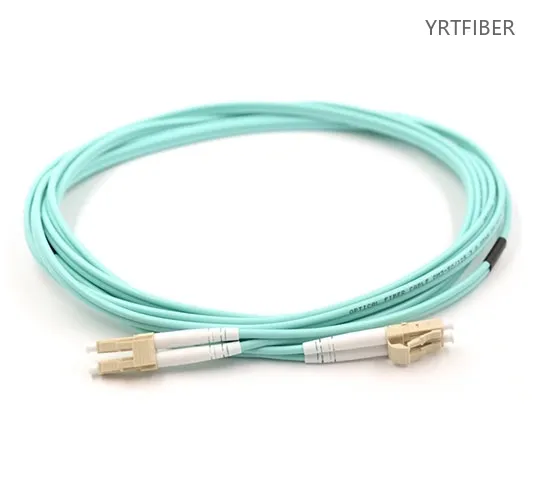
OM3 Simplex/Duplex Multimode Fiber Patch Cord – 50/125µm, 850nm VCSEL, LC/SC/FC/ST/MPO/MTP
Available in simplex and duplex configurations, tailored for short - distance high - speed data transmission.
Features OM3 50/125μm multimode fiber, optimized for 850nm VCSEL transmission.
Supports 10Gbps up to 300 meters and 40Gbps up to 100 meters.
Comes with LC, SC, FC, ST connectors in simplex or duplex versions.
Exhibits low insertion loss, excellent return loss, and is factory - polished and tested.
Offers flame - retardant jacket options: LSZH, PVC
What is an OM3 Multimode Fiber Patch Cord?
An OM3 multimode fiber patch cord, available in simplex and duplex forms, is designed for short - distance high - speed data transfer in LANs, data centers, SANs, and high - performance computing environments, providing stable and efficient connectivity through its optimized fiber and connector set - up.
OM3 Multimode Fiber Patch Cord Specification parameters
- Specification parameters
- OPTICAL CHARACTERISTICS
| Item | OM3 Patch Cord (Simplex/Duplex) | |
|---|---|---|
| Fiber Type | Multimode OM3 (50/125) | |
| Jacket Material | LSZH / PVC | |
| Connector Type | SC / FC / LC / ST ,APC / UPC | |
| Ferrule Materials | Ceramic | |
| Cable Dimension | 2.0mm, 3.0mm | |
| Cable Color | Aqua | |
| Testing Wavelengths | 850±30 / 1300±30nm | |
| Insertion Loss (dB) | ≤ 0.3dB | |
| Return Loss (dB) | ≥ 35dB | |
| Operating Temperature (°C) | -10°C ~ +70°C | |
| Storage Temperature (°C) | -40°C ~ +85°C | |
| Package | Poly bag | |
Product Structure & Composition
OM3 50/125μm fiber, optimized for 850nm VCSELs, offers efficient short-distance transmission. Connectors are available in LC, SC, FC, and ST, with factory polishing ensuring low insertion loss and high return loss. LC is great for high-density setups. Sheath materials include LSZH (low smoke, halogen-free, fire-safe), PVC (general-purpose and cost-effective), providing mechanical protection and environmental adaptability.
Benefits of OM3 Multimode Fiber Patch Cord
Optimized for High - Speed Short - Distance Transmission
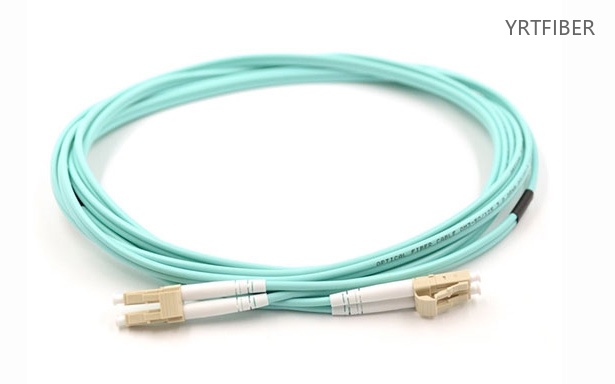
The OM3 50/125μm multimode fiber, optimized for 850nm VCSEL transmission, enables high - speed data transfer over short distances. This makes it well - suited for applications in data centers, LANs, and SANs where rapid data exchange within a limited range is required.
Versatile Connector Options
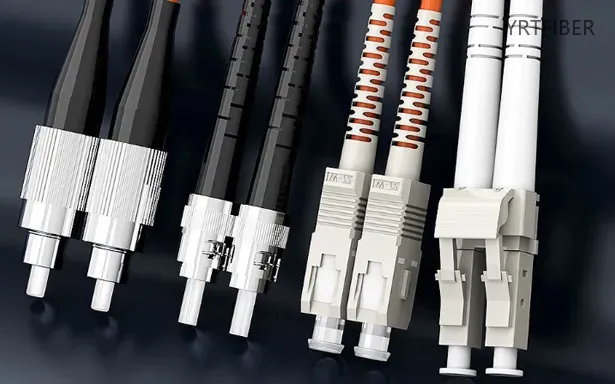
With LC, SC, FC, and ST connector options, the OM3 multimode fiber patch cord can be easily integrated into different network setups. Whether it's a high - density data center (using LC connectors) or a more traditional network installation (using other connector types), users can choose the connector that best suits their requirements.
Excellent Optical Performance
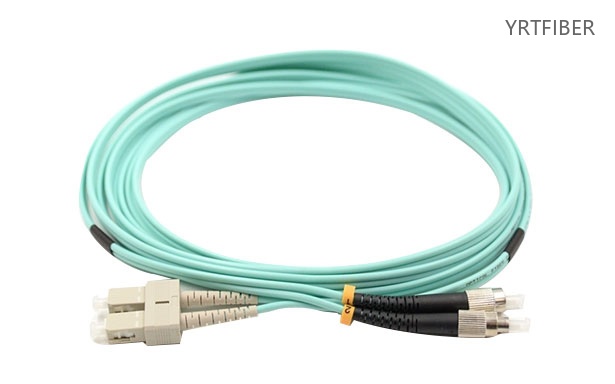
Featuring low insertion loss and excellent return loss, the OM3 patch cord ensures reliable optical signal transmission. The factory - polished connectors contribute to this high - quality performance, minimizing signal degradation and ensuring accurate data transfer.

Flame - retardant Jacket for Safety
The availability of LSZH, PVC flame - retardant jackets provides options for different installation environments. This ensures the safety of the network infrastructure, especially in areas where fire - safety is a concern.
Engineering Applications OM3 Multimode Fiber Patch Cord

Intra-Data Center Server Interconnection
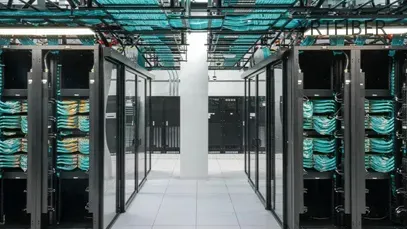
Within data center racks, OM3 multimode fiber patch cords are commonly used to connect Top-of-Rack (ToR) switches to server network interface cards (NICs). Supporting transmission distances of up to 300 meters at 10 Gbps, they fully meet the requirements for short-range, high-bandwidth connectivity within and between adjacent racks. Additionally, their low insertion loss ensures low-latency switching for massive data volumes.

Campus Network Building Backbone Links
OM3 patch cords enable 10-Gigabit backbone connections between aggregation-layer and access-layer switches across office buildings in enterprise campuses. Compared to single-mode fiber, they offer lower costs by utilizing 850nm VCSEL light sources. Their bend-insensitive design facilitates installation along complex pathways—such as low-voltage risers and cable trays—making them ideal for medium-to-large local area networks (LANs) found in educational campuses and technology parks.
Storage Area Network (SAN) Construction
In sectors requiring high-performance storage, such as finance and healthcare, OM3 patch cords are used alongside 8G/16G Fibre Channel (FC) storage switches to connect storage arrays with server Host Bus Adapters (HBAs). Their high bandwidth supports the real-time writing of online transaction logs and prevents I/O bottlenecks between disk arrays; furthermore, the simple duplex polarity management makes them well-suited for storage environments subject to frequent configuration changes.
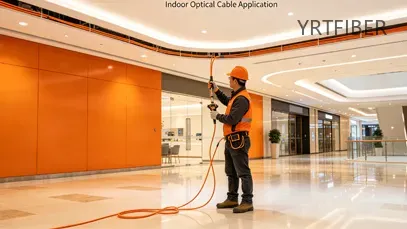
High-Definition Audio-Visual Transmission Systems
When large venues or command centers employ fiber-based KVM or DVI extenders, OM3 patch cords serve as the transmission medium, enabling the uncompressed delivery of 4K video signals over distances of up to 200 meters. Their immunity to electromagnetic interference ensures that on-site lighting and audio equipment do not cause signal loss or screen blackouts, making them a common choice for projects such as sports broadcasting and subway surveillance and dispatch systems.
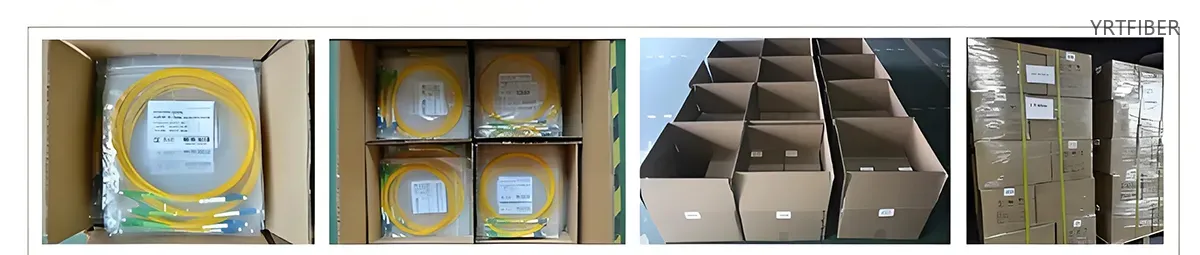
Shipping & Packaging

Product Comparison:
OM3 vs OM4
| Feature / Dimension | OM3 Multimode Fiber Patch Cord | OM4 Multimode Fiber Patch Cord |
|---|---|---|
Effective Modal Bandwidth (EMB) | 2000 MHz·km. | 4700 MHz·km - more than double OM3's bandwidth. |
Maximum Transmission Distance (10GbE) | 300 meters (standard). | 550 meters (premium quality). Higher bandwidth enables longer 10G reach. |
Maximum Transmission Distance (40/100GbE) | 100 meters (both 40G and 100G Ethernet). | 150 meters for 40/100GbE - 50% longer reach than OM3. |
Attenuation at 850nm | ≤2.4 dB/km (typical). | ≤2.4 dB/km - identical to OM3 for multimode applications. |
Typical Applications | 10GbE in data centers (up to 300m), enterprise LANs, 40/100GbE short-reach (<100m), horizontal/equipment distribution areas, legacy 1GbE upgrades. | High-bandwidth 40/100GbE data center core links (up to 150m), 10GbE longer distances (up to 550m), future‑proofed enterprise backbone, premium trunking in colocation facilities. |
Engineering Pros | ① Industry‑standard, mature technology with wide hardware compatibility. ② Lower initial material cost - most cost‑effective for sub‑100m 40/100G links. ③ Supports 1G, 10G, 40G and 100G Ethernet with VCSEL optimization. ④ Aqua jacket color for easy MM identification. ⑤ Excellent bend‑insensitive performance for tight cable management. ⑥ Widespread availability across manufacturers. | ① 50% longer 40/100GbE reach - ideal for larger data center inter‑rack distances. ② Higher modal bandwidth (4700 MHz·km) enables better future upgrade potential. ③ Supports 10GbE up to 550m - can replace OS2 in campus backbones. ④ Higher link budget margin reduces risk of signal degradation. ⑤ More headroom for connector and splice loss accumulation. ⑥ Better differential mode delay (DMD) control for high‑speed parallel optics. |
Engineering Cons | ① Limited to 100m for 40/100GbE - insufficient for larger data center cores. ② Cannot support 10GbE beyond 300m without signal loss. ③ Not recommended for future high‑bandwidth long‑reach upgrades. ④ Lower modal bandwidth limits performance in high‑speed parallel transmission applications (e.g., 400G). | ① Higher material cost than OM3 - premium for enhanced bandwidth. ② Requires use of 850nm VCSEL sources - not compatible with legacy LED‑based OM1/OM2 systems. ③ Over‑specified for short sub‑100m patches, leading to unnecessary expense. ④ Aqua jacket identical to OM3 can cause field identification confusion (violet OM4 introduced but not universally adopted). |
| Cost (Relative) | Lower. Most economical 50μm multimode solution for distances ≤100m @ 40/100G, ≤300m @ 10G. Best price‑performance for intra‑rack to middle‑of‑row connectivity. | Higher. Premium pricing for extended reach and bandwidth. Cost premium of 20-40% over OM3, but justified for applications requiring >100m @ 40/100G or >300m @ 10G. |
Core Diameter / Jacket Color | 50/125μm / Aqua (standard). | 50/125μm / Aqua (common) or Erika Violet (Euro variant for differentiation). |
Bend Insensitivity (G.657 support) | Bend‑insensitive variants widely available - minimal attenuation under tight bends. | Bend‑insensitive variants available - same microbend resistance as OM3 but with higher bandwidth. |
Connector Compatibility | LC, SC, MPO/MTP (8/12/24 fiber) - supports 40G/100G parallel optics with MPO. | LC, SC, MPO/MTP - same connector ecosystem as OM3, fully backward compatible. |
Insertion Loss (per connector pair) | ≤0.15 dB (standard), ≤0.10 dB (premium). | ≤0.15 dB (standard), ≤0.10 dB (premium) - identical performance. |
OM3 Multimode Fiber Patch Cord Selection Guide
OM3 and OM4 share the same 50/125μm core diameter, Aqua jacket color (violet OM4 exists but not widely adopted), and VCSEL optimization for multimode transmission. The decisive factor is the required link distance at given data rates, not simply which grade is "better."
Choose OM3 patch cords when the transmission distance for 40GbE/100GbE is 100 meters or less, and for 10GbE 300 meters or less. OM3 is the most cost‑effective solution for intra‑rack and middle‑of‑row connections within standard data center layouts. For new greenfield deployments with fiber runs between 100 and 150 meters at 40/100GbE, or between 300 and 550 meters at 10GbE, OM4 is the required choice - the premium cost is justified by longer reach without migrating to single‑mode fiber.
For greenfield data centers building out 40G/100G core networks with inter‑rack distances of 100-150 meters, OM4 is now the industry default. For cost‑sensitive retrofits of existing 10G infrastructure where no upgrade beyond 40/100G over multimode is anticipated within the next 5-7 years, OM3 remains a practical and economical choice. When designing for maximum future flexibility (e.g., migration to 200G/400G over parallel optics), OM4 is preferred for its higher bandwidth headroom and better DMD performance, which are critical for high‑speed short‑wave wavelength division multiplexing (SWDM) and next‑generation multimode applications.
If link distance at 40/100G exceeds 150 meters (e.g., building‑to‑building campus backbone), single‑mode OS2 fiber must be used, regardless of OM grade. Multimode fiber, including OM4, cannot support these longer spans. Conversely, for very short patches (e.g., 1-5 meters between adjacent equipment), OM3 is fully sufficient and offers better value than OM4.
| Requirement | Recommended Grade |
|---|---|
| ≤100m @ 40/100GbE, ≤300m @ 10GbE (intra‑rack, middle‑of‑row) | OM3 (cost‑optimal) |
| 100-150m @ 40/100GbE, or 300-550m @ 10GbE | OM4 (required) |
| Future‑proofing for 200G/400G upgrades | OM4 (higher bandwidth) |
| Link distance >150m @ 40/100GbE | OS2 Single‑mode (not OM3/OM4) |
| Legacy OM1/OM2 system migration | OM3 (backward compatible, economical) |
| High‑density 40/100G parallel optics with MPO | OM3 (≤100m) or OM4 (≤150m) |
How to install OM3 fiber patch cord?
Pre‑installation Inspection: Visually check the OM3 patch cord for jacket damage and ensure connector locks work properly.
Connector Cleaning: Wipe the ferrule end‑face with an alcohol‑dampened lint‑free swab (follow the angle for APC), then dry with a clean swab.
Connection: Align the key with the slot; push‑pull types (LC/SC) click when locked, threaded types (FC) screw in slowly and tighten securely.
Cable Routing: Maintain a minimum bend radius of 10× cable diameter; secure with ties, trays, or clips to avoid strain.
Post‑installation Testing: Measure insertion loss with an optical power meter; if excessive, re‑clean connectors and inspect the cable for hidden damage.
Download YRTFIBER Product Catalog
Factory Real Shot
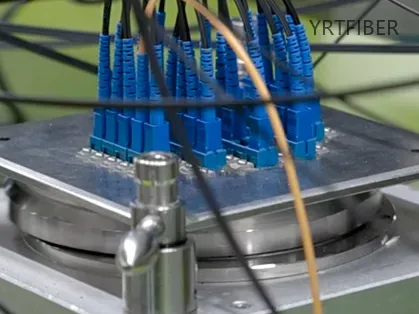
1. Class 10.000 Clean Workshop + Fully Automated Lines for Unmatched Consistency
We operate a 60000 m²; temperature- and humidity-controlled clean workshop, with core areas meeting ISO Class 7 (Class 10.000) standards. The facility houses 12 fully automated patch cord assembly lines, where processes such as precise cutting, stripping, cleaning, and connector assembly are robotically coordinated to minimize human error. For OM3 multimode fiber, we have specially optimized stripping and coating handling parameters to preserve high bandwidth performance at 850 nm.
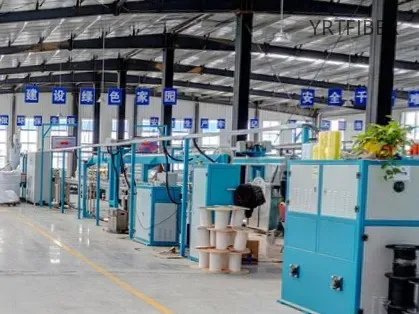
Precision Core Manufacturing Process
The process begins with micro-tolerance cutting (end-face angle tolerance: ±0.5°) and six-axis fusion splicing (core deviation ≤1 μm). After multilayer jacketing with LSZH, PVC materials, connectors undergo automated polishing for PC, UPC, or APC finishes. The line achieves up to 7.000 connectors per 11-hour shift.

Rigorous Quality Assurance & Testing
Every patch cord is subject to 100% inspection, including interferometric end-face analysis (400x magnification), automated contamination detection, and insertion/return loss testing via OTDR. Additionally, environmental samples must pass temperature, humidity, and pull-force tests in compliance with IEC/TIA standards.
Frequently Asked Questions & Quick Inquiry
OM3 Multimode Fiber Patch Cord FAQ
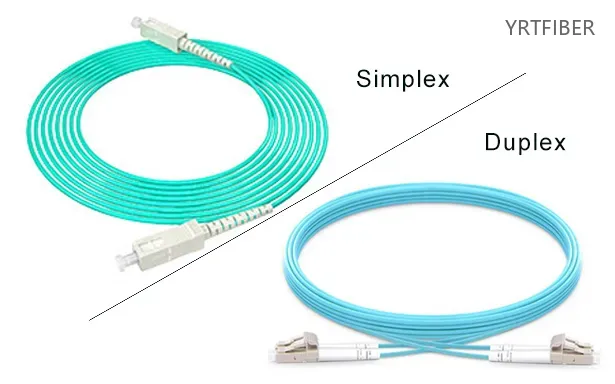
Q1: What is the difference between OM3 simplex and duplex patch cords?
A1: Simplex uses one fiber for one-way transmission, duplex uses two for bidirectional data transfer.
Q2: What are the typical transmission speeds supported by OM3?
A2: OM3 supports 10Gbps up to 300m and 40Gbps up to 100m over multimode fiber.
Q3: Are LC, SC, FC, ST connectors all available for OM3?
A3: Yes, all common connector types are available in both simplex and duplex formats.
Q4: Can I customize the jacket type?
A4: Yes, you can choose from PVC, LSZH jackets depending on your environment.
Q5: Is OM3 backward compatible with OM2 and OM1 systems?
A5: Yes, OM3 can connect with older multimode systems, though speed will depend on system limitations.
Send Your Inquiry
Fill out the form below and we'll get back to you within 24 hours.


