

 Español
 Português
 لالعربية
 Русский
 Bahasa Indonesia
 Français
 Türkçe
 Bahasa Melayu

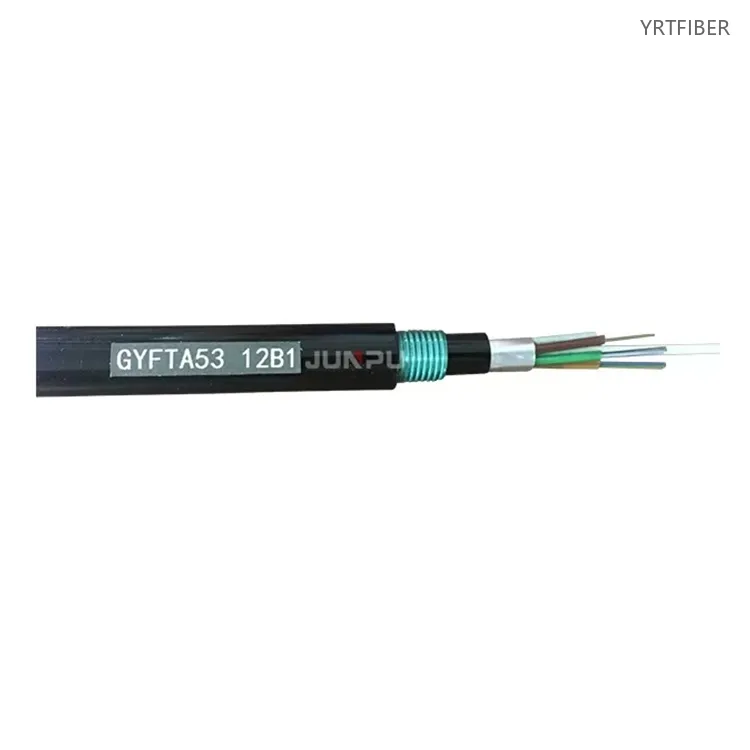
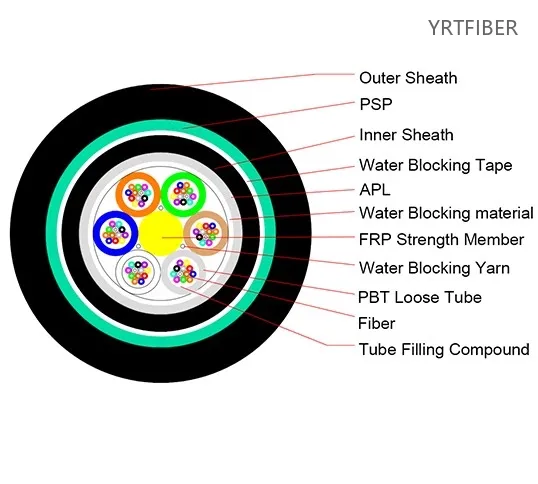
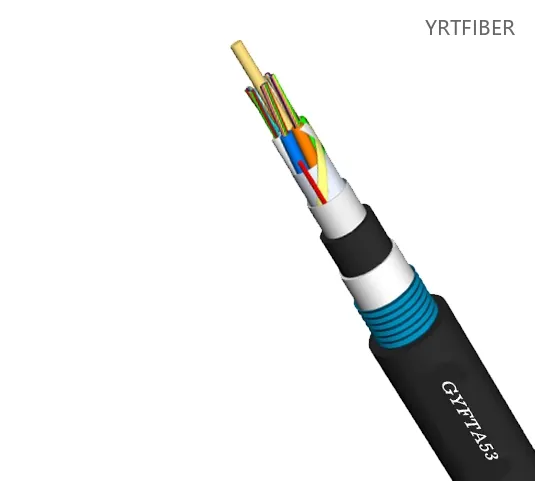
GYFTA53 Direct Burial Armored Fiber Optic Cable with FRP Strength Member
Good mechanical properties, good high temperature resistance, high strength loose casing, hydrolysis resistance
Special casing filler plays a key role in protecting optical fibers
Anti-extrusion, good flexibility
PSP enhanced moisture resistance
APL moisture barrier
Good water resistance
What is GYFTA53 Optical Cable?
GYFTA53 is a direct burial armored fiber optic cable designed for outdoor underground, duct and harsh-environment communication networks. It places 250 μm optical fibers inside PBT loose tubes, which are filled with tube filling compound to protect the fibers from moisture and mechanical stress.
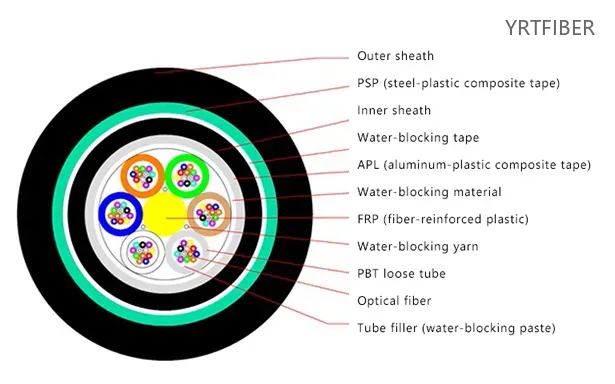
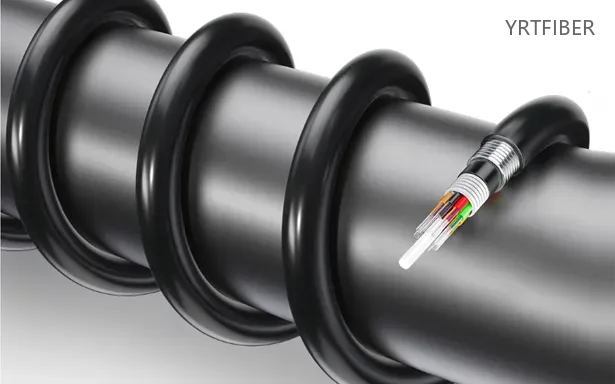
The loose tubes and fillers are stranded around a non-metallic FRP central strength member to form a compact circular cable core. The core is further protected by water-blocking yarn, water-blocking tape and an APL aluminum-polyethylene laminate moisture barrier. A PE inner sheath is applied over the cable core, followed by PSP plastic-coated steel tape armor and a PE outer sheath.
This structure provides strong moisture resistance, crush resistance and rodent protection, making GYFTA53 suitable for direct burial, duct, tunnel and other outdoor underground fiber optic network installations.
GYFTA53 Armored Fiber Cable Specification parameters
- Specification parameters
- OPTICAL CHARACTERISTICS
optical properties
| G.652 | G.655 | 50 / 125μm | 62.5/125 μm | ||
| Attenuation (+20℃) | @850nm | ≤3.0 dB/km | ≤3.0 dB/km | ||
| @1300nm | ≤1.0 dB/km | ≤1.0 dB/km | |||
| @1310nm | ≤0.36 dB/km | ≤0.40 dB/km | |||
| @1550nm | ≤0.22 dB/km | ≤0.23dB/km | |||
| Bandwidth (Class A) | @850nm | ≥500 MHz·km | ≥200 MHz·km | ||
| @1300nm | ≥1000 MHz·km | ≥600 MHz·km | |||
| Numerical Aperture | 0.200±0.015NA | 0.275±0.015NA | |||
| Cable Cut-off Wavelength | ≤1260nm | ≤1480nm | |||
| Storage/Operating temperature | -40℃ ~+70℃ | ||||
Technical parameters
| Model | Fiber Count | Tubes | Outer Diameter (mm) | Weight (kg/km) | Tensile Strength Long /Short term N | Crush Resistance N/100mm | Bending Radius Static / Dynamic mm |
| GYTC8S-2~6F | 2~6 | 1 | 9.2*18 | 215 | 600/1500 | 300/1000 | 10D/20D |
| GYTC8S-8~12F | 8~12 | 2 | 9.2*18 | 215 | 600/1500 | 300/1000 | 10D/20D |
| GYTC8S-14~18F | 14~18 | 3 | 9.2*18 | 215 | 600/1500 | 300/1000 | 10D/20D |
| GYTC8S-20~24F | 20~24 | 4 | 9.2*18 | 215 | 600/1500 | 300/1000 | 10D/20D |
| GYTC8S-26~30F | 26~30 | 5 | 9.2*18 | 215 | 600/1500 | 300/1000 | 10D/20D |
Product Structure & Composition
Outer Sheath – Mechanical & environmental protection.
PSP – Swells to block water ingress.
Inner Sheath – Extra bedding/protection layer.
Water‑blocking Tape – Prevents longitudinal water migration.
APL – APL aluminum-polyethylene laminate moisture barrier
Water‑blocking material – Powders/tapes/yarns that swell to seal gaps.
FRP Strength Member – Provides tensile strength & stiffness.
Water‑blocking Yarn – Swells to fill and block water paths.
PBT Loose Tube – Houses fibres with flexibility.
Fiber – Transmits optical signals.
Tube Filling Compound – Gel/grease protecting fibres from moisture & stress.
Benefits of GYFTA53 Armored Fiber Cable
Excellent Transmission and Mechanical Performance
Low Loss and Low Dispersion: The optical fiber itself has low loss and low dispersion, ensuring long-distance, high-quality signal transmission.
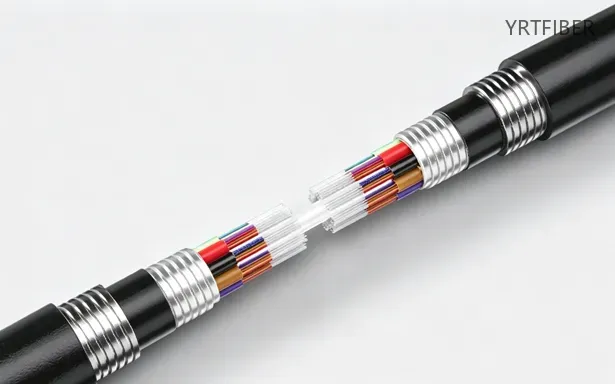
Excellent Compression and Tensile Resistance: Its double-layer metal tape longitudinal wrapping and double-layer sheath design give it outstanding tensile strength (short-term 3000N) and lateral pressure resistance (short-term 3000N/100mm), effectively withstanding pressure during construction and from the soil.
Strong Environmental Adaptability
Full-section Water Resistance and Moisture Proof: The optical cable interior is filled with water-blocking compound, achieving full-section water blocking; externally, it uses double-sided laminated corrugated steel tape and double-sided coated aluminum tape (APL) longitudinal wrapping, tightly bonded with the PE sheath, effectively preventing moisture from penetrating radially and enhancing lateral pressure resistance.
Ultra-wide Operating Temperature: Operating temperature range is -40℃ to 70℃, suitable for various harsh climates from extreme cold to high heat.
Rodent Damage Prevention: The sturdy double armor and sheath structure provide certain resistance to rodent gnawing and termites.
Long Service Life: Under normal engineering applications, its design life typically exceeds 30 years.
UV Aging Resistance: The black polyethylene (PE) outer sheath has excellent resistance to ultraviolet radiation, allowing long-term outdoor use.
Key Engineering Application Advantages
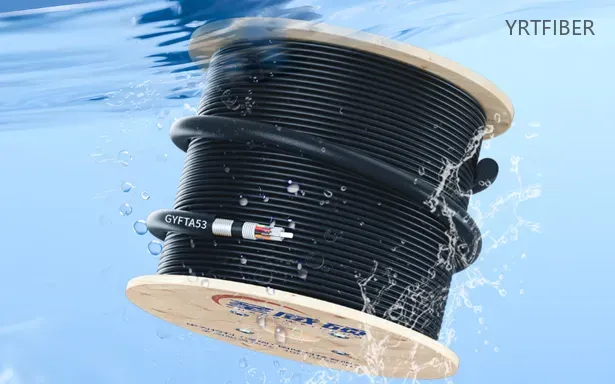
No Electromagnetic Interference (EMI): Using a non-metallic central strength member (FRP), the entire optical cable has an all-dielectric (non-metallic) structure, producing no electromagnetic induction and not being affected by external electromagnetic fields, especially suitable for areas with high electromagnetic interference, such as lightning-prone regions, high-power areas, and electrified railways.
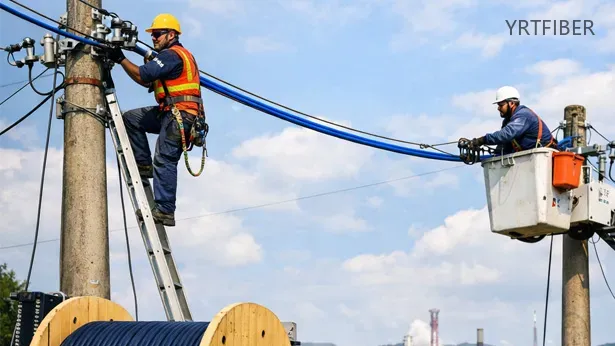
Flexible and Easy Installation: With non-metallic internal reinforcements, the optical cable is relatively lightweight, facilitating transportation and laying, thus reducing construction costs.
Optional Fire Resistance: According to project fire protection requirements, the outer sheath can be customized with low-smoke zero-halogen (LSZH) flame-retardant material, effectively reducing the generation of toxic smoke during a fire.
Engineering Applications GYFTA53 Armored Fiber Cable
Long-haul direct burial in high lightning-strike areas
In regions with over 80 thunderstorm days per year (e.g., mountainous areas in the south), GYFTA53 is used for direct burial. Its all-dielectric central strength member prevents lightning-induced breakdown, while the double steel tape armor resists side pressure and rodent damage.
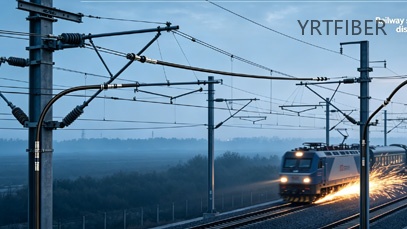
Railway communication relocation projects (electrified lines)
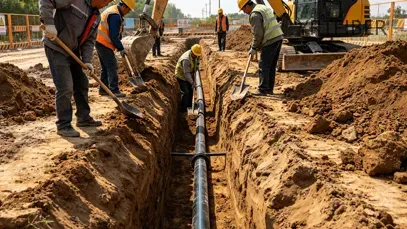
When laying communication ducts along electrified railways (e.g., high-speed rail), GYFTA53 withstands strong electromagnetic interference and traction current effects. The corrugated steel tape and aluminum laminate armor also handle dynamic pressure from train vibration and construction machinery.
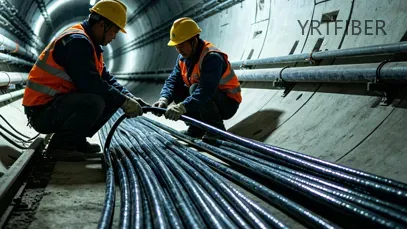
High-voltage power tunnel integrated cabling
Inside 220kV and above power tunnels, GYFTA53 is laid together with high-voltage cables. The non-metallic central member eliminates electromagnetic coupling and earth potential rise risks, while the full-section water blocking design adapts to high humidity in tunnels.
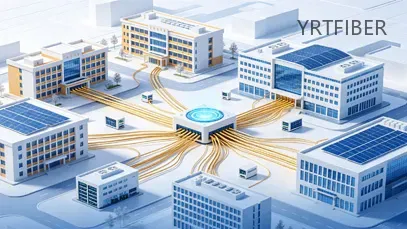
Industrial park outdoor direct burial & road-crossing ducts
In harsh environments such as chemical or steel plants, GYFTA53 connects workshops and the central control room. The outer sheath resists UV and oil contamination, and the steel tape armor withstands heavy vehicle pressure and accidental digging, ensuring long-term link stability.
Shipping & Packaging
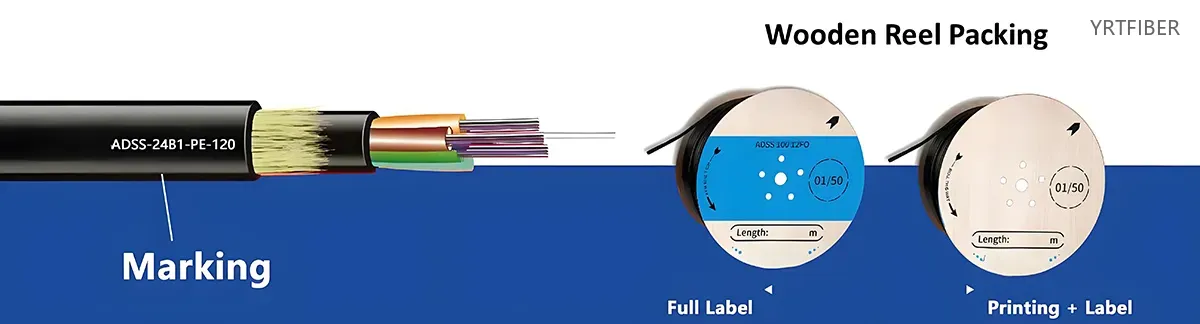
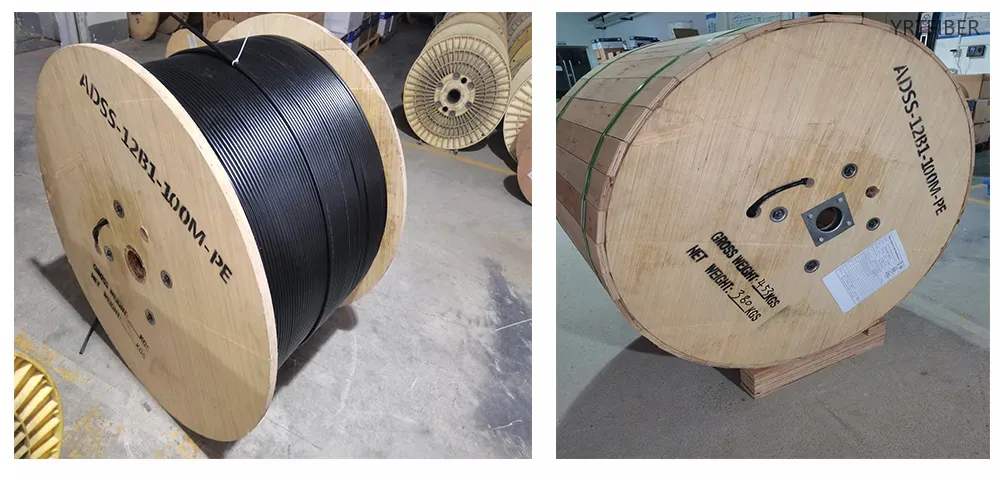
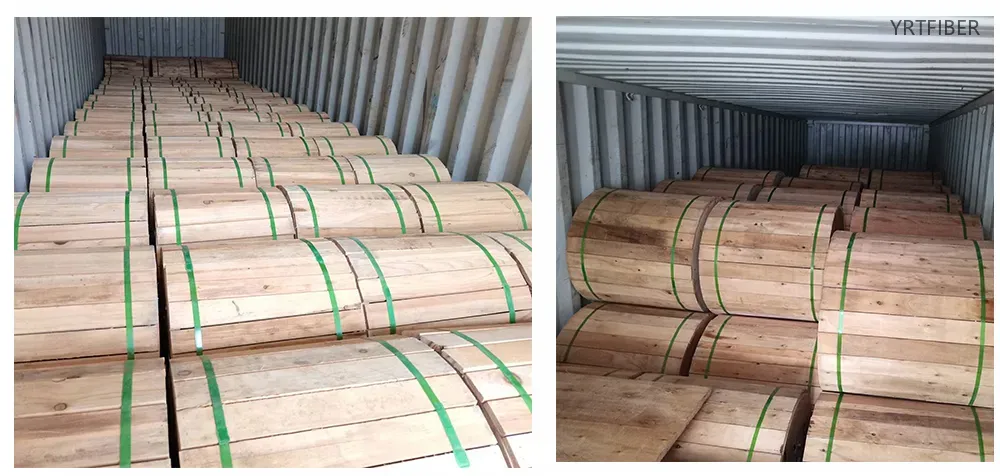
Packaging Requirements:
1:All cables shall be wound on treated wooden spools that are not returnable
2:Cable ends must be firmly secured to the spool and protected with waterproof shrink caps
3:Each spool must include:
A protective outer layer of plastic wrapping
Reinforcing wooden slats to ensure stability
At least 1 meter of free cable end reserved for testing
A standard spool length of 3000mm (with a permissible tolerance of ±2%)
Cable Identification:
The outer jacket must display:
1、Unique sequential numbering every 1m (±1% variance permitted)
2、 Additional repeating markings at 1m intervals showing:
Product code and fiber count
Manufacturer identification
Production date (month/year)
Total cable length
Standard Packaging Dimensions:
| Length | Container | Size (L×W×H) | Net Mass | Total Mass |
|---|---|---|---|---|
| 2 km | Wood spool | 90×75×90 cm | 156 kg | 220 kg |
| 3 km | Wood spool | 100×68×100 cm | 240 kg | 280 kg |
| 4 km | Wood spool | 109×75×109 cm | 300 kg | 368 kg |
| 5 km | Wood spool | 129×72×129 cm | 400 kg | 480 kg |
Technical Reference:
1、 Standard cable diameter: 10.0mm
2、Maximum span distance: 100m
3、Contact sales team for complete technical specifications
Spool Marking Standards:
Permanent markings (minimum 25-30mm height) must appear on both sides of each spool:
1、 Company name and trademark
2、Contained cable length
3、Cable specifications (type/fiber count)
4、Winding orientation
5、Weight measurements (gross/net)
Note: All wooden packaging materials must undergo proper fumigation treatment prior to use.
Product Comparison:
GYFTA53 vs GYTZA53 vs GYTZS
| Feature / Dimension | GYFTA53 (Non-Metallic Strength + Aluminum Tape Armor) | GYTZA53 (Metallic Strength + Aluminum Tape Armor + LSZH) | GYTZS (Metallic Strength + Steel Tape Armor + LSZH) |
|---|---|---|---|
| Structure Type | Stranded loose tube around non-metallic FRP central strength member. | Stranded loose tube around metallic central strength member (steel wire). | Stranded loose tube around metallic central strength member (steel wire). |
| Armor Layers | Double armor: inner layer – corrugated aluminum tape (APL), outer layer – corrugated steel tape (PSP). | Double armor: inner layer – laminated aluminum tape, outer layer – corrugated steel tape. | Single armor: corrugated steel tape (CST) + optional fire-resistant tape layer. |
| Sheath Material | Inner: PE; Outer: PE. PE sheath provides UV resistance for outdoor exposure. | Inner: LSZH; Outer: LSZH. LSZH ensures low smoke, halogen‑free, flame‑retardant performance. | LSZH outer sheath – flame‑retardant, low smoke, halogen‑free. |
| Fiber Core Capacity | 2 – 216 cores (up to 432 cores in some designs). | 2 – 216 cores (up to 432 cores). | 2 – 288 cores (up to 432 cores). |
| Typical Applications | Direct burial, duct, aerial (with messenger). Suitable for high‑voltage corridors, lightning‑prone areas (FRP non‑metallic core), general outdoor backbone and metro networks requiring double armor protection. | Direct burial, duct. Suitable for fire‑sensitive areas: tunnels, subway entry sections (≥500m), power plants, chemical plants, high‑rise building entry – where both high mechanical strength and LSZH flame‑retardancy are required. | Duct, aerial (with messenger), direct burial (light duty). Suitable for indoor/outdoor transition sections, tunnels, data center entry – where flame‑retardancy is needed but high corrosion resistance is not the top priority. |
| Engineering Pros | ① FRP non-metallic core – immune to EMI/lightning, no induced current near HV lines; ② Double armor (aluminum + steel) provides excellent crush, rodent, and impact resistance – superior moisture barrier (full‑section water‑blocking); ③ PE sheaths provide good UV and weather resistance for long‑term outdoor exposure; ④ Suitable for harsh direct burial (rocky soil, rodent‑prone areas). | ① LSZH dual sheaths – low smoke, halogen‑free, self‑extinguishing, safe for confined spaces with fire codes; ② Double armor (aluminum + steel) provides same high mechanical strength as GYFTA53; ③ Excellent crush resistance (3000N/100mm short term); ④ Suitable for direct burial in fire‑rated environments. | ① LSZH sheath provides flame‑retardancy for indoor/confined spaces; ② Single corrugated steel tape armor offers good crush and rodent resistance; ③ Steel wire central member adds tensile strength; ④ More economical than double‑armor cables when high corrosion resistance is not required. |
| Engineering Cons | ① LSZH variant not standard – PE sheath burns with smoke, not suitable for indoor/fire‑sensitive spaces; ② Double armor makes cable heavier and stiffer – larger bend radius (static 10D/12.5D); ③ Higher cost than single‑armor cables; ④ Outer steel tape requires grounding consideration near HV lines. | ① Metallic central strength member – requires grounding near HV lines, risk of induced current; ② LSZH sheath has lower UV resistance than PE – long‑term outdoor exposure may reduce lifespan; ③ Larger diameter and heavier than GYTZS; ④ Higher cost (LSZH + double armor). | ① Single steel tape armor – lower crush and corrosion resistance than double‑armor cables; ② Steel central member and steel tape – requires grounding near HV lines; ③ Aluminum tape not present – moisture barrier slightly weaker than double‑armor designs; ④ Not recommended for long‑term direct burial in wet or highly corrosive soil. |
| Flame Retardancy | None (PE sheath). Flame‑retardant variant available as GYFTZA53 (LSZH). | LSZH – certified flame‑retardant, low smoke, halogen‑free. Meets fire safety codes for tunnels, high‑rise entry sections. | LSZH – certified flame‑retardant, low smoke, halogen‑free. Suitable for indoor/confined spaces with fire safety requirements. |
| Corrosion / Moisture Resistance | Excellent – aluminum tape provides superior corrosion resistance; double armor + full‑section water‑blocking. | Excellent – same aluminum + steel double armor as GYFTA53, but LSZH sheath less UV‑resistant for long‑term outdoor exposure. | Moderate to good – steel tape can corrode if sheath damaged; moisture barrier relies on steel tape + water‑blocking compound. |
| Grounding Requirement | Not required for core (FRP is dielectric), but outer steel tape may require grounding to prevent induced current in HV environments. | Required – metallic central member and armor can induce current near HV lines. | Required – metallic central member and armor can induce current near HV lines. |
| Cost (Relative) | Medium to high – double armor adds cost, but FRP core reduces some materials vs. steel core. Economical for direct burial requiring high mechanical protection in HV corridors. | High – LSZH material + double armor + metallic core increase cost. Premium choice for fire‑rated direct burial applications. | Medium – single armor + LSZH offers good flame‑retardancy at lower cost than double‑armor designs. Most economical flame‑retardant stranded cable for light‑duty direct burial. |
| Maintenance Difficulty | Low – excellent mechanical protection reduces fault rate; aluminum tape corrosion‑resistant; PE sheaths UV‑stable, suitable for long‑term outdoor operation. | Low to medium – LSZH sheath may degrade faster under prolonged UV exposure if used outdoors; requires careful inspection in outdoor deployments. | Low – simple structure, easy to handle; but steel tape requires periodic corrosion inspection in wet environments; LSZH sheath more UV‑sensitive than PE. |
GYFTA53 Armored Fiber Cable Selection Guide
Engineering selection between GYFTA53. GYTZA53 and GYTZS:
For harsh direct burial applications requiring high mechanical strength and long‑term protection against rocks, rodents, and backfill compaction, both GYFTA53 and GYTZA53 are excellent choices due to their double armor construction (aluminum tape inner + steel tape outer). GYFTA53 uses a non-metallic FRP central strength member, making it the preferred option for installation near high-voltage power lines or in lightning-prone areas, as it eliminates induced current and requires no grounding for the core. GYTZA53. on the other hand, uses a metallic central strength member and LSZH dual sheaths, providing flame-retardancy and low smoke emission – mandatory for fire‑rated environments such as tunnels, subway entry sections (typically ≥500m per segment), power plants, and high‑rise building access routes.
GYTZS features single corrugated steel tape armor with an LSZH outer sheath, offering flame-retardancy at a lower cost than double‑armor designs. It is suitable for indoor/outdoor transition sections, tunnels, data center entry, and light‑duty direct burial where high corrosion resistance is not the top priority. However, its single steel tape provides lower crush resistance and moisture barrier compared to GYFTA53/GYTZA53. and its metallic core requires grounding near HV lines.
Flame‑retardant and fire safety requirements:
For core network entry sections, tunnels, subway stations, high‑rise building risers, and any confined space where fire safety codes mandate low smoke and halogen‑free performance, GYTZA53 (double armor + LSZH) or GYFTZA53 (non-metallic core variant) are the correct choices. Standard GYFTA53 uses PE sheaths which are UV‑resistant for long‑term outdoor exposure but are not flame‑retardant – they burn and produce dense smoke, failing building code requirements for indoor or fire‑sensitive areas. GYTZS offers LSZH flame‑retardancy but with only single steel tape armor, suitable for applications where mechanical protection requirements are moderate.
Corrosion and UV resistance considerations:
GYFTA53 with PE sheaths provides excellent UV and weather resistance for long‑term outdoor direct burial or aerial exposure. The aluminum tape inner armor offers superior corrosion resistance compared to steel‑only designs, making it well‑suited for wet soil or coastal environments. GYTZA53 and GYTZS use LSZH sheaths which have slightly lower UV resistance than PE – prolonged outdoor exposure (e.g., long‑term aerial or shallow burial in sunny climates) may accelerate sheath degradation. For outdoor deployments requiring both flame‑retardancy and UV stability, consult manufacturers about LSZH formulations with enhanced UV resistance, or consider armoring with an additional outer PE layer.
Choose GYFTA53 when: Direct burial in rocky or rodent‑prone soil, long‑term outdoor exposure is required, installation is near high‑voltage lines or lightning‑prone areas (FRP non‑metallic core), and flame‑retardancy is not required.
Choose GYTZA53 when: Direct burial is required in fire‑rated environments – tunnels, subway entry sections, power plants, high‑rise building access – and both high mechanical protection and LSZH flame‑retardancy are mandatory.
Choose GYTZS when: Indoor/outdoor transition, tunnel or data center entry requires LSZH flame‑retardancy, mechanical protection requirements are moderate (light‑duty direct burial or duct), and budget is a primary constraint.
GYFTA53 Cable Installation Instructions (Short)
Handling & Sheath Stripping – Use proper tools to remove outer sheath, steel tape, and APL layer without damaging the inner components.
Bending Radius – Dynamic bending radius: ≥20× cable OD; Static: ≥10× cable OD.
Tension – Max allowable pulling tension: 3000N. Use a pulling grip on the strength members.
Crushing Resistance – Avoid side pressure exceeding 3000N/100mm during installation.
Installation Environment – Suitable for direct burial, duct, tunnel, and aerial installation. Avoid sharp edges and excessive twists.
Water Blocking – Cable is fully water-blocked; no special sealing required for splices, but ensure proper closure.
Temperature – Installation temperature range: -20℃ to +60℃.
Download YRTFIBER Product Catalog
Factory Real Shot
Complete optical cable production line
We have a complete optical cable production line with an annual output of over 100.000 kilometers of optical cable.
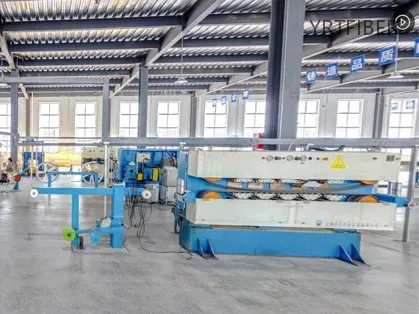
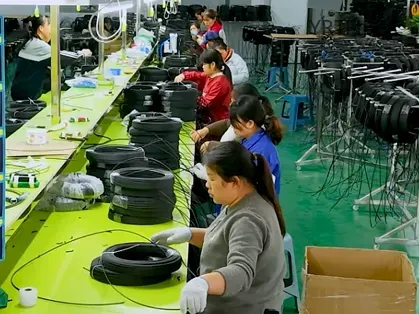
Skilled workers
The factory has a team of skilled workers, and this stable workforce ensures our product quality and delivery capabilities.
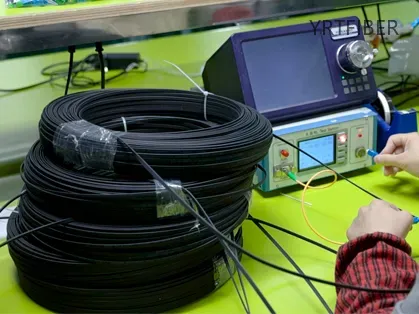
Quality Control Laboratory
Routine tests include tensile strength, crush resistance, temperature cycling, and water penetration to ensure compliance with industry standards.
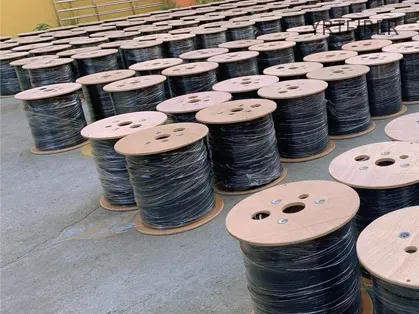
Final Coiling & Packaging Zone
Finished cables are precisely coiled onto wooden or steel reels, wrapped with protective materials, and labeled for shipment.
Frequently Asked Questions & Quick Inquiry
GYFTA53 Armored Fiber Cable FAQ
1. What's the core advantage of GYFTA53 compared to GYTS or GYTA?
GYFTA53 features non-metallic strength members (like FRP or aramid yarn) while still providing steel tape armor. It offers electrical isolation, making it ideal for high-voltage zones or EMI-prone environments, where traditional metallic cables may be unsafe.
2. Is this cable suitable for direct burial?
Yes. GYFTA53 is designed for direct burial and harsh outdoor environments. Its double PE jackets, corrugated steel tape armor, and water-blocking design ensure long-term durability underground.
3. Can this cable be used near power lines or substations?
Absolutely. Its all-dielectric core ensures no conductivity, while its outer steel armor provides mechanical protection. This makes GYFTA53 perfect for power utility networks, substations, and electrically noisy areas.
4. What fiber counts and types are supported?
GYFTA53 supports G.652D and G.655 single-mode fibers, in configurations from 2 to 144 cores, making it suitable for backbone, access, or FTTx networks.
5. Is this cable flame-retardant or rodent-proof?
The outer sheath can be customized with flame-retardant materials, and the corrugated steel tape armor provides a good level of rodent resistance. For enhanced flame performance, consider combining with LSZH jackets.
Send Your Inquiry
Fill out the form below and we'll get back to you within 24 hours.


