

 Español
 Português
 لالعربية
 Русский
 Bahasa Indonesia
 Français
 Türkçe
 Bahasa Melayu

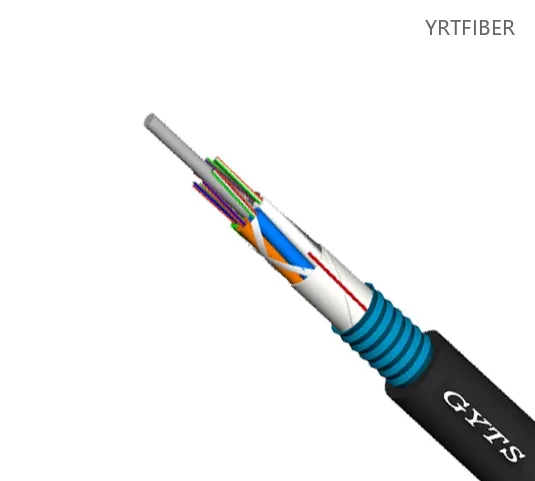
GYTS Stranded Loose Tube Armored Fiber Optic Cable – Steel Tape Armor, G.652D/G.655
Good mechanical and temperature performance
High-strength loose casing, resistant to hydrolysis
Special casing packing compounds ensure critical protection of the fiber
The specially designed compact structure prevents loose casing shrinkage
Premium PE sheath protects optical cables from UV radiation
PSP enhanced moisture resistance
What is GYTS Armored Fiber Optic Cable?
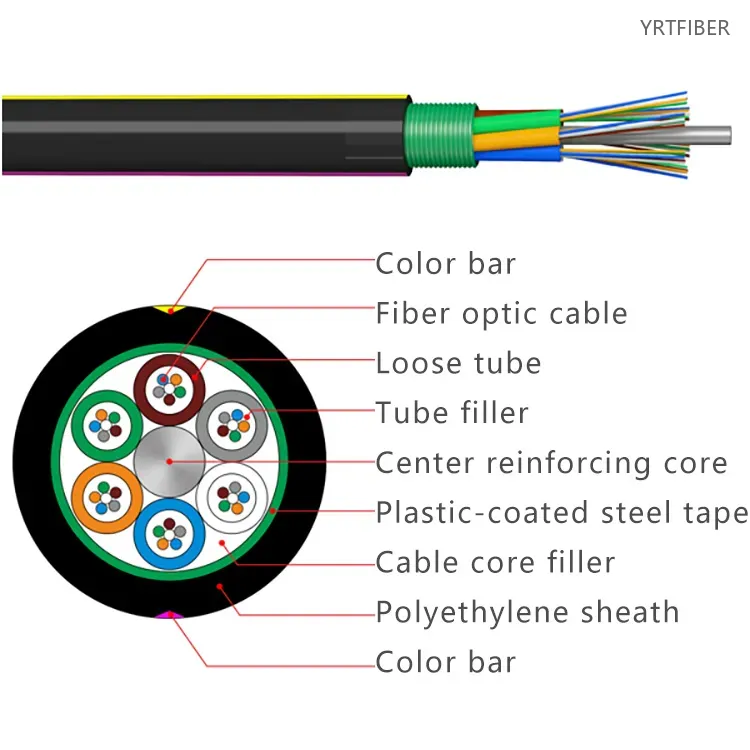
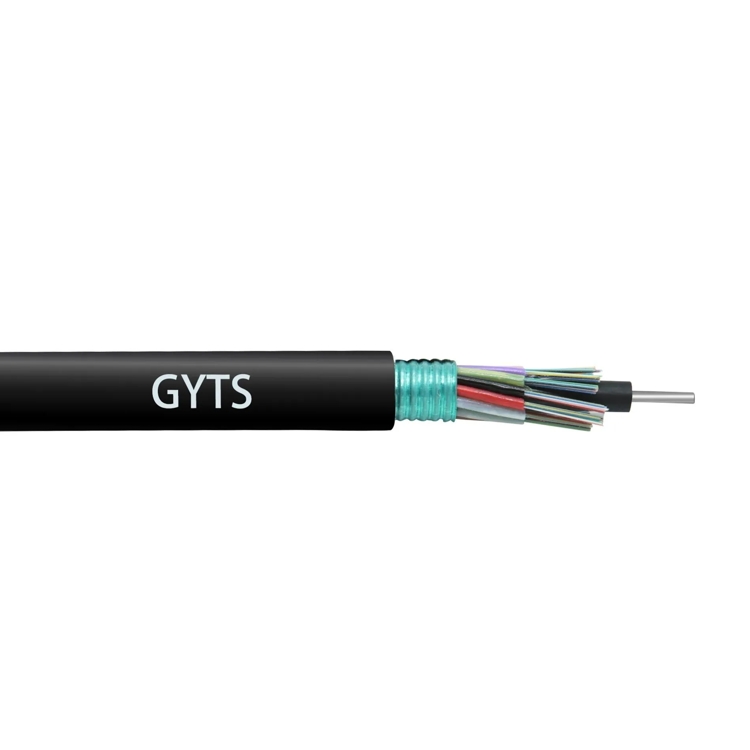
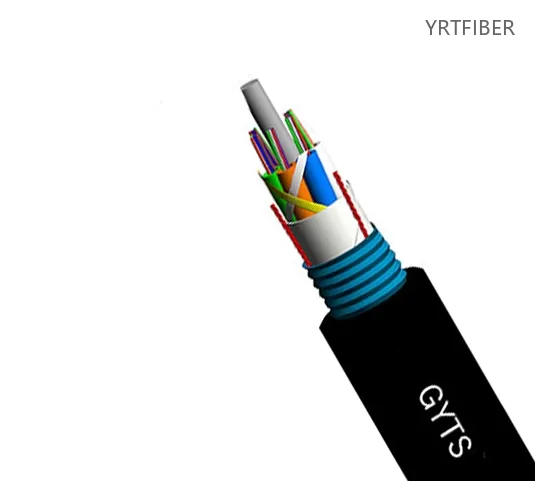
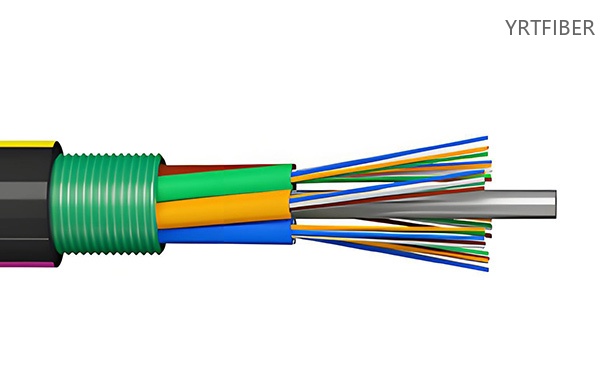
GYTS is a stranded loose tube armored fiber optic cable designed for robust outdoor use. At its core, 250 μm optical fibers are housed in high-modulus PBT loose tubes filled with a waterproof compound, ensuring critical fiber protection. A central steel wire acts as the metallic strength member, around which the gel-filled tubes and water-swellable fillers are helically stranded to form a compact, round cable core. For mechanical armor and moisture defense, a PSP (corrugated steel tape coated with copolymer) is applied longitudinally over the core, and the entire assembly is flooded with a water-blocking compound before being completed with a tough PE outer sheath. This construction gives GYTS its armored character, delivering excellent crush resistance, rodent protection, longitudinal watertightness, and high tensile strength - making it ideal for direct burial, duct, and outdoor aerial installations where physical protection and long-term reliability are paramount.
GYTS Steel Tape Armored Optical Cable Specification parameters
- Specification parameters
- OPTICAL CHARACTERISTICS
| G.652 | G.655 | 50 / 125μm | 62.5/125 μm | ||
| Attenuation (+20℃) | @850nm | ≤3.0 dB/km | ≤3.0 dB/km | ||
| @1300nm | ≤1.0 dB/km | ≤1.0 dB/km | |||
| @1310nm | ≤0.36 dB/km | ≤0.40 dB/km | |||
| @1550nm | ≤0.22 dB/km | ≤0.23dB/km | |||
| Bandwidth (Class A) | @850nm | ≥500 MHz·km | ≥200 MHz·km | ||
| @1300nm | ≥1000 MHz·km | ≥600 MHz·km | |||
| Numerical Aperture | 0.200±0.015NA | 0.275±0.015NA | |||
| Cable Cut-off Wavelength | ≤1260nm | ≤1480nm | |||
| Storage/Operating temperature | -40℃ ~+70℃ | ||||
Technical parameters
| Model | Fiber cores | Tubes | Diameter (mm) | Weight (kgs/km) | Tensile (N) | Crush (N) | Bending radius | ||
| Long term | Short term | Long term | Short term | Static/ Dynamic | |||||
| GYTS-12~36F | 12~36 | 2~6 | 9.5 | 100 | 1000 | 1500 | 300 | 1000 | 10D/20D |
| GYTS-38~72F | 38~72 | 2~6 | 11 | 155 | 1500 | 3000 | 300 | 1000 | 10D/20D |
| GYTS-74~96F | 74~96 | 7~8 | 13.6 | 192 | 1900 | 3000 | 300 | 1000 | 10D/20D |
| GYTS-98~120F | 98~120 | 9~10 | 15 | 225 | 2200 | 3000 | 300 | 1000 | 10D/20D |
| GYTS-122~144F | 122~144 | 11~12 | 16.9 | 277 | 2700 | 3000 | 300 | 1000 | 10D/20D |
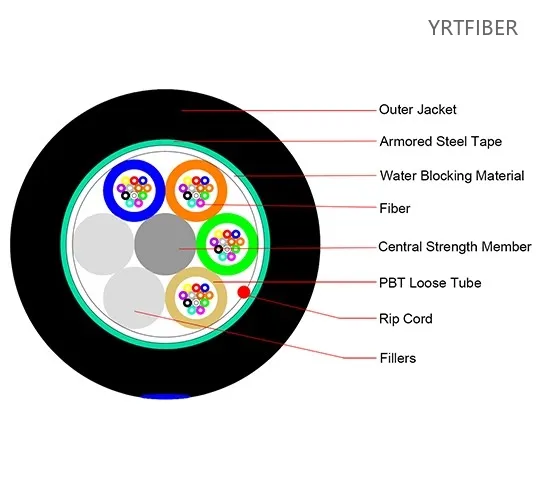
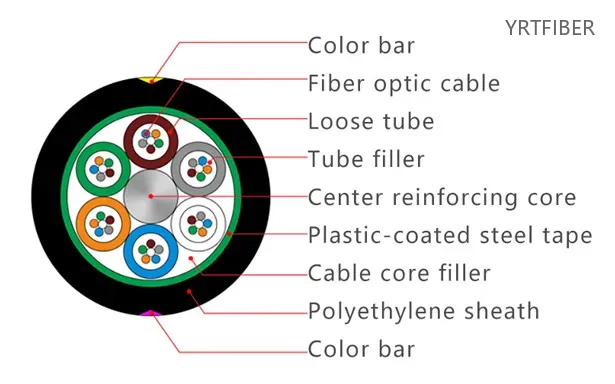
Product Structure & Composition
Outer Jacket – PE sheath, UV/moisture/abrasion resistant.
Armored Steel Tape – Corrugated steel armor for rodent/crush protection.
Water Blocking Material – Swellable compound/tape to block longitudinal water ingress.
Fiber – 250 µm single‑mode fiber carrying the data signal.
Central Strength Member – Steel wire providing tensile strength and core backbone.
PBT Loose Tube – High‑modulus tube housing fibers, isolating stress.
Rip Cord – Strong yarn for easy jacket removal during termination.
Fillers – Strands filling core gaps to maintain round, compact structure.
Benefits of GYTS Steel Tape Armored Optical Cable
1. Superior Fiber Protection and Structural Integrity
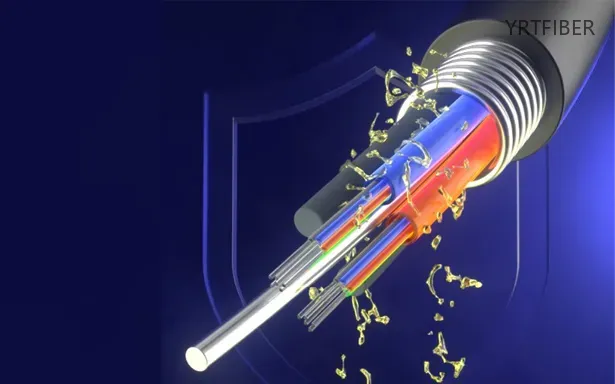
The GYTS cable ensures long-term fiber reliability through a hydrolysis-resistant PBT loose tube and a specially engineered filling compound that cushions and shields the fiber from moisture and mechanical shock. Its compact, stranded core design is structurally locked to prevent loose tube shrinkage, maintaining consistent fiber excess length and avoiding microbending losses even under temperature cycling or tensile load.
2. Outstanding Environmental and Mechanical Durability
Excellent mechanical and temperature performance is delivered by the central steel strength member and the overall robust construction, which withstands heavy pulling tension and extreme temperatures. The premium PE outer sheath provides strong UV and abrasion resistance for long outdoor life, while the longitudinal PSP (corrugated steel tape) adds mechanical armor and significantly enhances moisture resistance, making the cable ideal for direct burial and duct applications.
Engineering Applications GYTS Steel Tape Armored Optical Cable
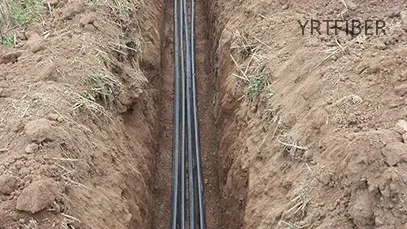
Long-distance Backbone Network Direct Buried Installation
GYTS optical cable with longitudinally wrapped steel tape armor has strong compression and rodent-proof capabilities and can be directly buried in 1.2-meter deep trenches without additional protective pipes.
The cable core filled with compound material along with PSP water-blocking tape ensures that even in permanently humid buried environments, the optical fibers remain unharmed by water over the long term.
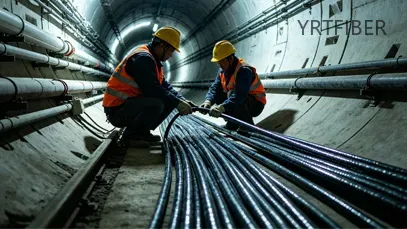
Urban Municipal Duct Deployment
In areas where urban underground duct resources are limited, GYTS optical cable has a compact diameter and high tensile strength, making it suitable for long-distance mechanical pulling or blowing installation.
The corrugated steel tape provides excellent lateral compression resistance, able to withstand duct settlement and manhole pressure, ensuring the optical link remains continuously stable.
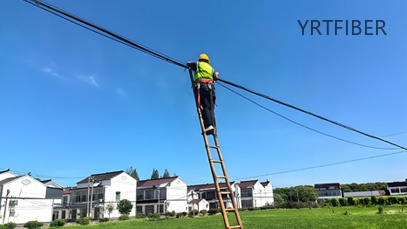
Outdoor Overhead and Complex Terrain Transmission
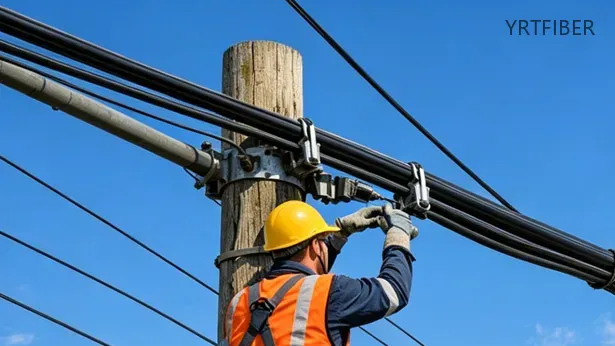
In mountainous areas, forests, or on power poles, GYTS optical cable can use the tensile strength provided by the central steel wire and armored layer for self-supporting or lifted line overhead installation.
The PE outer sheath resists UV aging, and the steel tape prevents damage from squirrels and other animals, maintaining very high durability even in unattended outdoor environments.
Shipping & Packaging
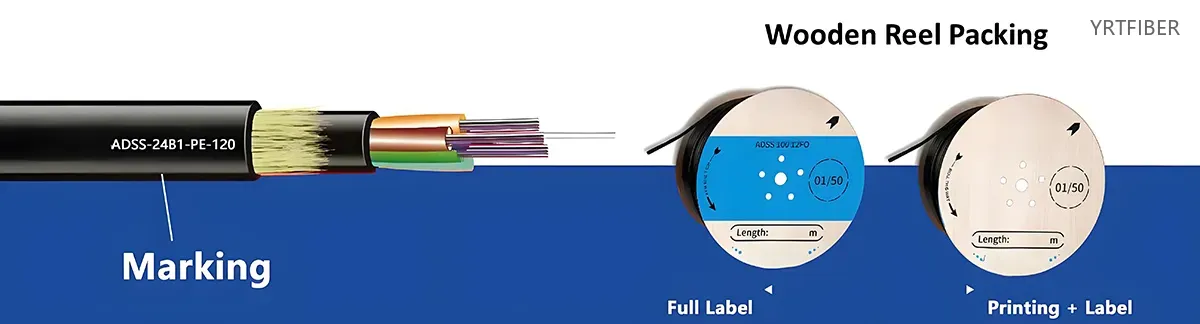
Packaging Requirements:
1:All cables shall be wound on treated wooden spools that are not returnable
2:Cable ends must be firmly secured to the spool and protected with waterproof shrink caps
3:Each spool must include:
A protective outer layer of plastic wrapping
Reinforcing wooden slats to ensure stability
At least 1 meter of free cable end reserved for testing
A standard spool length of 3000mm (with a permissible tolerance of ±2%)
Cable Identification:
The outer jacket must display:
1、Unique sequential numbering every 1m (±1% variance permitted)
2、 Additional repeating markings at 1m intervals showing:
Product code and fiber count
Manufacturer identification
Production date (month/year)
Total cable length
Standard Packaging Dimensions:
| Length | Container | Size (L×W×H) | Net Mass | Total Mass |
|---|---|---|---|---|
| 2 km | Wood spool | 90×75×90 cm | 156 kg | 220 kg |
| 3 km | Wood spool | 100×68×100 cm | 240 kg | 280 kg |
| 4 km | Wood spool | 109×75×109 cm | 300 kg | 368 kg |
| 5 km | Wood spool | 129×72×129 cm | 400 kg | 480 kg |
Technical Reference:
1、 Standard cable diameter: 10.0mm
2、Maximum span distance: 100m
3、Contact sales team for complete technical specifications
Spool Marking Standards:
Permanent markings (minimum 25-30mm height) must appear on both sides of each spool:
1、 Company name and trademark
2、Contained cable length
3、Cable specifications (type/fiber count)
4、Winding orientation
5、Weight measurements (gross/net)
Note: All wooden packaging materials must undergo proper fumigation treatment prior to use.
Product Comparison:
GYTS vs GYTA vs GYTZS
| Dimension | GYTS (Steel Tape Armor) | GYTA (Aluminum Tape Armor) | GYTZS (Steel Tape + LSZH Sheath) |
|---|---|---|---|
| Armor Material | Corrugated steel tape (PSP) | Corrugated aluminum tape (APL) | Corrugated steel tape (PSP) |
| Tensile Strength (short‑term) | ≤1500 N (typical for 12‑core) | ≤1500 N (similar to GYTS) | ≤1500 N (similar mechanical construction) |
| Crush Resistance | High (steel tape provides excellent side pressure resistance) | Moderate (aluminum tape is softer, less crush resistant) | High (same steel tape as GYTS) |
| Moisture / Corrosion Resistance | Good, but steel tape can rust if sheath is damaged | Excellent - aluminum tape naturally resists corrosion, better for damp environments | Good (same steel tape as GYTS, but LSZH sheath is less resistant to long‑term outdoor UV) |
| Fire / Smoke Performance | PE sheath - burns with smoke, not flame‑retardant | PE sheath - same as GYTS | LSZH - low smoke, halogen‑free, self‑extinguishing |
| Typical Applications | Aerial (with messenger), duct, direct burial. General outdoor use where high mechanical strength is needed. | Aerial, duct. Preferred for wet or coastal areas where corrosion is a concern. | Indoor (riser/plenum), tunnels, ships, or any enclosed space requiring fire safety. Not recommended for long‑term outdoor exposure. |
| Installation Flexibility | Stiffer due to steel tape, larger minimum bend radius (≥12.5xOD static) | More flexible than GYTS (aluminum tape is lighter and softer) | Similar stiffness to GYTS, but LSZH sheath may be slightly more brittle in cold temperatures |
| Cost (Relative) | Medium (standard choice, good cost‑performance) | Medium‑low (aluminum is cheaper than steel tape) | Medium‑high (LSZH material adds cost) |
GYTS Steel Tape Armored Optical Cable Selection Guide
GYTS Armored Fiber Optic Cable - Brief Installation Guidelines
Handle GYTS cable with care to avoid damaging the corrugated steel armor and outer PE sheath. Maintain a minimum dynamic bending radius of 20 times the cable diameter during pulling, and a static radius of 10 times after placement. Apply pulling force only to the central strength member using a pulling grip and swivel, never exceeding the rated tensile load. Before installation, seal cable ends with heat‑shrink caps to prevent water migration into the water‑blocking core. For outdoor or direct‑burial applications, bond the metallic armor tape to the site grounding system at both ends. In vertical runs, secure the cable at 1‑meter intervals, and always store spare coils in a dry area with end caps intact.
Download YRTFIBER Product Catalog
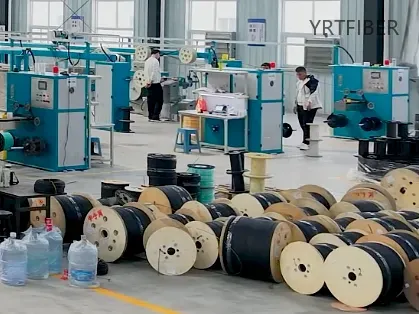
Factory Real Shot
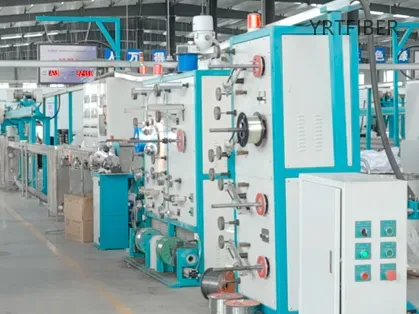
Fully Integrated Optical Cable Manufacturing Facility
Our production floor runs a complete, uninterrupted process chain - fiber coloring, secondary coating, loose tube stranding, and double-layer sheath extrusion - all under one roof, enabling end-to-end quality control and maximum efficiency.
Work zones are meticulously separated into fiber coloring, loose tube extrusion, cable stranding, armored jacketing, and final testing & packaging stations, ensuring a contamination-free flow from raw input to finished drum.
Guaranteed On-Schedule Delivery
Every custom order is production-scheduled strictly against the contracted timeline, and the build plan is executed without deviation to meet shipment deadlines.
A dedicated order coordinator follows each project from material allocation through final inspection, serving as a single point of accountability to deliver exactly on the agreed date.
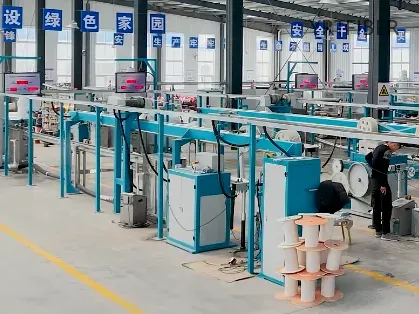
Continuous Production Line Availability
Hot-standby extruder heads and dual-station pay-off racks enable instant specification changeovers or maintenance actions with zero line shutdown, preserving throughput and on-time output.
Strategic consumables - steel tape, PE compound, and water-blocking fillers - are linked to an automated monitoring system that triggers advance replenishment alerts, eliminating any risk of stockout-induced stoppages.
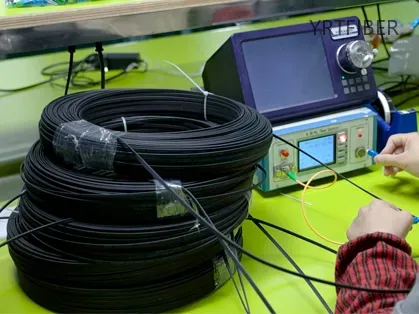
Deep OEM/ODM Customization Capability
We customize every detail to your specifications: jacket color, cable print legend, spool dimensions, and packaging format, all driven by your drawings or reference samples.
Fully neutral packaging without any factory logo is available, as well as branded labeling and custom-printed film wrap featuring your identity and part numbers.
Our ODM service covers the complete development cycle - from concept structure design and material selection through rapid sample verification - fully orchestrated by experienced cable engineers.
Frequently Asked Questions & Quick Inquiry
GYTS Steel Tape Armored Optical Cable FAQ
1. Is the GYTS cable suitable for direct burial without additional protection?
Yes. GYTS is specifically designed for direct burial applications. Its corrugated steel tape armor and polyethylene outer sheath offer excellent protection against mechanical pressure, soil moisture, and rodent damage, eliminating the need for extra conduits in many cases.
2. What’s the difference between GYTS and GYTA cables? Which one should I choose?
While both are outdoor armored cables, GYTS uses steel tape armor, making it more robust and affordable for general environments. GYTA uses aluminum tape armor, which offers better electromagnetic interference (EMI) resistance.
Choose GYTS for standard outdoor duct or buried routes, and GYTA for electrically noisy areas or near power lines.
3. Can this cable be installed in flooded or high-moisture environments?
Yes. GYTS has water-blocking gel in the loose tubes and moisture-resistant armor, making it highly reliable in wet or flood-prone underground conditions.
4. How many fibers does the GYTS cable support?
GYTS cables are available in multiple fiber counts — typically from 2 to 144 cores, using G.652D or G.655 single-mode fibers. The exact configuration can be customized based on your project requirements.
5. Is GYTS suitable for long-distance or backbone network applications?
Absolutely. GYTS combines low attenuation G.652D/G.655 fibers with excellent environmental protection, making it well-suited for backbone transmission, highway, railway, or rural broadband projects.
6. What’s the expected lifespan and maintenance of this cable?
When properly installed, GYTS cables can last over 25 years. Thanks to their durable structure, they require minimal maintenance, especially in underground deployments.
Send Your Inquiry
Fill out the form below and we'll get back to you within 24 hours.


