

 Español
 Português
 لالعربية
 Русский
 Bahasa Indonesia
 Français
 Türkçe
 Bahasa Melayu


100GBASE QSFP28 BiDi Optical Module
What Makes YRTFIBER 100GBASE QSFP28 BiDi the Right Choice?
YRTFIBER 100GBASE QSFP28 BiDi optical modules transmit and receive 100G Ethernet signals over one single-mode fiber by using different wavelengths in each direction. Simplex LC connectivity and matched U/D transceiver pairs help network operators add high-capacity links while preserving fiber resources in data-center interconnect, telecom, ISP, mobile transport and enterprise networks.
The product family covers 10km, 20km, 40km and 80km transmission requirements. NRZ or PAM4 solutions can be selected according to the host platform, FEC capability and existing network architecture, while custom firmware coding is available for specified switches, routers and transport equipment.
100GBASE QSFP28 BiDi Specification parameters
- Specification parameters
- OPTICAL CHARACTERISTICS
| Part Number | Data Rate | Wavelength | TX | Sensitivity | Distance | Connector | Temperature | Datasheet |
|---|---|---|---|---|---|---|---|---|
| AE-Q28-BX10-U | 100G | TX1270/RX1330nm | -1.4~4.5dBm | -5.1dBm | 10KM | Simplex LC | 0~70°C |  |
| AE-Q28-BX10-D | 100G | TX1330/RX1270nm | -1.4~4.5dBm | -5.1dBm | 10KM | Simplex LC | 0~70°C | |
| AE-Q28-BX20-U | 100G | T1290nm/R1310nm | -0.2~6dBm | -7.6dBm | 20KM | Simplex LC | 0~70°C | |
| AE-Q28-BX20-D | 100G | T1310nm/R1290nm | -0.2~6dBm | -7.6dBm | 20KM | Simplex LC | 0~70°C | |
| AE-Q28-BX40-U | 100G | T1304.58nm/R1309.14nm | 1.7~7.1dBm | -13.8dBm | 40KM | Simplex LC | 0~70°C | |
| AE-Q28-BX40-D | 100G | T1309.14nm/R1304.58nm | 1.7~7.1dBm | -13.8dBm | 40KM | Simplex LC | 0~70°C | |
| AE-Q28-BX80-U | 100G | 1270nm/1310nm | 1~7dBm | -22dBm | 80KM | Simplex LC | 0~70°C | |
| AE-Q28-BX80-D | 100G | 1310nm/1270nm | 1~7dBm | -22dBm | 80KM | Simplex LC | 0~70°C | |
Product Structure & Composition
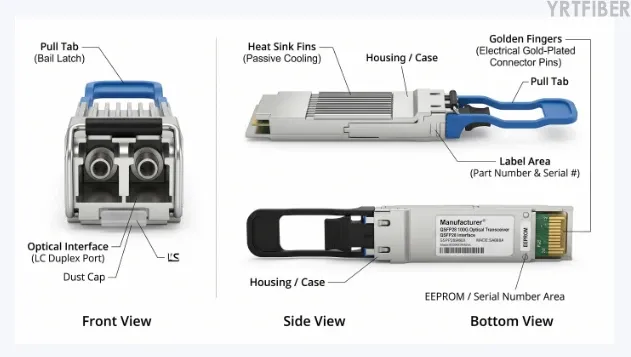
The compact QSFP28 housing integrates high-speed electrical lanes, optical transmit and receive components, wavelength filters, control circuitry, digital diagnostic monitoring and a host connector. Internal wavelength-division components combine the transmit and receive optical paths onto one simplex LC port, allowing both directions to share a single fiber strand.
Benefits of 100GBASE QSFP28 BiDi
Saves Fiber Resources
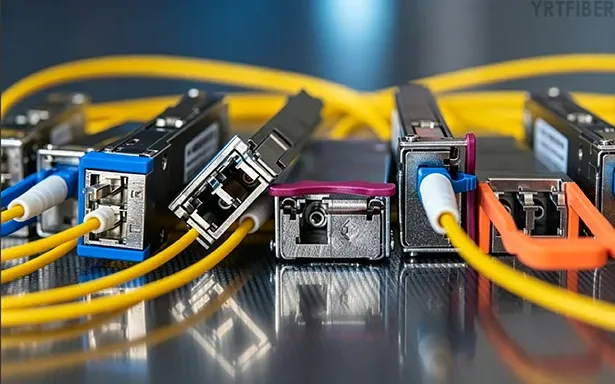
Transmits and receives over a single fiber strand, cutting fiber usage by 50% compared with standard 100G modules. Uses a duplex LC connector instead of MPO cabling.

Lowers Total Cost
Reduces cabling and infrastructure costs, making it ideal for upgrading existing 10G/25G/40G networks to 100G over existing duplex LC fiber.
Easy Deployment
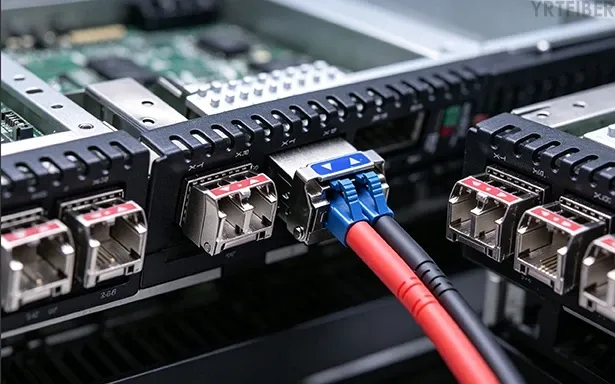
Plug-and-play design with no external Mux/DeMux required. Compliant with QSFP28 MSA and IEEE standards, supporting hot-plug and DDM/DOM.
Low Power, High Density: Around 4W power consumption and a compact QSFP28 form factor for high-density switch and router deployment.

Long Reach & Stable Performance
Supports 10km, 20km, 40km, and specialized 80km links over single-mode fiber, with PAM4 and KP4 FEC for reliable transmission.
Engineering Applications 100GBASE QSFP28 BiDi
Data Center Interconnect
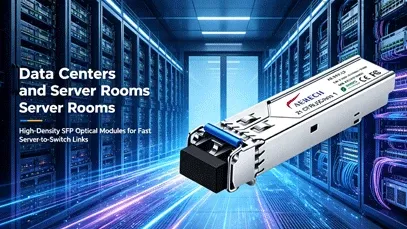
Connect data-center buildings or facilities with 100G Ethernet over one single-mode fiber strand.
BiDi modules help preserve limited fiber capacity between sites and simplify future bandwidth expansion.
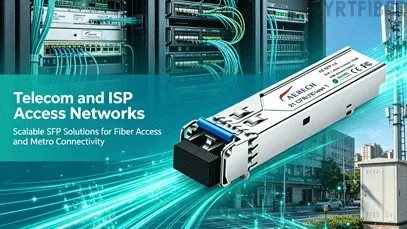
Telecom and ISP Networks
Deploy 100G aggregation, metro and backbone links through existing single-fiber routes.
Choose 10km, 20km, 40km or 80km pairs according to the route length and complete optical-loss calculation.
Mobile Transport Networks
Increase bandwidth between access, aggregation and core locations without consuming an additional fiber strand.
Confirm modulation and FEC compatibility with the mobile transport platform before selecting NRZ or PAM4.

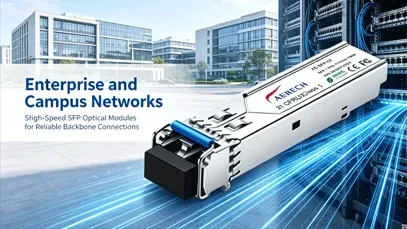
Enterprise and Campus Backbones
Upgrade building-to-building and campus core links where only one suitable single-mode fiber is available.
The simplex LC interface supports straightforward point-to-point cabling between compatible 100G devices.
Shipping & Packaging
Packaging and Shipping
Each 100G QSFP28 BiDi optical module is protected by anti-static packaging and identified with its model, U/D direction, transmit and receive wavelengths, distance and compatibility information. Clear pair labeling helps prevent wavelength-matching errors during installation.
Individual anti-static protective packaging
Clearly matched U/D pair identification
TX/RX wavelength, distance and compatibility labels
Protective inner tray or box and reinforced export carton
OEM label, serial number, barcode and packaging customization
Express, air-freight and sea-freight delivery support
Product Comparison:
NRZ vs PAM4 100G QSFP28 BiDi Optical Modules
| Comparison | NRZ BiDi | PAM4 BiDi |
|---|---|---|
| Typical Use | Existing 100G platforms designed for NRZ optical signaling | Platforms designed for 100G PAM4 optical signaling |
| Host Requirement | Host must support the selected NRZ module type | Host must support PAM4 and the required FEC mode |
| FEC | Depends on the module and host implementation | Commonly requires RS(544,514) FEC support |
| Fiber Usage | One single-mode fiber | One single-mode fiber |
| Connector | Simplex LC | Simplex LC |
| Pairing | Complementary U/D wavelengths required | Complementary U/D wavelengths required |
| Selection Priority | Match existing NRZ platform and optical budget | Confirm PAM4 and FEC support before ordering |
100G QSFP28 BiDi Reach and Wavelength Pairing
| Reach | U-Side TX / RX | D-Side TX / RX | Connector | Typical Selection Scenario |
|---|---|---|---|---|
| 10km | 1270 / 1330nm | 1330 / 1270nm | Simplex LC | Campus and short metro links |
| 20km | 1290 / 1310nm | 1310 / 1290nm | Simplex LC | Extended campus and metro access |
| 40km | 1304.58 / 1309.14nm | 1309.14 / 1304.58nm | Simplex LC | Metro aggregation and regional links |
| 80km | 1270 / 1310nm | 1310 / 1270nm | Simplex LC | Extended long-distance point-to-point links |
100GBASE QSFP28 BiDi Selection Guide
How to Select a 100GBASE QSFP28 BiDi Optical Module
Confirm the host port: Verify that both devices have compatible 100G QSFP28 ports.
Choose NRZ or PAM4: Match the optical modulation to the host platform. For PAM4 modules, confirm that the equipment supports the required RS(544,514) FEC.
Measure the fiber route: Select a 10km, 20km, 40km or 80km pair according to the actual distance and total optical loss.
Order a matched U/D pair: Install the U module at one end and its complementary D module at the other. Two U modules or two D modules cannot form a working BiDi link.
Check the fiber and connector: The referenced modules use one single-mode fiber with simplex LC connectors.
Calculate the optical budget: Include fiber attenuation, connector loss, splice loss and an engineering margin while checking receiver sensitivity and overload limits.
Confirm equipment compatibility: Provide the manufacturer, exact host model and software version for the correct firmware coding.
Check the environment: The referenced commercial-temperature modules operate from 0 to 70°C.
How to Install a 100GBASE QSFP28 BiDi Optical Module
Wear an anti-static wrist strap and verify the module distance, modulation, FEC requirement, host compatibility and U/D wavelength pair before installation. Keep the module latch closed, align the QSFP28 module with the host port and gently push it into place until fully seated. Install the U module at one end of the link and the complementary D module at the other; never connect two identical U modules or two identical D modules.
Clean and inspect both simplex LC connectors, then connect the single-mode fiber to the two modules. After configuring the 100G port and required FEC mode, verify host recognition, link status, transmit and receive optical power and error counters. If the link remains down, recheck the U/D pairing, fiber continuity, connector cleanliness, modulation and FEC settings. Keep dust caps installed whenever the module or connector is disconnected.
Download YRTFIBER Product Catalog
Factory Real Shot
Frequently Asked Questions & Quick Inquiry
100GBASE QSFP28 BiDi FAQ
What is a 100GBASE QSFP28 BiDi optical module?
It is a 100G optical transceiver that sends and receives on different wavelengths over one single-mode fiber. A working link requires two complementary modules with matched U and D wavelength directions.
How does a 100G QSFP28 BiDi module save fiber?
A conventional duplex optical link uses one fiber for transmit and another for receive. BiDi technology combines both directions onto one strand, leaving the second strand available for another service or future expansion.
Can two identical BiDi modules work together?
No. The transmit wavelength of each module must match the receive wavelength of the module at the other end. Order and install one U module and its corresponding D module.
What transmission distances are available?
The referenced product family includes 10km, 20km, 40km and 80km options. Final reach depends on the complete link loss, connector quality, splices and engineering margin.
What is the difference between NRZ and PAM4 BiDi modules?
They use different optical signaling methods and are not automatically interchangeable. Choose the version supported by the host platform. PAM4 deployments commonly require compatible RS(544,514) FEC.
Does a 100G BiDi optical module require FEC?
It depends on the selected module and host implementation. PAM4 LR1 and ER1 solutions commonly require RS(544,514) FEC. Confirm the transceiver datasheet and equipment capabilities before ordering.
Which fiber patch cord should be used?
Use a simplex LC single-mode fiber patch cord that meets the link requirements. Clean and inspect the connector end faces before installation.
Can the module be coded for my switch or router?
Yes. Custom compatibility coding is available. Provide the equipment manufacturer, exact model and software or firmware version before ordering.
Can an 80km BiDi module be used on a short link?
Only after checking the receiver overload limit and total link loss. The received optical power may be too high on a short route, so an optical attenuator can be required.
Why does the BiDi link remain down after installation?
Check that one U and one D module are installed, the wavelengths are complementary, the fiber is continuous and clean, both ports are configured for 100G, the modulation matches the host and the required FEC mode is enabled.
Do 100G QSFP28 BiDi modules support hot plugging?
QSFP28 modules are hot-pluggable in compatible equipment. Follow the equipment manufacturer's handling instructions and use proper anti-static protection during installation or removal.
What information is required for a quotation?
Please provide the quantity, distance, host equipment brand and model, required NRZ or PAM4 modulation, FEC capability, simplex LC fiber details, operating temperature, OEM labeling needs and delivery destination.
Send Your Inquiry
Fill out the form below and we'll get back to you within 24 hours.


