

 Español
 Português
 لالعربية
 Русский
 Bahasa Indonesia
 Français
 Türkçe
 Bahasa Melayu

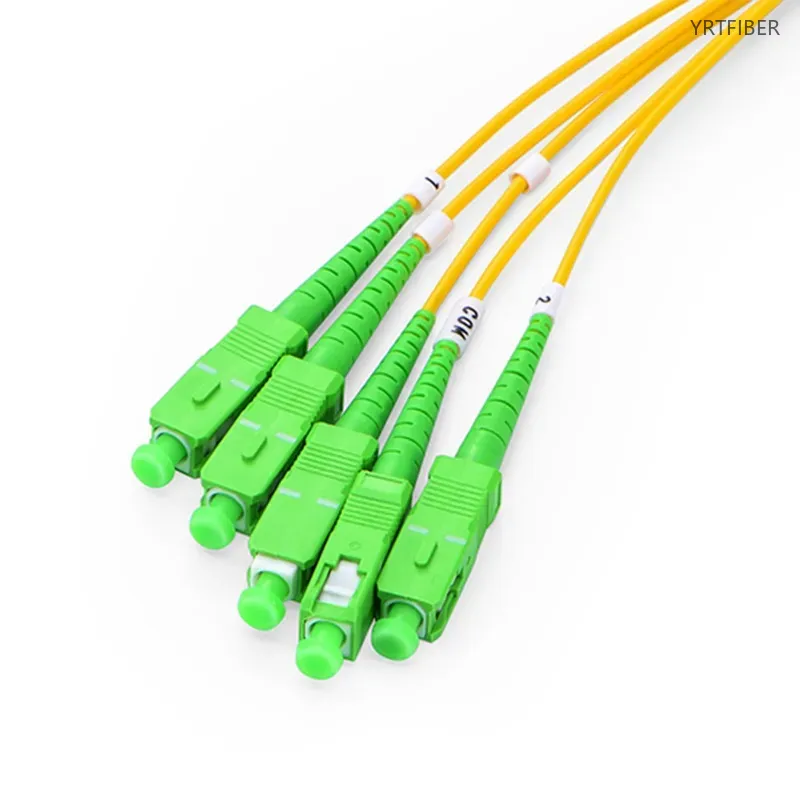
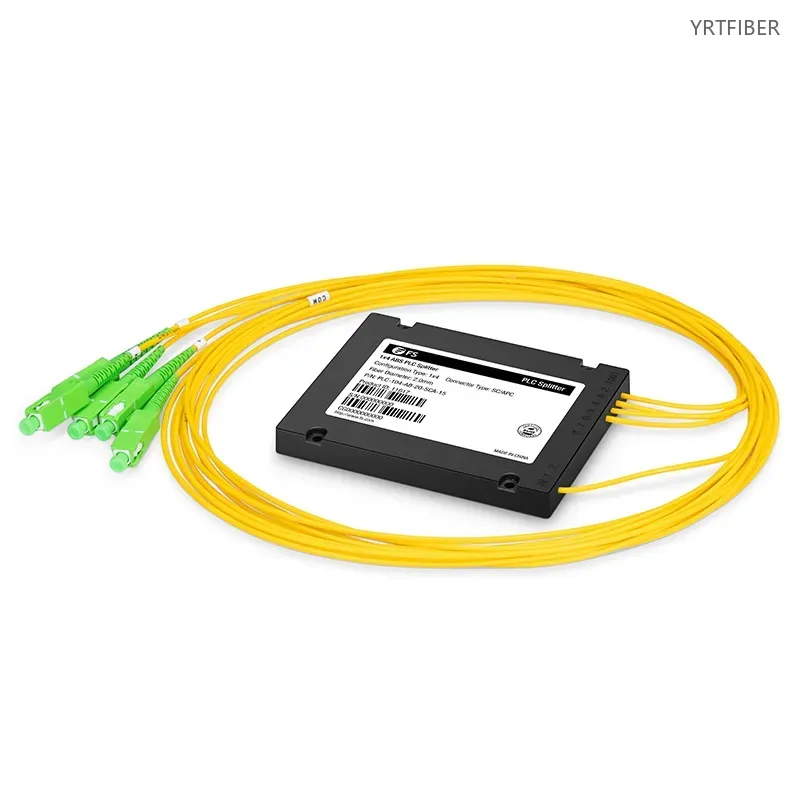
Custom 1x4 ABS Fiber Splitter - SC/LC/FC/ST Connectors (UPC/APC)
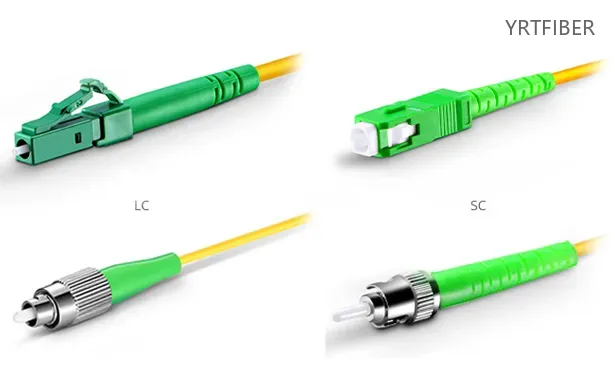
Connector Customization: Choose from SC/LC/FC/ST connectors with UPC or APC polish
Precision Splitting: PLC technology ensures uniform 1×4 splitting ratio
Optimized Performance: Low insertion loss (≤7.2dB) and PDL (≤0.3dB)
Robust Housing: ABS enclosure provides dust/water resistance
Wide Compatibility: 1260~1650nm wavelength range on single-mode fiber
What is 1x4 ABS Fiber Optic Splitter
The 1x4 ABS Fiber Optic Splitter is a highly adaptable device designed for efficient optical signal distribution in diverse network setups. Its key features, centered around customization, precision, and performance, make it a valuable asset in modern fiber - optic networks.
1x4 ABS Fiber Splitter Specification parameters
- Specification parameters
- OPTICAL CHARACTERISTICS
| Package | ABS Module | Configuration | 1x4 |
| Fiber Grade | G.657A1 | Mode | Singlemode |
| Connectors | SC/APC | Split Ratio | Symmetrical |
| Diameter | 2.0mm | Length | 1.5m |
| Insertion Loss | ≤ 7.4dB | Return Loss | ≥ 55dB |
| Uniformity | ≤ 0.6dB | Directivity | ≥ 55dB |
| PDL | ≤ 0.2dB | TDL | ≤ 0.5dB |
| WDL | ≤ 0.3dB | Bandwidth | 1260~1650nm |
| Size | 10x100x80mm | Temperature | -40 to 85°C (Op & Stg) |
Product Structure & Composition
Optical Splitting Core
The PLC-based core precisely splits an incoming signal into four outputs via planar waveguides on a substrate, ensuring even, high-quality distribution while maintaining signal integrity.
ABS Enclosure
The ABS housing protects the core mechanically and environmentally, with openings for input/output connectors. Its dust- and water-resistant design prevents contaminant ingress that could degrade performance.
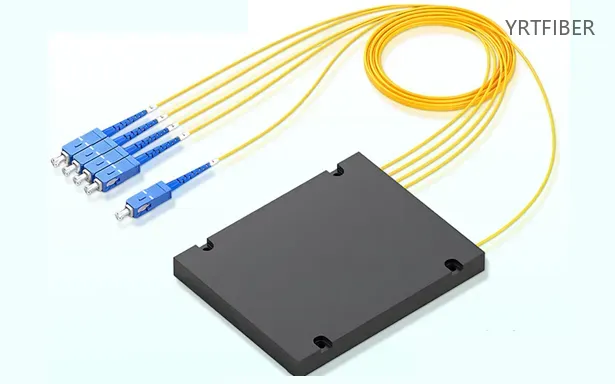
Connectors and Pigtail Cables
The splitter includes 2.0mm pigtail cables pre-terminated with user-selected connectors. This standard diameter balances routing flexibility and mechanical strength, while the securely attached connectors ensure reliable optical connections.
Benefits of 1x4 ABS Fiber Splitter
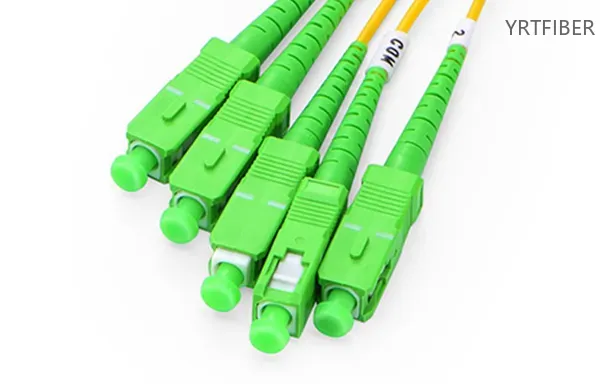
Connector Customization
Multiple connector types and polish options offer flexible network integration—e.g., LC/UPC for high‑density data centers (low loss, short‑range) and FC/APC for long‑haul telecom (minimized back‑reflection). This avoids the need for adaptors or complex re‑cabling, enabling seamless incorporation into existing infrastructure.
Precision Splitting
The PLC technology provides a uniform 1×4 splitting ratio. In FTTH applications, each of the four households receives consistent, sufficient optical power for high‑speed internet, voice, and video, reducing signal‑related issues (slow speeds, dropped connections) and improving user experience.
Optimized Performance
Low insertion loss preserves signal power over long distances, while low PDL minimizes polarization‑induced errors in high‑speed data transmission. Together, they ensure reliable, high‑quality, error‑free data transfer across the network.

Engineering Applications 1x4 ABS Fiber Splitter
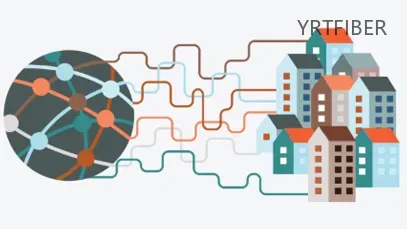
1. FTTH Last‑Mile
In FTTH, the 1x16 ABS splitter acts as a secondary node, expanding one feeder to 16 subscribers. With ~13.5 dB loss and compact size, it fits wall enclosures and supports 20 km reach under 1:32 split ratios.
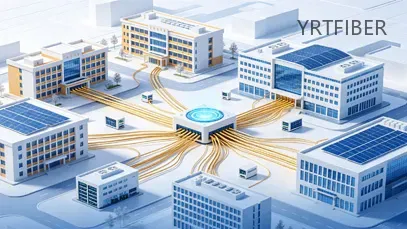
2. Campus & Enterprise
For campuses, it distributes one fiber to 16 buildings in outdoor cabinets. Operating -40 to 85°C with low PDL, it enables redundant links and reduces active hardware.

3. Surveillance & Sensing
In surveillance and sensing, it splits one transmitter to 16 cameras or OTDR probes. Compact and vibration‑resistant, it suits roadside cabinets, manholes, and bridge piers.
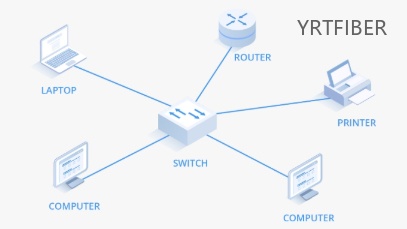
4. Emergency & Testing
For emergencies and field testing, it connects a portable source to 4 temporary points. It also links one OTDR to multiple fibers, supports 500+ cycles, and allows rapid setup and retrieval.
Shipping & Packaging
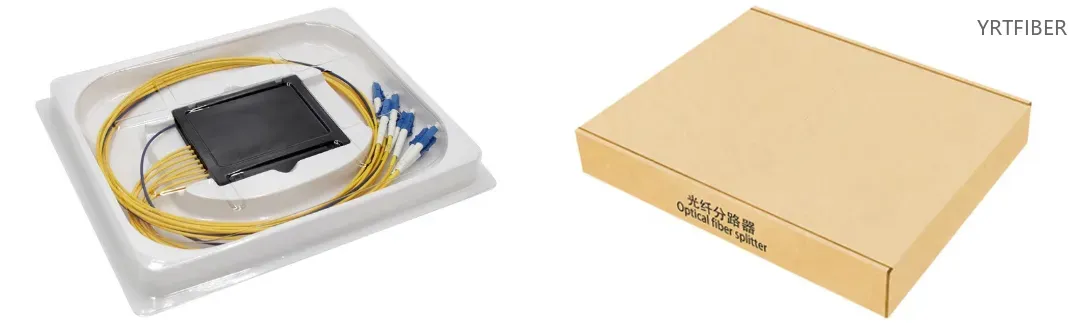
Product Comparison:
| Feature / Dimension | 1×4 ABS Box PLC Splitter | 1×4 LGX Cassette PLC Splitter | 1×4 FBT Splitter |
|---|---|---|---|
| Technology | Planar Lightwave Circuit (PLC) - silica waveguide on a semiconductor chip | Planar Lightwave Circuit (PLC) - same chip technology as ABS | Fused Biconical Taper (FBT) - multiple fibers fused and stretched together |
| Housing / Package | Lightweight thermoplastic (ABS) box | Standardized metal cassette (aluminum or steel frame) | Steel tube, ABS box, or other enclosures |
| Typical Dimensions | Compact - typically ~100×80×10 mm or smaller | 1.14″ × 5.08″ × 6.10″ (29 × 129 × 155 mm) - LGX standard | Compact, similar to ABS but may be larger for multiple cascaded stages |
| Mounting / Installation | Flexible - tie-points or screws; fits into FAT/FDB boxes, pole-mounted CTO enclosures | Slides into 19″ racks, ODF frames, or wall-mount LGX enclosures | Flexible - can be installed in various enclosures |
| Front Panel Interface | Typically pigtails (0.9mm / 2.0mm / 3.0mm) with optional connectors | Front-panel LC/SC/FC/ST adapter ports for easy patching | Pigtails or adapters (varies by package) |
| Typical Applications | Outdoor FTTH distribution: FAT/FDB boxes, pole-mounted CTO, rural ODN | Indoor structured cabling: central office ODF racks, 19″ data center cabinets | Small networks, custom asymmetric splits, legacy systems |
| Insertion Loss (typical) | ≤ 7.2 dB | ≤ 7.2 dB (identical PLC chip) | ~ 7.0 - 8.0 dB (varies; less uniform than PLC) |
| Return Loss | ≥ 55 dB | ≥ 55 dB (identical) | ≥ 50 dB (typically lower than PLC) |
| Polarization Dependent Loss (PDL) | ≤ 0.2 dB | ≤ 0.2 dB (identical) | ≤ 0.45 dB (cascaded from multiple 1×2 stages) |
| Split Uniformity | Excellent - even split across all outputs | Excellent - same as ABS | Poor - uniformity degrades as split ratio increases |
| Split Ratio Options | 1×4 (also 1×2, 1×8, 1×16, 1×32, 1×64) | 1×4 (also 1×2, 1×8, 1×16, 1×32, 1×64) | 1×2, 1×3, 1×4, 1×8 (custom ratios possible) |
| Relative Cost | Low to medium - compact plastic housing | Higher - metal cassette, rack-compatible form factor | Lower for small ratios (1×2, 1×4); higher for 1×8+ (cascaded) |
| Maintenance & Reconfiguration | Requires opening the enclosure; less convenient for frequent changes | Hot-swappable; easy module replacement without disrupting other cables | Varies by package; less flexible than LGX |
1x4 ABS Fiber Splitter Selection Guide
Choose the 1×4 ABS Box PLC Splitter when:
Deploying outdoor FTTH distribution - pole-mounted FAT boxes, FDB enclosures, or CTO terminals.
Space is limited in compact outdoor enclosures where a small plastic module is easier to fit.
Installation requires flexible, versatile mounting options with tie-points or screw holes.
The deployment is in rural ODN or drop-level distribution where rack compatibility is not needed.
Budget is constrained - ABS modules typically cost less than metal LGX cassettes.
Choose the 1×4 LGX Cassette PLC Splitter when:
Deploying in indoor structured cabling environments such as central offices, data centers, or telecom equipment rooms with 19-inch racks or ODF frames.
Requiring front-panel access for easy patching, testing, and reconfiguration.
Needing hot-swappable modules that can be replaced or upgraded without disrupting adjacent fibers or cables.
Managing high-density rack installations where standardized, professional cable management is critical.
Choose the 1×4 FBT Splitter only when:
A custom, non-standard split ratio is required (e.g., 1×3) that PLC cannot provide.
The application is a small network or short-distance deployment where uniformity and wide temperature range are less critical.
Budget is extremely constrained for very small split ratios (1×2. 1×4).
Working with legacy systems that only support specific wavelengths (850nm, 1310nm, 1550nm).
Note: For 1×4 splitting, FBT may offer cost savings, but it provides poorer uniformity, higher PDL, narrower wavelength range, and lower temperature tolerance than PLC. For greenfield FTTH deployments, PLC is the recommended choice.
Mixed deployment strategy:
Use LGX cassettes in the central office or data center headend for professional rack-based management, and ABS modules in the field at distribution points, pole-mounted cabinets, or outdoor FDB enclosures. This leverages the strengths of each format: rack-based modularity indoors, and compact, weather-resistant packaging outdoors.
Key decision factors:
| Factor | ABS Box | LGX Cassette | FBT |
|---|---|---|---|
| Best for | Outdoor FTTH, FAT/FDB/CTO boxes | Indoor racks, ODF, data centers | Small networks, custom ratios |
| Mounting | Tie-points, screws, or adhesive | Slides into 19″ racks or LGX enclosures | Varies |
| Density | Higher (compact size) | Lower per rack unit (larger footprint) | Moderate |
| Maintenance | Requires opening enclosure | Hot-swappable, front access | Varies |
| Cost | Lower | Higher | Lowest for 1×4 |
| Environmental | Outdoor, weather-resistant | Indoor, controlled climate | Limited |
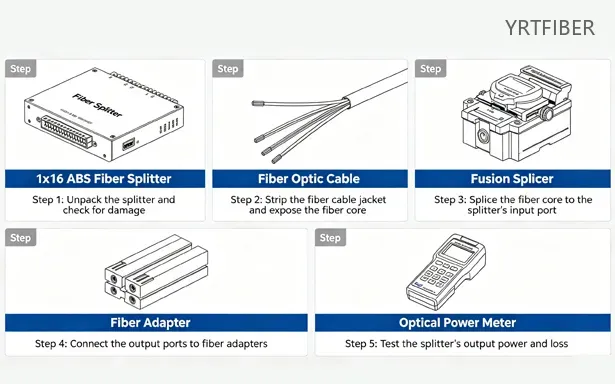
Installation Instructions (Abridged)
Pre‑installation Inspection
- Check the ABS enclosure for visible damage (cracks, dents, scratches).
- Inspect connectors: ensure clean ferrules and no defects in UPC/APC polish.
- Examine 2.0mm pigtails for kinks, cuts, or other physical damage.
- Verify that input/output port labels are clear and legible.
Mounting
- Select a suitable location (cabinet, wall‑mount enclosure, or patch panel).
- Secure the splitter using the mounting holes/clips; ensure firm attachment to avoid movement or vibration.
Fiber Connection
- Align the connector key of the incoming single‑mode fiber with the input port keyway; insert firmly until it locks.
- Repeat for each of the four output ports, connecting the corresponding single‑mode fibers. Clearly label each output for easy identification during operation and maintenance.
Testing
- Measure insertion loss at each output with an optical power meter; verify against the specified value (≤7.2 dB).
- Measure PDL at each output with a PDL meter; ensure it is within the limit (≤0.3 dB).
- If readings deviate significantly, re‑check connections, clean connectors if needed, and inspect the splitter for internal damage.
Download YRTFIBER Product Catalog
Factory Real Shot
1. Advanced Production Environment
Our 60000 m² dust‑proof workshop houses 21+ automated lines for single‑core and MPO patch cords, equipped with high‑precision cutters (±0.08 mm), FLC terminators, and UV systems. MES integration ensures consistent daily output of thousands of connectors with full traceability.
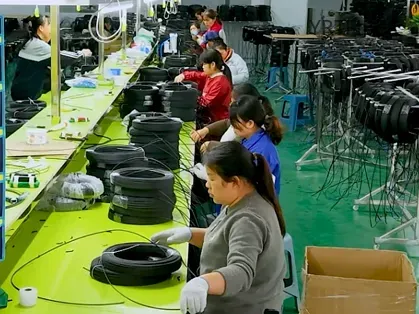
2. Micro‑Precision Core Assembly
Core assembly starts with end‑face cutting (±0.5°) and six‑axis fusion splicing (core deviation ≤1 μm), verified by real‑time imaging. Multi‑layer jacketing with LSZH, PVC, or OFNP prepares the interface for subsequent polishing.
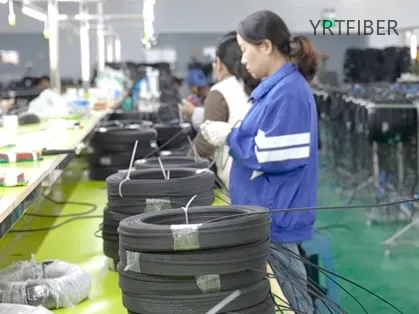
3. Automated Polishing & End‑Face Finishing
Robotic polishing lines automatically apply PC, UPC, or APC finishes, achieving mirror‑like end faces. With two 11‑hour shifts, the polishing section produces up to 7.000 connectors per day for final verification.
4. Comprehensive Testing & Environmental Validation
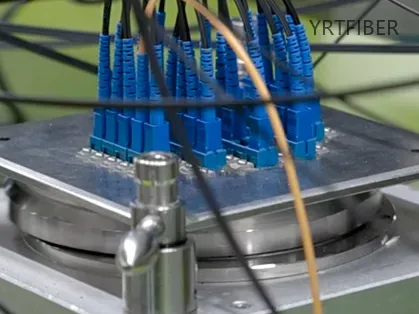
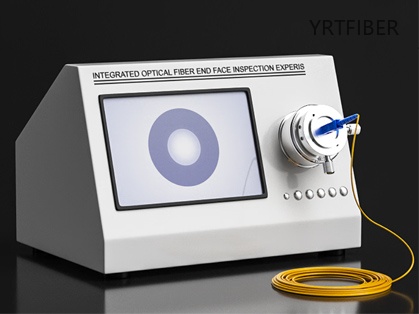
Every patch cord receives 100% inspection: 400× interferometric imaging, particle detection, and OTDR loss measurements. Samples also pass temperature, humidity, and pull‑force tests per IEC/TIA standards, ensuring both optical and mechanical compliance.
Frequently Asked Questions & Quick Inquiry
1x4 ABS Fiber Splitter FAQ
Why is PLC technology important for the splitting ratio?
PLC technology uses planar waveguides on a substrate to split the optical signal. These waveguides are precisely fabricated to ensure that the incoming optical signal is divided evenly into the output channels. This precision is crucial for maintaining a uniform 1×4 splitting ratio. Without PLC technology, the splitting may be uneven, leading to inconsistent signal strengths at the output ports. This could result in some connected devices receiving a weaker signal, which may cause performance issues such as slow data transfer or unreliable communication.
What is the significance of the 1260 - 1650nm wavelength range compatibility?
This wide wavelength range compatibility means that the splitter can be used in multiple optical communication applications. Different applications, such as telecommunications, CATV, and fiber - optic sensing, operate within this wavelength range. For example, in telecommunications, the 1550nm wavelength is often used for long - distance transmission, while in fiber - optic sensing, different wavelengths within this range may be used for various sensing purposes. By being compatible with this range, the splitter can be a versatile component in different network setups, reducing the need for specialized splitters for each specific wavelength - based application.
Send Your Inquiry
Fill out the form below and we'll get back to you within 24 hours.


