

 Español
 Português
 لالعربية
 Русский
 Bahasa Indonesia
 Français
 Türkçe
 Bahasa Melayu
I. Introduction to Fiber Optic Patch Cords
Fiber optic patch cords, also known as fiber optic connectors, refer to optical cables with connector plugs at both ends, used to achieve movable connections in the optical path. If only one end has a plug, it is called a pigtail.
Fiber optic patch cords are structurally similar to coaxial cables, but lack the braided shielding layer. At the center is a glass core for light propagation. In multimode fiber, the core diameter is typically between 50μm and 65μm, roughly the thickness of a human hair. single-mode fiber core diameters are between 8μm and 10μm. The core is encased in a low-refractive-index glass cladding to confine the optical signal within the core. The outermost layer is a thin plastic jacket for protection.
II. Classification of Fiber Optic Patch Cords
Fiber optic patch cords can be divided into common single-mode patch cords and multimode patch cords based on the transmission medium. In addition, there are some fiber optic patch cords that use materials such as plastic as the transmission medium.
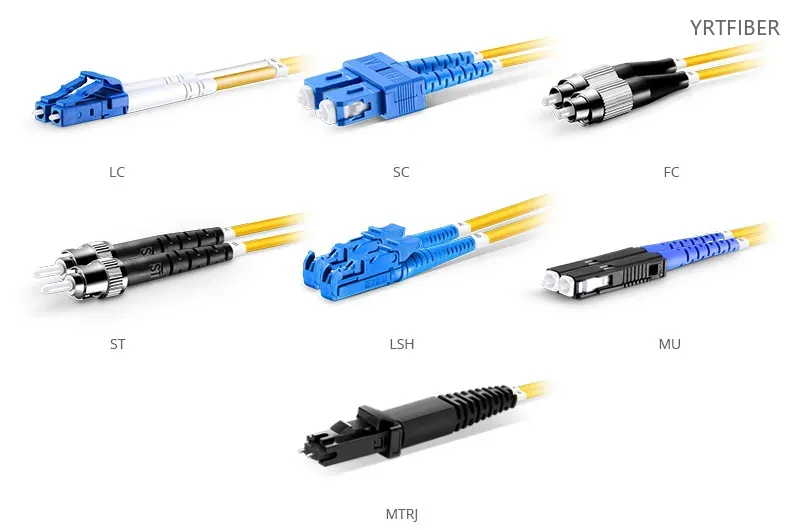
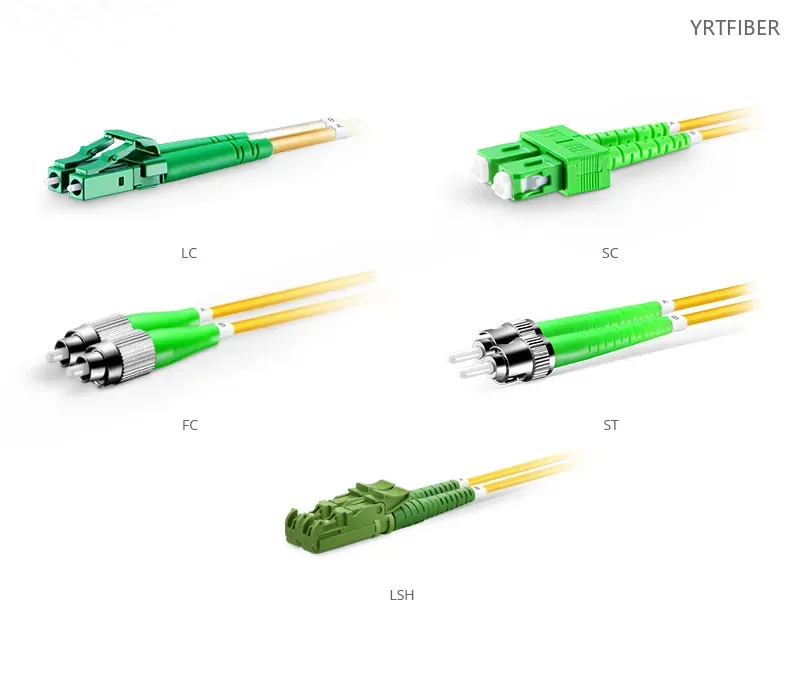
Based on the structure of the connector, fiber optic patch cords mainly include FC patch cords, SC patch cords, ST patch cords, LC patch cords, MTRJ patch cords, MPO patch cords, MU patch cords, SMA patch cords, FDDI patch cords, E2000 patch cords, DIN4 patch cords, D4 patch cords, and many other types. Common fiber optic patch cords also include different combinations such as FC-FC, FC-SC, FC-LC, FC-ST, SC-SC, and SC-ST.
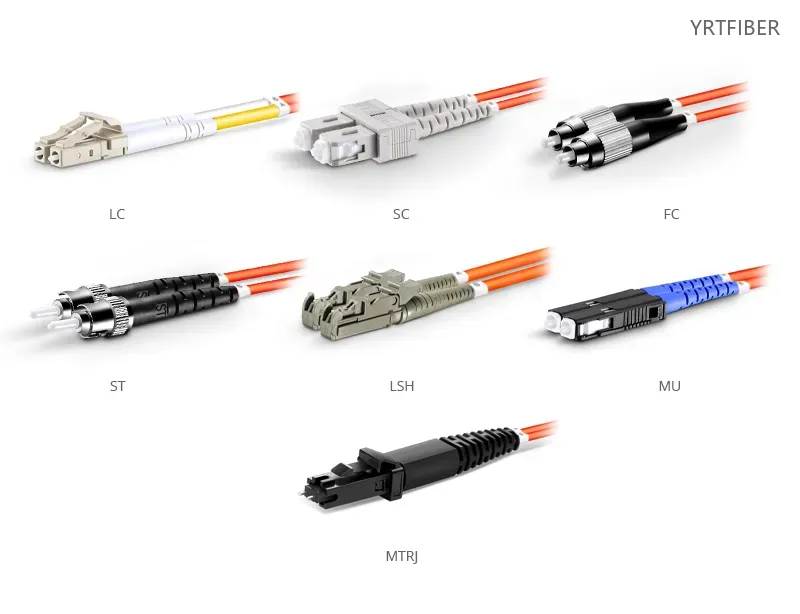
Single-mode fiber is generally represented by yellow, with blue connectors and protective sleeves, and has a longer transmission distance. Multimode fiber is usually represented by orange, but sometimes by gray, with beige or black connectors and protective sleeves, and has a relatively shorter transmission distance.
III. Precautions for using fiber optic patch cords
The transmit and receive wavelengths of the optical modules at both ends of a fiber optic patch cord must be consistent; that is, optical modules with the same wavelength should be used at both ends of the fiber. A simple way to distinguish them is to check if the colors of the optical modules are the same.
Typically, short-wavelength optical modules are used with multimode fiber, while long-wavelength optical modules are used with single-mode fiber to ensure the accuracy of data transmission.
During use, avoid excessive bending or looping of optical fibers, as this will increase the attenuation of the optical signal during transmission.
After using fiber optic patch cords, always protect the fiber optic connectors with protective sleeves, as dust and oil can impair the coupling effect of the fiber. If the fiber optic connectors become dirty, clean them with a cotton swab dipped in a small amount of alcohol; otherwise, communication quality may be affected.
Before use, clean the ceramic ferrule and end face of the fiber optic patch cord with alcohol and degreased cotton. During use, the minimum bending radius of the fiber should not be less than 30mm. Take care to protect the ferrule and end face from damage or contamination; replace the dust cap immediately after disassembly. Do not look directly at the fiber optic end face during laser signal transmission. Replace the damaged fiber optic patch cord immediately if damage occurs due to human error or other uncontrollable factors. Carefully read the product manual before installation and perform installation and debugging under the guidance of the manufacturer's or distributor's engineers. When an abnormality occurs in the fiber optic network or system, troubleshooting methods can be used to test each component one by one. When testing for patch cord faults, a continuity test can be performed first. This can usually be done by shining a visible laser pointer across the entire fiber optic link to determine the fault. Alternatively, a precision fiber optic insertion loss/return loss meter can be used to test various indicators. If the indicators are within the acceptable range, the patch cord is normal; otherwise, it is unqualified.
IV. Characteristics of Fiber Optic Patch Cords
The main characteristics of fiber optic patch cords include low insertion loss, good repeatability, high return loss, good interlocking performance, good temperature stability, and strong tensile strength.
V. Applications of Fiber Optic Patch Cords
Fiber optic patch cords are widely used in communication equipment rooms, fiber-to-the-home (FTTH), local area networks (LANs), fiber optic sensors, fiber optic communication systems, fiber optic transmission equipment, and national defense. They are suitable for cable television networks, telecommunications networks, computer fiber optic networks, and optical testing equipment. Specifically, their main applications include the following:
Fiber Optic Communication System
Fiber optic access network
Fiber optic data transmission
Fiber Optic CATV
local area network
Test equipment
Fiber optic sensor
VI. Selection of Fiber Optic Patch Cords
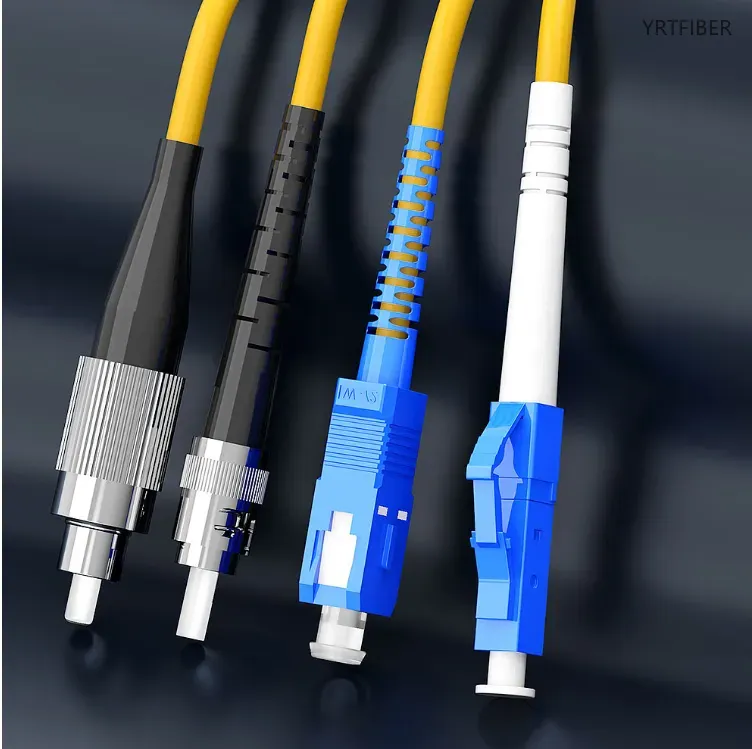
Fiber optic patch cords are mainly classified into three types according to termination type: ST-ST, SC-SC, and ST-SC. They are also mainly classified into two types according to fiber type: single-mode fiber and multimode fiber.
Common patch cord lengths include 0.5m, 1m, 2m, 3m, 5m, and 10m. Based on the material of the outer sheath, they can be categorized as ordinary type, ordinary flame-retardant type, low-smoke halogen-free type, and low-smoke halogen-free flame-retardant type.
Depending on the building's fire resistance rating and the fire resistance requirements of materials, the structured cabling system needs to take appropriate measures. Flame-retardant cables should be used when laying cables in flammable areas and building shafts. In large public places, flame-retardant, low-smoke, and low-toxicity cables are recommended. Flame-retardant wiring equipment should be selected for adjacent equipment rooms or junction boxes.
VII. The difference between fiber optic patch cords and fiber optic pigtails
Fiber optic patch cords are mainly used for patching between equipment and fiber optic cabling links. They have a thick protective layer and are typically used for connections between optical transceivers and terminal boxes.
Pigtails, also known as fiber optic cables, have a connector on one end and a broken fiber core on the other, requiring splicing to connect to other fiber cores. Pigtails are typically found inside fiber optic terminal boxes to connect fiber optic cables to fiber optic transceivers, and may also involve couplers, patch cords, and other components.
Fiber optic connectors are devices that enable detachable connections between optical fibers. Their function is to precisely align the end faces of two fibers, maximizing the coupling of light energy from the transmitting fiber to the receiving fiber while minimizing its impact on the overall optical link system. This is a fundamental requirement for fiber optic connectors. In short, fiber optic connectors significantly influence the reliability and overall performance of optical transmission systems.
8. How to test whether a fiber optic patch cord is qualified?
During testing, you can first use an insertion loss meter or optical transducer to test whether the patch cord transmits light, confirming that the optical fiber is not broken. Generally, the testing standard for telecommunications grade is an insertion loss of less than 0.3dB and a return loss of greater than 45dB.
The performance testing of fiber optic patch cords mainly includes the following aspects:
Optical performance testing: This includes return loss and insertion loss testing, which is typically performed using the FibKey 7602 integrated return/insertion loss tester.
End-face geometry inspection: This mainly tests parameters such as radius of curvature, vertex offset, and fiber height. The instrument used is an interferometer, such as the Norland AC/NC3000 or CC6000. Among them, the CC6000 interferometer is increasingly being adopted by factories due to its cost-effectiveness.
Fiber optic end-face scratch inspection: This is done using a video fiber optic magnifier, such as the FibView FV-400PA, which provides clear imaging and is easy to operate. Some users also use the FibKey-5600 variable magnification magnifier , which integrates 400x, 200x, and 80x magnification functions, allowing for clear and convenient observation of the fiber optic end-face and ferrule end-face. Alternatively, automated inspection can be performed using relevant software.
Fiber optic tensile test: Used to test the amount of tensile force that a fiber optic connector can withstand.
Ambient temperature test: Used to test the performance of fiber optic connectors under different ambient temperature conditions.
IX. Applications of Common Fiber Optic Patch Cord Interfaces
Common fiber optic patch cord interface types include FC, SC, ST, PC, APC, and LC. FC connector fiber optic patch cords are mostly used in patch panels, while SC connector fiber optic patch cords are commonly used in routers and switches. In addition, there are many other interface types such as MTRJ, MPO, MU, SMA, FDDI, E2000. and D4.
When purchasing fiber optic patch cords, the type of connector is an important factor to consider. Understanding the meaning and purpose of various connectors can help users find the right product more quickly.
FC type fiber optic patch cord: Reinforced with an external metal sleeve, secured with a screw thread. FC connectors are commonly found in telecommunications networks, tightened onto the adapter with a nut. Advantages include a reliable connection and good dust protection; disadvantages include slightly longer installation time. Typically used on the ODF side, and also frequently found on patch panels and optical transceivers.
SC type fiber optic patch cord: Used to connect GBIC optical modules. It has a rectangular outer shell and a plug-in latch fastening method, requiring no rotation. SC connectors are easy to plug and unplug and simple to use, but their disadvantage is that they are prone to loosening. They are most widely used in routers and switches.
ST-type fiber optic patch cords: The ST connector requires a half-turn rotation after insertion and is secured by a bayonet. A drawback is its susceptibility to breakage. They are commonly used in fiber optic distribution frames, have a round outer shell, and are fastened with screws. ST-type connectors are typically used in 10Base-F connections.
LC type fiber optic patch cord: Used to connect SFP modules, it adopts a modular jack structure, is easy to operate, and has a latching mechanism similar to an RJ interface. SFP optical modules use the LC interface by default.
MT-RJ fiber optic patch cord: This is a square fiber optic connector that integrates transmitting and receiving, allowing simultaneous transmission and reception of two fibers at one end. The MT-RJ patch cord consists of two high-precision molded plastic connectors and an optical cable. The connector exterior is made of precision plastic and features a push-pull locking mechanism, making it suitable for indoor applications in telecommunications and data network systems.


