

 Español
 Português
 لالعربية
 Русский
 Bahasa Indonesia
 Français
 Türkçe
 Bahasa Melayu
6 Suitable and Unsuitable Applications - What to Tell Your Customers
7 Frequently Asked Questions - Directly from Dealers and End Customers
For dealers and procurement professionals, the choice between armored and unarmored fiber optic cable is not primarily a technical question-it is a business decision that affects inventory turnover, profit margins, customer satisfaction, and return rates.
The short answer is this: armour cable is for harsh outdoor, direct-burial, industrial, and rodent-prone environments where physical damage is a real risk. Unarmored cable is for protected indoor environments, conduit installations, and applications where weight and flexibility matter more than crush protection. Neither is universally "better"-each has a clear place in your product portfolio.
This guide explains the structural differences, mechanical performance, cost implications, and-most importantly for buyers-which types to stock, which questions to ask your customers, and what to avoid.
What Is an Armored Fiber Optic Cable?
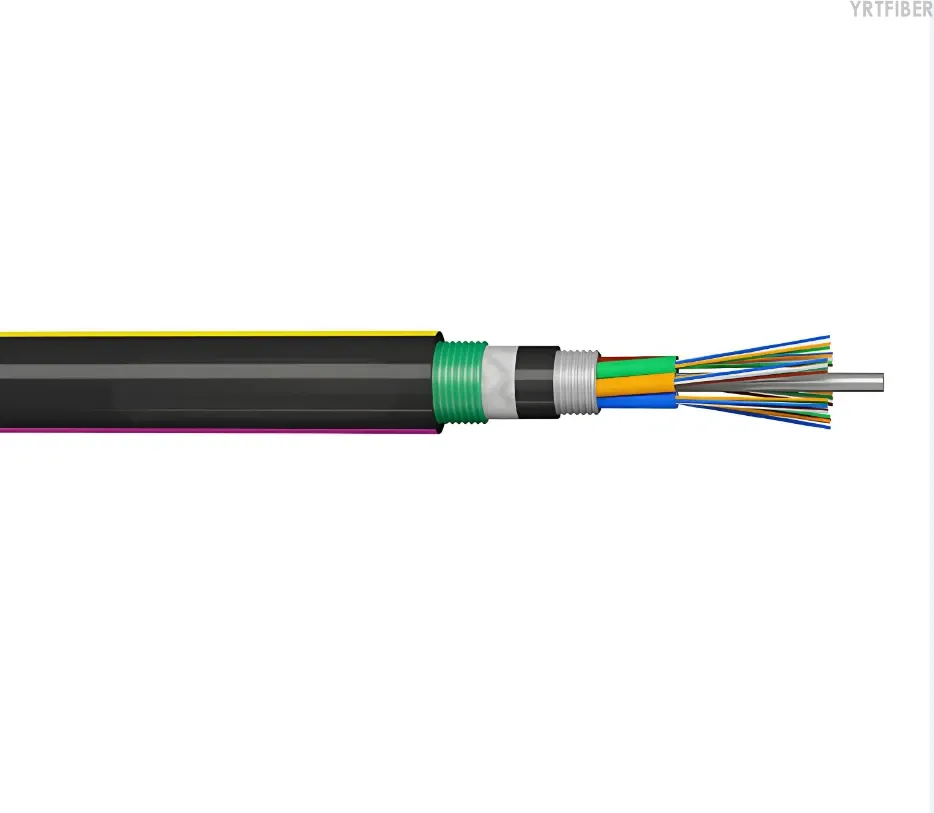
An Armored Fiber Optic Cable includes a metallic protective layer-typically corrugated steel tape (CST), steel wire armor (SWA), or aluminum-between the cable core and the outer jacket. This armor provides mechanical shielding against crushing, impact, rodent bites, and abrasion.
Common Armor Types You Will Encounter
| Armor Type | Material | Best For | Dealer Note |
|---|---|---|---|
| Corrugated steel tape (CST) | Steel tape | Crush resistance, rodent protection | Most commonly stocked; broadest application range |
| Steel wire armor (SWA) | Steel wires | High tensile strength, direct burial | Higher cost, heavier; used in demanding projects |
| Aluminum armor | Aluminum | Corrosion resistance, coastal/marine | Niche market; lower volume |
| Non-metallic armor | Aramid/FRP | Electrical isolation, lightweight | Special order; do not overstock |
What Is an Unarmored Fiber Optic Cable?
An unarmored (or non-armored) fiber optic cable contains no metallic armor layer. It consists of optical fibers, buffer coating, strength members (typically aramid yarn), and an outer jacket-usually PVC or LSZH (Low Smoke Zero Halogen).
Unarmored cables are lighter, more flexible, easier to terminate, and significantly cheaper to ship-all of which matter to your bottom line. However, they offer no mechanical protection and must be installed in protective conduit or controlled indoor environments.
Armored vs Unarmored - Comparison Table for Buyers
| Feature | armored fiber cable | Unarmored Fiber Cable |
|---|---|---|
| Protection level | High (crush, rodent, impact) | Basic (jacket only) |
| Typical applications | Direct burial, industrial, outdoor exposed, rodent areas | Indoor riser/plenum, conduit, data centers, office buildings |
| Weight (per km) | Heavier (approx. 120-250 kg/km depending on design) | Lighter (approx. 40-80 kg/km) |
| Minimum bend radius | Larger (typically 20x cable OD during installation) | Smaller (typically 10x cable OD) |
| Unit cost (materials) | Higher (armor adds 30-60% to material cost) | Lower |
| Shipping cost | Higher (weight + volume) | Lower |
| Termination complexity | More complex (armor removal required) | Simple, standard connectors |
| Grounding requirement | Required for metallic armor | Not required (fully dielectric) |
| Typical lead time | Longer (more production steps) | Shorter |
| Customer return risk | Lower if specified correctly; higher if misapplied indoors | Lower if specified for correct indoor use; high if used outdoors without conduit |
Mechanical Performance - What Numbers Actually Matter
When evaluating product data sheets, pay attention to these mechanical parameters. Always verify that values are reported with test conditions.
Crush Resistance (IEC 60794-1-2 Method E3)
Armored cable: Typical rated crush resistance ranges from 2,000 N to 4,000 N or higher, depending on armor type and cable construction.
Unarmored cable: Typically 500 N to 1,000 N-sufficient for standard handling, not for heavy loads.
Buyer alert: A number like "crush resistance 3,000 N" is meaningless unless accompanied by the test method, load duration, and allowable attenuation change. Always ask your supplier for the full test report or standard reference.
Tensile Strength (IEC 60794-1-2 Method E1)
Armored (SWA) : Can withstand 3,000 N to 10,000 N during installation.
Armored (tape) : Typically 1,500 N to 3,000 N.
Unarmored: Typically 600 N to 1,500 N.
Minimum Bend Radius
Armored: During installation, typically 20x cable outer diameter; in operation, 10x OD.
Unarmored: During installation, typically 10x cable outer diameter; in operation, 5x OD.
Stocking and Sourcing Considerations for Dealers
As a dealer or procurement professional, you need to balance demand volume, margin, and risk of obsolescence.
Recommended Stocking Strategy
| Product Type | Recommended Stock Level | Typical Customer | Margin Potential | Turnover |
|---|---|---|---|---|
| GYTS (steel tape armored, loose tube) | High (core item) | Industrial, buried, duct projects | Medium-High | Fast |
| GYTA (aluminum armored) | Medium | Aerial, light outdoor | Medium | Moderate |
| GYTA53 (double steel tape + PE sheath) | Low (made to order) | Direct burial, harsh environments | High | Slow (but high-value) |
| Unarmored indoor (PVC/LSZH) | High (core item) | Data centers, offices, LAN | Low-Medium | Very fast |
| Non-metallic armored | Low (special order) | Power utilities, railways | High | Slow |
Key Questions to Ask Your Supplier Before Buying
Are the mechanical ratings verified by independent testing or self-declared? - Demand IEC test reports.
What is the minimum order quantity (MOQ) for armored vs unarmored? - Some suppliers push high MOQs on armored cables; negotiate.
What is the typical shipping weight and volume? - Affects freight cost; factor this into your landed cost.
Do you provide termination kits or compatible accessories? - Customers often need glands, grounding kits, and splice closures for armored cables.
What is the warranty and return policy for mechanical damage claims? - Clarify this upfront.
Suitable and Unsuitable Applications - What to Tell Your Customers
Your customers will frequently ask: "Do I really need armored cable?" Here is how to guide them.
When to Recommend Armored Cable (Yes - Hard Sell)
Direct burial without protective conduit
Industrial factories with heavy machinery
Rodent-prone agricultural or rural areas
Outdoor exposed runs along building exteriors
Military, government, or high-security installations
When to Recommend Unarmored Cable (No - Save Them Money)
Indoor riser, plenum, or horizontal runs
Data center patch cords and backbone links
Cable pulled through HDPE or PVC conduit
Temporary or test setups
FTTH drop cables in protected pathways
Critical Limitations You Must Disclose (To Avoid Returns)
| Statement | Reality Check |
|---|---|
| "Armored cable is waterproof." | Armor prevents mechanical damage, but water blocking requires separate materials (gels, tapes, or dry water-blocking). Always check water-blocking type. |
| "Armored cable can be used in any outdoor environment." | Aerial applications require UV-resistant jacket. Armor alone does not guarantee UV resistance. |
| "Steel tape and steel wire armor are interchangeable." | No. Tape = crush/rodent; wire = tensile/direct burial. They serve different functions. |
| "Flame-retardant = fire-resistant." | No. Flame-retardant (LSZH) limits fire spread. Fire-resistant maintains circuit integrity during fire. Do not confuse them. |
| "All armored cables can be buried directly." | No. Direct burial requires specific construction (e.g., GYTA53 with dual jackets). Always check the rated application. |
| "Metallic armor does not need grounding." | False. Metallic armor must be properly grounded according to NEC or local electrical codes. Failure to ground is a safety hazard and a liability. |
Frequently Asked Questions - Directly from Dealers and End Customers
1. "A customer asked: Armored cable costs 50% more. Why shouldn't I just buy unarmored and use conduit?'"
Suggested reply: "That is a fair question. Conduit adds material cost (PVC/HDPE pipe) and installation labor-often more than the cable itself. Armored cable eliminates the conduit cost and speeds up installation. However, if your customer already has ductwork in place or is running cable inside a building, unarmored is the smarter, cheaper choice. It depends entirely on the site."
2. "What do I do if a customer orders armored cable but their installers don't ground it?"
Suggested reply: "Armored cable with metallic armor must be grounded at both ends or per local code. Unarmored cable does not require grounding. If grounding is not feasible-for example, in remote sites without grounding infrastructure-recommend non-metallic armored cable (aramid/FRP) instead of steel-armored cable."
3. "How do I explain the difference between GYTS and GYTA to a non-technical buyer?"
Suggested reply: "Both are armored outdoor cables. GYTS uses corrugated steel tape armor-great for crush and rodent protection in duct or direct burial. GYTA uses aluminum tape armor-lighter and corrosion-resistant, better for aerial or coastal installations. If your customer is burying it, go GYTS. If they're hanging it or installing near the sea, go GYTA."
4. "Can I use armored cable indoors?"
Technically yes, but practically no. Armored cable is rigid, heavy, difficult to terminate, and expensive for indoor use. Unarmored indoor cable (LSZH or PVC) is cheaper, easier to route, and perfectly adequate for protected indoor environments. Recommending armored cable for an office building is over-specifying-and your customer will remember the wasted budget.
Cost Breakdown and Margin Considerations
For procurement, here is a rough guide to how costs compare:
| Cost Component | Armored Cable | Unarmored Cable |
|---|---|---|
| Raw materials | High (steel, thicker jackets) | Low (jacket + aramid) |
| Manufacturing complexity | High (multiple extrusion/stranding steps) | Low |
| Packaging (wooden reels vs plastic reels) | Wooden drum required (adds ~$10-$30/unit) | Plastic reel sufficient |
| Shipping (per container capacity) | ~30-40% fewer km per container | ~60-70% more km per container |
| Landed cost (your cost per meter) | Significantly higher | Lower |
| Selling price (your margin) | Higher absolute margin per meter | Lower absolute margin per meter, but higher volume |
Dealer tip: Armored cables offer higher absolute profit per meter but tie up more capital in inventory. Unarmored cables offer faster turns and lower carrying costs. A balanced inventory-roughly 60% unarmored, 30% steel-tape armored, and 10% specialty-works well for most general-purpose dealers.
Selection Checklist - For Your Procurement File
Before placing an order, run through this checklist with your customer (or for your own stock plan):
Installation environment: Indoor, outdoor exposed, duct, or direct burial?
Mechanical threats: Rodents, heavy equipment, soil pressure, or none?
Distance and pulling length: If long spans, SWA may be required for tensile capacity.
Grounding availability: Is proper grounding feasible? (If no, avoid metallic armor.)
Budget and project timeline: Armored cables may have longer lead times.
Jacket material: LSZH for indoor safety, HDPE for outdoor UV resistance, PVC for general indoor.
Fiber count and type: G.652D (standard), G.657A1/A2 (bend-insensitive), or G.655 (DWDM).
Supplier certification: Does the supplier provide IEC 60794 test reports upon request?
Conclusion
For dealers and procurement professionals, stocking armored vs unarmored fiber cable is not about choosing the "better" product-it is about matching the right cable to the right environment while managing inventory costs, profit margins, and customer expectations.
Armored cable (especially steel tape): Stock as a core item for outdoor, industrial, and rodent-prone projects. Higher margin per unit, but requires longer lead times and more careful technical questioning of the end customer.
Unarmored cable: Stock as a high-volume, fast-turnover item for indoor and conduit-protected installations. Lower margin per meter but faster cash flow.
Always ask your customer about the installation site before quoting. A five-minute conversation about grounding, duct availability, and rodent history can save you from a costly return or a disappointed end user.
References
IEC 60794-1-2: Optical fibre cables - Basic test procedures - Mechanical tests methods (E1: Tensile, E3: Crush, E4: Impact)
IEC 60794-1-21: Optical fibre cables - Generic specification - Basic optical cable test procedures - Mechanical tests methods
ITU-T G.652, G.657: Characteristics of single-mode optical fibres
National Electrical Code (NEC) Article 770 - Optical Fiber Cables and Raceways
Manufacturer technical data sheets for GYTS, GYTA, GYTA53, and indoor LSZH cable constructions


