

 Español
 Português
 لالعربية
 Русский
 Bahasa Indonesia
 Français
 Türkçe
 Bahasa Melayu
1.1 Double-Jacket Design: Dual Protection for Long-Term Stability in Harsh Environments
1.2 All-Dielectric Self-Supporting Construction: Efficient Aerial Installation Without Power Outages
1.3 Flexible Fiber Options: G.652D and G.655 for Diverse Applications
1.4 Precision Engineering Parameters: Meeting Various Aerial Installation Needs
1.5 Global Application Cases: Proven Excellence from YRTFiber
1.7 Application Outlook: Core Support for Smart Grids and Global Communication Infrastructure
ADSS-D Double-Jacket Fiber Optic Cable: Powering Global Smart Grid Transformation and the Fiber Infrastructure for the Computing Era
In 2026, the fiber optic cable industry is undergoing a profound value shift. Driven by the massive buildout of AI data centers, the digital transformation of power systems, and continued infrastructure expansion in overseas markets, global demand for optical fiber is surging. Data shows that G.652D fiber prices in China have risen by over 80% since late 2025 – the first time in more than seven years that Chinese prices have exceeded European levels. Within the power communication sector, the deep integration of fiber optic technology is becoming a key enabler of smart grid development. As a professional manufacturer in the global fiber optic cable industry, YRTFiber has launched the ADSS-D All-Dielectric Self-Supporting Double-Jacket Fiber Optic Cable. Combining exceptional weather resistance, high tensile strength, and flexible fiber count configurations, this cable offers a reliable optical infrastructure solution for power communication networks worldwide.
1. Double-Jacket Design: Dual Protection for Long-Term Stability in Harsh Environments
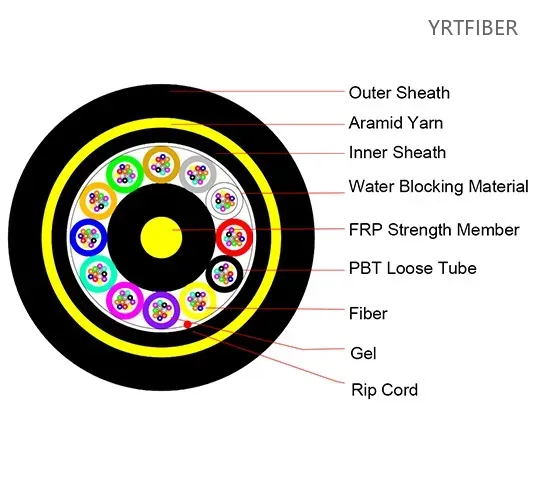
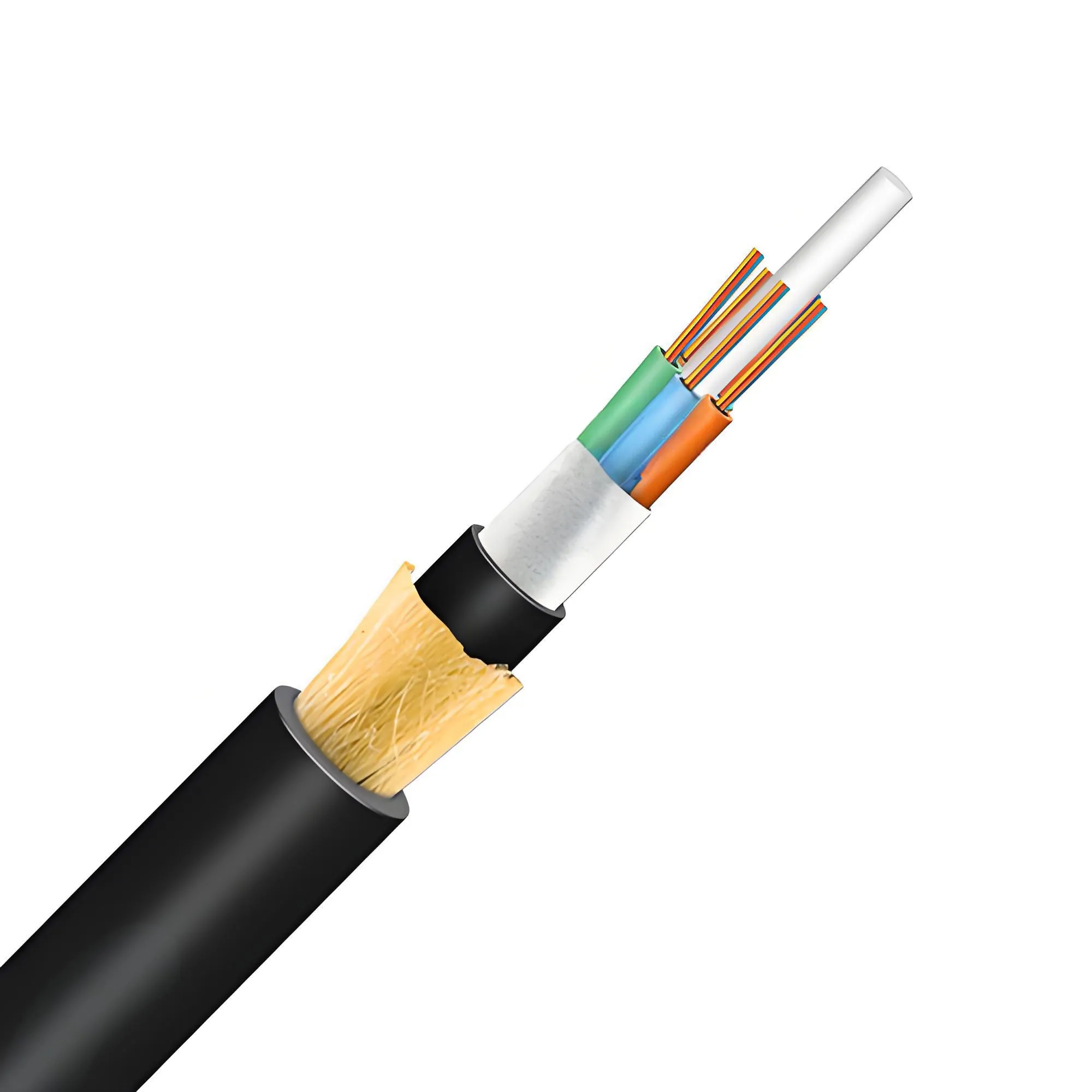
The most distinctive structural feature of the ADSS-D cable is its unique double-jacket design. The product uses a stranded loose tube construction. 250μm optical fibers are placed in loose tubes made of high-modulus plastic, and the tubes are filled with water-blocking compounds for moisture protection. Over the core, an inner polyethylene (PE) sheath is applied, followed by a layer of aramid yarn as the tensile strength member, and finally an outer PE or AT (Anti-Tracking) sheath completes the construction.
This dual-layer design brings significant technical advantages. First, the double jacket greatly enhances the cable's resistance to mechanical stress, UV radiation, and moisture ingress – critical for long-span aerial installation and extreme weather conditions. Second, the intermediate layer formed by the inner sheath and aramid yarns ensures that tensile loads are evenly distributed, effectively protecting the internal fibers from damage. For high-voltage power environments, the ADSS outer sheath offers a crucial choice: the AT anti-tracking sheath withstands voltages up to 500 kV, while the PE sheath suits lines below 110 kV. The sheath also provides excellent UV resistance, making it an ideal solution for outdoor networks in challenging terrain.
2. All-Dielectric Self-Supporting Construction: Efficient Aerial Installation Without Power Outages
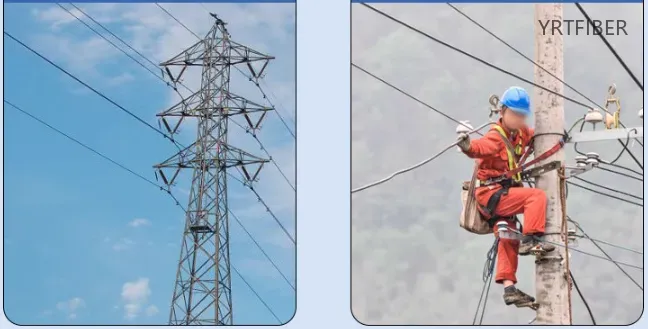
The core advantage of the ADSS (All-Dielectric Self-Supporting) cable lies in its all-dielectric self-supporting structure. Unlike traditional overhead cables, ADSS cables are composed entirely of dielectric materials and incorporate their own support system. They can be directly suspended from power poles or towers without relying on transmission lines or additional steel messengers. This offers several engineering benefits:
Independent installation with flexibility. ADSS cables do not depend on power lines. They can be deployed directly using existing utility poles/towers, with high efficiency and no need for power outages – a critical benefit for grid operation.
All-dielectric, safe and reliable. The cable uses non-metallic strength members (aramid yarn) and polyethylene sheaths, ensuring high insulation in strong electric fields and preventing electrochemical corrosion of metal components. The non-metallic construction also eliminates electromagnetic interference and lightning risks, making it ideal for lightning-prone areas and high-field-strength regions.
High tensile strength for long spans. With aramid yarn as the tensile reinforcement, the ADSS-D cable achieves very high tensile strength. Technical specifications show a breaking strength of 10 kN to 70 kN, an elastic modulus of 7.6 to 19.6 kN/mm²;, and depending on tension design, maximum spans exceeding 800 meters.
Light weight and small diameter. The cable's light weight and small diameter significantly reduce the effects of ice, wind, and loads on towers and supports, ensuring stable operation even in severe weather conditions such as high winds and ice accretion.
3. Flexible Fiber Options: G.652D and G.655 for Diverse Applications
The ADSS-D cable supports flexible fiber counts from 2 to 288 cores. It uses ITU-T standard G.652D or G.655 single-mode fibers, making it suitable for backbone networks and access networks alike.
G.652D is the most widely deployed standard single-mode fiber. It can operate at both 1310 nm and 1550 nm windows, with the lowest attenuation at 1550 nm, making it an economical choice for long-haul backbone transmission.
G.655 (non-zero dispersion-shifted fiber) is optimized for Dense Wavelength Division Multiplexing (DWDM) systems. It offers lower dispersion in the C-band (1530–1565 nm) and a larger effective core area, maximizing optical amplifier performance – ideal for high-speed, high-capacity metro and backbone networks.
Both fiber types exhibit excellent low attenuation:
G.652D: attenuation ≤0.36 dB/km at 1310 nm, ≤0.22 dB/km at 1550 nm.
G.655: attenuation ≤0.40 dB/km at 1310 nm, ≤0.23 dB/km at 1550 nm.
The cable operates over a temperature range of -40°C to +70°C, adapting to climates from severe cold to hot deserts.
4. Precision Engineering Parameters: Meeting Various Aerial Installation Needs
The ADSS-D cable provides detailed mechanical parameter options to accommodate different project requirements. Based on fiber count and span length, four models (A, B, C, D) are available, with either PE or AT outer sheath choices. Outer diameters range from 12.5 mm to 15.6 mm, and maximum working tensions from 1.5 kN to 10.5 kN, meeting span requirements from 100 meters to over 800 meters.
For ADSS cables installed on overhead transmission lines, mechanical and environmental performance requirements are especially strict. Each ADSS project must be specifically designed according to the local natural environment, span length, and voltage level of the line. The three key technical aspects are: mechanical design of the cable, determination of suspension points, and selection/installation of matching hardware fittings.
5. Global Application Cases: Proven Excellence from YRTFiber
YRTFiber operates 13 modern production lines, clean workshops, and high-performance processing equipment. From raw material sourcing to finished product processing, quality testing, and export packaging, the company maintains an integrated production system. Its ADSS cables have been successfully deployed in numerous power communication projects worldwide.
Angola: In a power line corridor communication project, YRTFiber provided an OPGW backbone combined with outdoor cable products to build an extensive power communication network.
Turkey: YRTFiber participated in the modernization of an urban fiber optic network, delivering reliable outdoor cable solutions for city communication infrastructure upgrades.
Indonesia & Zambia: These projects demonstrated the performance of YRTFiber's outdoor cables in complex terrain and demanding engineering environments.
6. Quality Assurance and Industry Standards
YRTFiber ADSS-D cables are designed and manufactured in strict compliance with relevant IEC (International Electrotechnical Commission) standards. The IEC 60794 series covers optical cable specifications, basic test methods, and requirements for cables installed along power lines. In particular, IEC 60794-1-119:2025 specifically addresses wind-induced vibration resistance for overhead cables such as ADSS and OPGW.
For packaging, YRTFiber uses fumigated wooden reels. Cable ends are firmly secured and protected by waterproof shrink caps. Each reel includes a plastic wrapping layer and reinforced wooden slats. At least one meter of free cable end is left for testing. Standard reel lengths range from 2 to 5 kilometers, with packaging dimensions and weights carefully designed for container shipping.
7. Application Outlook: Core Support for Smart Grids and Global Communication Infrastructure
As the digital transformation of power systems accelerates worldwide, the application prospects for ADSS cables continue to expand. Information and communication technologies featuring digital intelligence have become key drivers as the new-generation power system ramps up. The industry views 2026 as the first year of large-scale commercial deployment for fgOTN (fine-grained optical transport network), and new technologies such as quantum encryption are further enhancing security for critical power services.
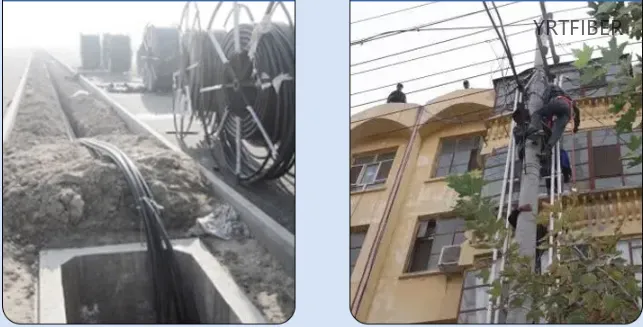
The ADSS-D cable is an ideal communication medium for overhead transmission lines and non-transmission overhead routes. Typical applications include: high-voltage grid communications, river-crossing and mountainous installations, long-haul telecom backbone networks, FTTx networks in remote areas, and power facility communication links. Compared to OPGW (Optical Ground Wire), ADSS is often more cost-effective and easier to install, especially for rapid deployment using existing utility pole lines or nearby structures.
In the AI computing era, the fiber optic cable industry is shifting from traditional telecom cycles to computational demand-driven growth. Emerging applications such as data center interconnect (DCI) and fiber-optic drones, combined with continued overseas infrastructure expansion, are driving diversified growth in fiber demand. As a flagship outdoor aerial cable, the ADSS-D double-jacket cable – with its unique advantages in power communication scenarios – will play an essential role as infrastructure support, providing a solid fiber communication foundation for global energy internet and smart grid development.
About YRTFiber: YRTFiber is an international enterprise specializing in the R&D, production, and sales of optical fiber and cables. With a comprehensive outdoor cable product line and global project service capabilities, YRTFiber welcomes inquiries about product details or customized solutions. Visit the official website or contact the sales team for more information.


