

 Español
 Português
 لالعربية
 Русский
 Bahasa Indonesia
 Français
 Türkçe
 Bahasa Melayu
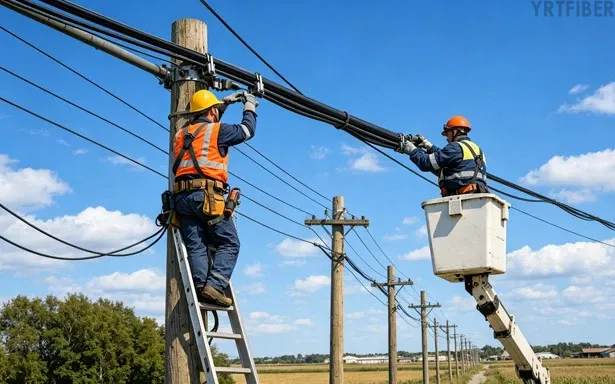
Aerial fiber optic cable is an optical cable specifically engineered for overhead outdoor installation, suspended between utility poles, transmission towers, or along existing power lines. Unlike underground cables that require trenching, aerial cables leverage existing elevated infrastructure to minimize deployment time and costs while providing reliable data transmission in exposed environments subject to wind, temperature extremes, UV exposure, and ice loading.
Important distinction: Aerial fiber optic cable is a broad category that includes multiple distinct cable types, each optimized for different span lengths, mechanical loads, and electrical environments. The choice between All-Dielectric Self-Supporting (ADSS), Figure-8. Mini ADSS (ASU), and lashed cable assemblies depends on factors such as proximity to power lines, pole spacing, fiber count, and budget constraints. Not all aerial cables are suitable for installation near high-voltage power lines—this is a critical safety and performance distinction.
What Is Aerial Fiber Optic Cable?
Aerial fiber optic cable is designed for suspension between elevated structures such as utility poles, transmission towers, or building facades. These cables incorporate structural elements to withstand tensile loads, environmental stressors, and mechanical forces encountered in overhead installations.
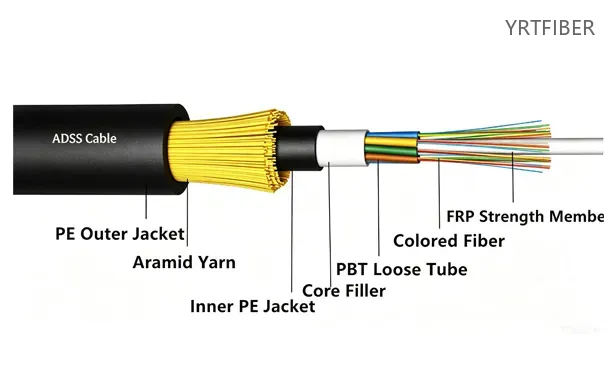
The core components of an aerial cable include:
Optical fibers: Single-mode (G.652D, G.657A) or multimode, typically 1 to 288 cores
Strength members: Aramid yarn, FRP (fiberglass-reinforced plastic) rods, or steel wires to withstand tension
Water-blocking materials: Jelly-filled compounds or dry water-blocking tapes to prevent moisture ingress
Outer sheath: UV-stabilized HDPE (high-density polyethylene) or PE for weather resistance
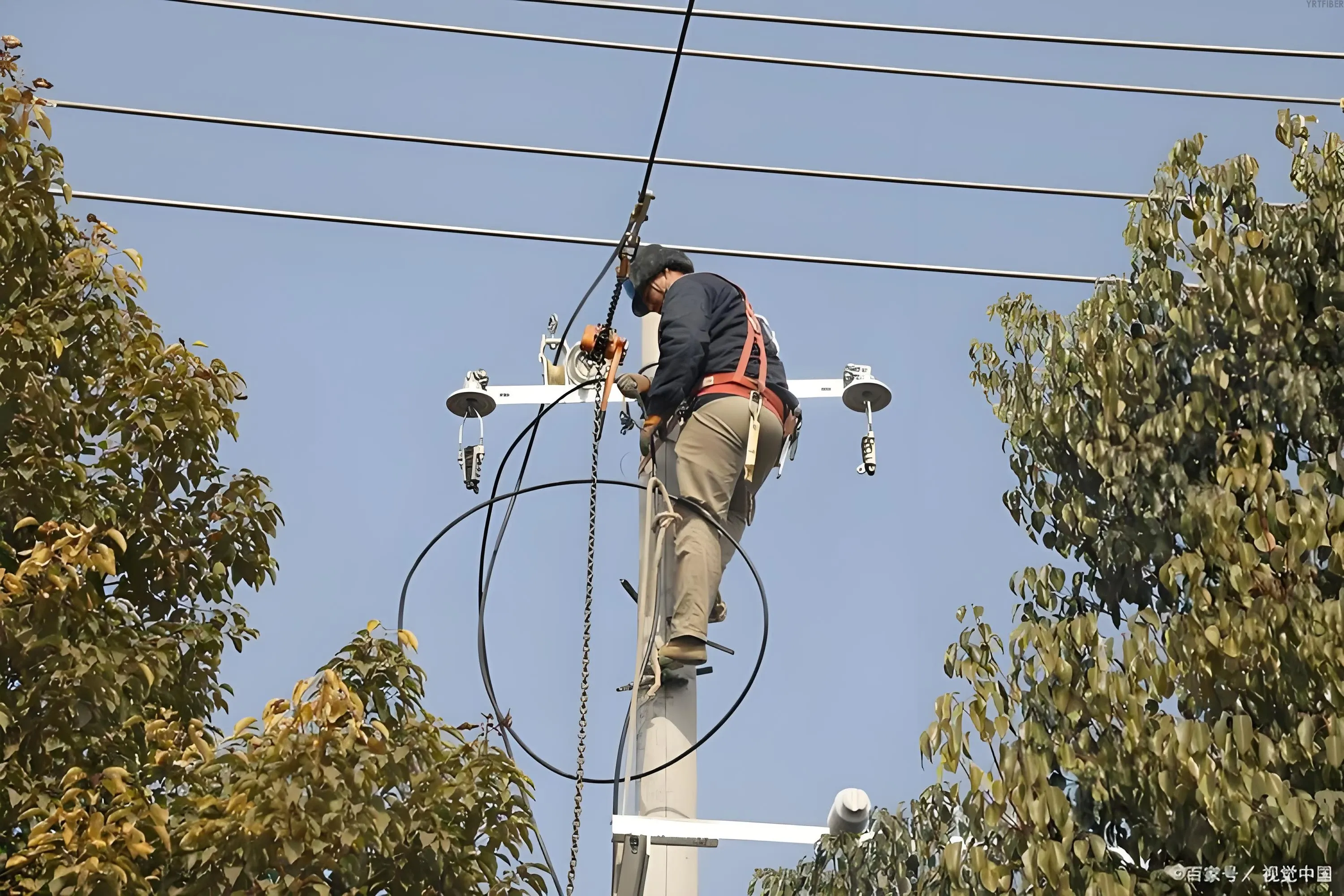
Aerial cables are deployed using two primary methods:
Lashed (吊线式): The cable is suspended from a separate messenger wire (steel or GRP) using lashing wire or hooks; the messenger bears the mechanical load
Self-supporting (自承式): The cable incorporates built-in strength members and can be hung independently without additional support
Types of Aerial Fiber Optic Cables
The following are the main categories of aerial optical cables, each with distinct design characteristics and application scenarios.
ADSS (All-Dielectric Self-Supporting) Cable
ADSS Cable is a completely non-metallic, self-supporting cable that relies on aramid yarn or FRP strength members to bear its own weight without an external messenger. It is designed for installation near high-voltage power lines.
Key advantage: ADSS cables can be installed in the power space of utility poles without concern for induced currents, making them a preferred aerial cable type for placement alongside high-voltage transmission lines. The latest IEC 60794-1-119:2025 standard provides specific test procedures for ADSS cables exposed to aeolian vibrations, defining cable load at the maximum installation tension (MIT).
ASU / Mini ADSS Cable
ASU (All-dielectric Self-supporting Unitube) is a lightweight, lower-cost alternative to full ADSS, optimized for short-span access networks.
Key difference from ADSS: ASU uses FRP reinforcement rather than aramid yarn, which reduces cost but limits span capability. ASU is commonly used as an economical aerial solution in areas where poles are closely spaced and share space with power lines.
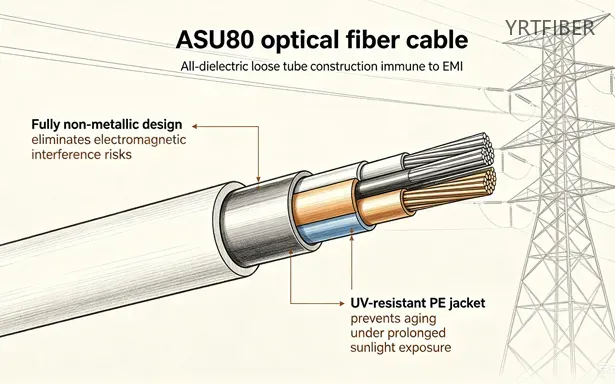
Figure-8 Cable
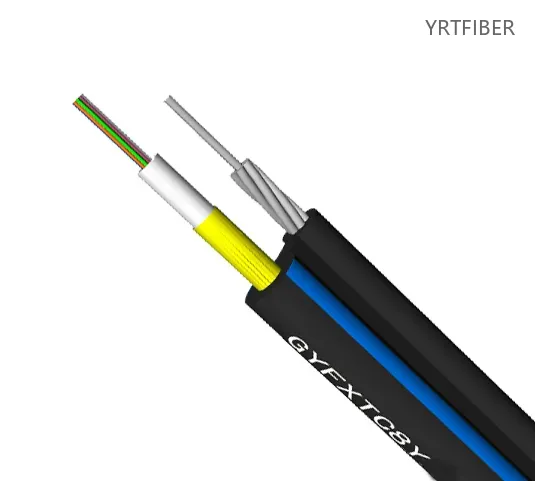
Figure-8 cable is named for its cross-sectional shape resembling the number "8"—the upper section contains a steel messenger wire for load-bearing, and the lower section contains the optical fiber transmission elements.
Key advantage: Steel messenger wire is significantly cheaper than aramid yarn, making Figure-8 cable a cost-effective aerial option when electrical safety is not a concern.
OPGW (Optical Ground Wire)
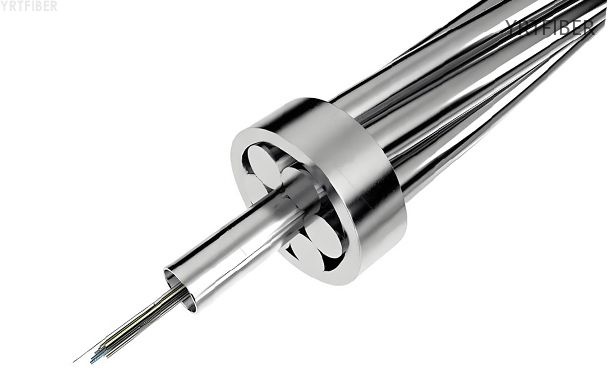
OPGW is a composite cable that combines optical fibers with traditional overhead ground wire (earth wire) on transmission towers. It serves as both a protective grounding conductor and a communications medium.
Key advantage: OPGW eliminates the need for separate ground wire and communications infrastructure on transmission towers. IEEE 1138-2021 provides comprehensive testing and performance requirements for OPGW used on electric utility power lines.
OPAC (Optical Power Attached Cable)
OPAC is an all-dielectric cable wrapped or lashed directly onto an existing power or ground conductor. This method allows adding communications capacity to existing transmission lines without structural modifications.
Key characteristics: Small diameter, lightweight, all-dielectric construction.
Lashed Aerial Cable
Traditional aerial cable assemblies consist of a standard outdoor cable lashed to a separate steel messenger wire using lashing wire or hooks. This is the most common method for telecom networks in areas without power line conflicts.
Key requirements: The messenger and lashing wire are conductive and must be properly grounded. Span analysis must consider messenger size, cable weight, and sag requirements; the Fiber Optic Association recommends sag limited to less than 2% of span length and maximum tension less than 30% of cable minimum breaking strength. Reference should be made to ANSI/ICEA P-79-561-2020. Guide for Selecting Aerial Cable Messengers and Lashing Wires.
Comparison of Aerial Cable Types
Cable Type | Strength Member | Metallic? | Typical Span | Best Use Case | Relative Cost |
ADSS | Aramid yarn or FRP | No | 100-1,000+ m | High-voltage power line corridors, long spans | High |
ASU/Mini ADSS | FRP | No | 80-120 m | FTTH access, short spans, cost-sensitive | Medium-low |
Figure-8 | Steel messenger | Yes | 100-500 m | Rural broadband, last-mile without power lines | Low |
OPGW | Steel/Aluminum conductors | Yes | Transmission tower spans | New HV transmission lines with communications | High |
Lashed | Separate steel messenger | Yes | Variable | Telecom networks, non-power routes | Medium |
Installation Guidelines for Aerial Fiber Optic Cables
The Fiber Optic Association (FOA) and industry experts provide the following guidelines for aerial cable installation to ensure performance, reliability, and safety:
Separation and Clearance
Cables on poles sharing electrical and telecom/CATV cables must be installed in the telecom space with proper clearance from electrical cables; this includes midspan separation accounting for cable sag
Exception: ADSS cables may be installed in the power space by qualified personnel
All aerial cables should be installed clear of obstructions including buildings, trees, and other cables; weather conditions (storms, icing, wildfires) may justify greater separation from trees
Tension and Sag
Span analysis must determine messenger size, tension required for span length, and cable weight to meet sag requirements
Sag generally limited to less than 2% of span length
Maximum tension less than 30% of cable minimum breaking strength
Reference: ANSI/ICEA P-79-561-2020. Guide for Selecting Aerial Cable Messengers and Lashing Wires
Grounding
Steel messenger wire and lashing wire are electrical conductors and must be properly grounded
ADSS cables are all-dielectric and do not require grounding
Workmanship
All cables must be securely lashed with no loose hanging cables anywhere along the span
Messenger wire must be neatly terminated at the ends
Splice closures should be attached with necessary service loops using appropriate hardware; service loops must be secured with snowshoe turnarounds or loops respecting minimum bend diameter
No service loops or cables awaiting installation may be left hanging from the span
How to Select the Right Aerial Cable
Selection of the appropriate aerial cable type depends on three primary factors:
Step 1: Determine Proximity to Power Lines
If poles share space with power lines:
Select all-dielectric cables: ADSS or ASU
Avoid: Figure-8 cable, lashed cable with metal messenger, or any cable with metallic components (metal is conductive and dangerous near live lines)
If poles have no power lines:
Figure-8 cable is the most cost-effective choice for most applications
Lashed cable assemblies are also suitable
Step 2: Assess Span Length
Span Length | Recommended Cable Type | Rationale |
<120 m | ASU / Mini ADSS | Sufficient strength at lower cost |
100-1,000+ m | ADSS | Higher tensile strength for longer spans |
Transmission tower spans | OPGW | Utility-specific cables for power lines |
Step 3: Consider Fiber Count and Budget
Low fiber count (≤24): ASU or Figure-8 are economical
Medium fiber count (24-96): Figure-8 or ADSS
Budget-sensitive: Figure-8 cable offers lower cost per fiber for non-power routes
Suitable and Unsuitable Applications for Aerial Cables
Suitable Applications
Power utility communications: ADSS and OPGW for monitoring, SCADA, and grid management
Rural broadband deployment: Figure-8 cable for cost-effective last-mile connectivity without power line conflicts
FTTH access networks: ASU for short-span aerial drops and urban pole routes
Long-haul transmission: ADSS or OPGW for backbone routes
Cases Requiring Another Cable Type
Underground or direct burial: Aerial cables lack appropriate moisture barriers, armoring, and crush resistance; select dedicated direct-burial cables
High rodent pressure areas: May require dedicated anti-rodent cables with steel tape armoring
Flame-retardant requirements indoors: Aerial cables with PE/HDPE jackets are not flame-retardant; select LSZH or flame-retardant cables for indoor sections
Frequently Asked Questions
What is the difference between ADSS and ASU?
Both are all-dielectric and self-supporting, but ADSS uses aramid yarn reinforcement for long spans (hundreds of meters) on backbone and power-line routes, while ASU uses FRP reinforcement for short access-network spans (80-120 m) at lower cost.
Can Figure-8 cable be installed near power lines?
No. Figure-8 cable contains a steel messenger wire—a metal conductor. Installing it near power lines creates safety hazards and risks induced current. Only all-dielectric cables (ADSS, ASU) should be installed near live power lines.
Does ADSS cable require grounding?
No. ADSS is all-dielectric and contains no metallic components, so it does not require grounding.
What is the typical operating temperature range for aerial cables?
Aerial cables are typically rated for -40°C to +70°C operating temperature, with UV-stabilized HDPE or PE jackets to withstand sunlight exposure and temperature extremes.
What standards apply to aerial fiber optic cables?
Aerial cables are manufactured to IEC 60794 series standards (optical fibre cables), ITU-T G.652/G.657 (single-mode fiber characteristics), IEEE 1138 (OPGW), and ANSI/ICEA specifications.
Conclusion
Aerial fiber optic cable provides a cost-effective, rapidly deployable solution for overhead telecommunications infrastructure. The selection process requires matching cable type to the specific combination of span length, proximity to power lines, fiber count, and environmental conditions. ADSS cable is the preferred choice for power utility corridors and long spans due to its all-dielectric construction and high tensile strength, with specific test procedures defined in IEC 60794-1-119:2025. Figure-8 cable offers cost-effectiveness for non-power routes. ASU provides a lightweight, economical alternative for short-span FTTH access. OPGW, governed by IEEE 1138. serves specialized utility applications on transmission lines.
YRT Fiber, established in 2008 with 230 employees, 21 production lines, and ISO 9001/14001/45001 certifications, manufactures a complete aerial cable portfolio including ADSS, ASU, and Figure-8 cable types with fiber counts from 1 to 288 cores, compliant with ITU-T and IEC standards.
References
Hayes, J. Looking Good! Guidelines for Aerial Fiber Optic Cable Installation. Electrical Contractor Magazine (June 2025)
IEC 60794-1-119:2025. Optical fibre cables - Part 1-119: Generic specification - Basic optical cable test procedures - Mechanical test methods - Aeolian vibration, Method E19
JEA Fulton Cut Replacement Project Specification for Fiber Optic Ground Wire (OPGW). FC-TLN-OPG-SP (October 2024)
Made-in-China.com. Double Layer Stranded Cable Optical Ground Wire OPGW - Product Specifications


